



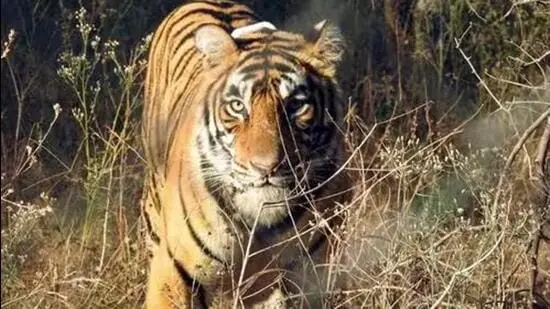
Rajasthan has taken a historic step in tiger conservation with its first-ever inter-state aerial translocation of a big cat, aiming to strengthen tiger numbers and improve genetic diversity in the state’s reserves.
A three-year-old tigress from Madhya Pradesh’s Pench Tiger Reserve, identified as PN-224, was airlifted to Rajasthan late Sunday night and released into an acclimatisation enclosure at the Ramgarh Vishdhari Tiger Reserve (RVTR) in Bundi district on Monday morning.
The tigress arrived at Jaipur airport around 10:30pm aboard an MI-17 helicopter before being transported by road under tight security to Ramgarh Vishdhari. She was placed in the Bajalia enclosure, spread over one hectare, at around 6:30am. Forest officials said the animal is responding well to the new surroundings and has begun adjusting to the habitat.
Deputy conservator of forest, Ramgarh Vishdhari Tiger Reserve, Arun Kumar D, said the tigress is in good health and displaying normal behaviour.
“She is doing fine and is slowly acclimatising. She is confidently roaming inside the enclosure. If her health and behaviour remain normal, she will be kept in the enclosure for about a week before being released into the wild,” he said.
Officials explained that the acclimatisation period is a critical phase of the translocation process. It allows the tigress to adapt to local climatic conditions, terrain and prey availability before being allowed to move freely in the forest. Veterinary teams and forest staff are monitoring her movements, feeding patterns and overall behaviour round the clock.
Also Read: Second tigress released into the wild at Sahyadri Tiger Reserve
The relocation forms part of Rajasthan’s broader conservation strategy to strengthen tiger populations in Ramgarh Vishdhari and Mukundra Hills Tiger Reserves and to enhance genetic diversity through scientifically managed inter-state cooperation.
Located near Ranthambore Tiger Reserve, Ramgarh Vishdhari is seen as a key corridor in expanding and stabilising the state’s tiger landscape.
Once released into the wild, the tigress will be continuously tracked and monitored using standard wildlife management protocols.
Officials believe the successful acclimatisation and release of PN-224 will pave the way for further tiger translocations to Rajasthan in the coming months.
Minister of State for Forests Sanjay Sharma on Monday expressed gratitude to the
Madhya Pradesh government and its forest department for their cooperation, stating that the initiative would reinforce Rajasthan’s forest heritage and play a decisive role in strengthening Ramgarh Vishdhari as an emerging tiger habitat.
Advanced AI-based camera traps and motion sensor technology were deployed during the selection and monitoring of the tigress. Around 50 cameras were installed to closely track her movement and behaviour, helping authorities minimise potential risks both before and during the relocation.
At present, Ramgarh Vishdhari Tiger Reserve has seven big cats, including sub-adults, while Mukundra Hills Tiger Reserve has five, including a cub. Officials said the arrival of the Pench tigress is expected to strengthen the breeding potential of these landscapes over time.
A senior forest official described the move as historic, noting that this marks the first instance of tigers from other states being relocated to Rajasthan. The primary objective, he said, is to prevent inbreeding and establish a fresh gene pool for the state’s tiger population. The National Tiger Conservation Authority has granted in-principle approval for the proposal, clearing the way for such translocations.
Earlier research by the National Centre for Biological Sciences found that Rajasthan has more inbred tigers than any other state in the country, underscoring the need for genetic infusion. Commenting on the development, former Ranthambore Tiger Reserve Field Director Manoj Parashar said inbreeding is a concern across tiger landscapes due to population isolation.
“It’s the tigers from Ranthambore that have gone to Sariska and Mukundra. There is zero possibility that any tiger from outside comes in contact,” he said, adding that bringing in a new gene pool is essential to ensure the population continues to strengthen and grow. However, he stressed that it must be ensured that translocated tigers are thoroughly screened for diseases, both in themselves and in their family line.