



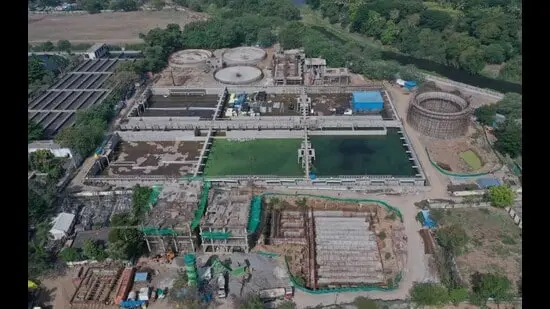
With water pollution emerging as a growing concern across urban Maharashtra and release of untreated sewage into rivers and lakes being one of the primary reasons, the Maharashtra Pollution Control Board (MPCB) is set to complete a statewide, third-party audit of sewage treatment plants (STPs) in housing societies across five major cities. The audit report is expected by mid-May, MPCB chairman Siddhesh Kadam said on Monday.
Addressing a press conference in Pune, Kadam said that the exercise, launched nearly three months ago, is in its final phase. “The audit is nearing completion and we are expecting to receive the report by mid-May. Societies found non-compliant with environmental norms will have to face action,” he said.
The first phase of the audit covers Mumbai, Pune, Nashik, Nagpur and Thane. It is being conducted by a panel of five independent agencies tasked with assessing whether or not housing societies have installed STPs and are operating the same in accordance with prescribed norms.
Kadam underlined that discharge of untreated sewage into rivers and other water bodies continues to be a major contributor to pollution levels in the state. “Water pollution is a serious issue in Maharashtra. One of the primary reasons is the release of untreated sewage into rivers and lakes. Despite repeated directions to municipal corporations, councils and local bodies, domestic effluent remains a major challenge,” he said.
While housing societies have been mandated to install STPs, the ongoing audit aims to verify compliance and identify gaps in implementation. “We have issued guidelines to local bodies and directed housing societies to set up treatment facilities. This audit will help ensure whether or not these norms are being followed,” Kadam said.
Regional officer of the MPCB, Balasaheb Kukade, said that the audit teams are reporting directly to the MPCB’s head office, which will take a call on enforcement measures. “Strict action will be taken against violators. This could include issuing directives and even seizure of bank guarantees, if required. We will also ensure follow-up action against those failing to comply,” he said.
In addition to tackling water pollution, the MPCB is also stepping up efforts to improve the air quality monitoring infrastructure in Pune. Kadam announced that 15 new, continuous air quality monitoring stations (CAQMSs) will be installed in the district in the coming months. Necessary permissions from local bodies have already been obtained, and installations will be carried out in phases.
At present, Pune district has seven manual air monitoring stations and eight continuous air monitoring stations. The addition of the new CAQMSs is expected to significantly enhance real-time tracking of air pollution levels and support data-driven policy decisions.
Meanwhile, in a move aimed at addressing manpower shortage, the MPCB is planning to recruit new employees. The plan for the same has been submitted to the state government and is under consideration, Kadam said. The hiring process is expected to be completed within three months. Currently, the board operates with a staff strength of around 200. With the addition of new recruits, the workforce will see a substantial increase. Officials also indicated that there are plans to further expand the total staff strength to 1,310, with a proposal pending before the state government.
“The board currently has around 200 employees. We will soon be recruiting 530, and this number will eventually increase to 1,310,” Kadam said, adding that the expansion will help the board handle its growing workload more effectively.
BOX
RMC plants must follow norms: Siddhesh Kadam
The revised norms for ready-mix concrete plants (RMCs) were issued last October. Since then, enough time has been given to the RMC industry for compliance with the new norms. If the norms are being followed in Mumbai and Thane, they should be followed in Pune and Pimpri-Chinchwad cities, too. The plant owners must take required permission from the PMC. Those not complying with norms have to face action, Kadam said.
Meanwhile, members of the Pune RMC association met Kadam on Monday and demanded unified standard operating procedures (SOPs) between the MPCB and these local bodies. “The association also raised concerns that ready-mix concrete is an essential and perishable product for the infrastructure sector, requiring time-bound transportation. A request was put in to coordinate with local authorities and traffic departments to facilitate smoother movement, and dedicated operational time windows for transit mixers. The chairman responded positively and assured support on this matter,” said Pradip Walhekar, president, Pune RMC Association.