



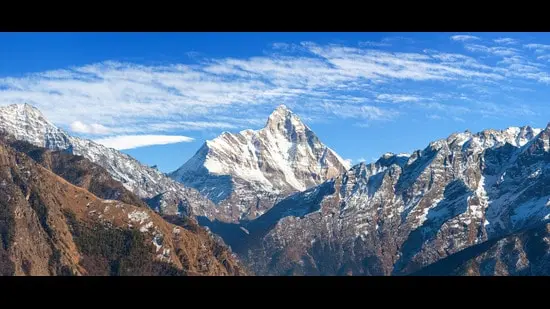
“The mountains would become in my life the symbol — and solution — of this conflict between the spirit and the senses, making straight the way to an understanding of purpose in life’s stumblings,” wrote Bill Aitken in The Nanda Devi Affair. Published 32 years ago this month, the book cemented the Scotsman’s reputation as a travel writer who respected local traditions even as he highlighted concerns facing local populations. Aitken, who hitchhiked to India in 1959 as part of his fieldwork for a course in comparative religion, believed in Nature. It is what kept him going until he breathed his last, aged 90, in April last year.

In The Nanda Devi Affair, he writes, “What Birmingham had done to stimulate my love for Dumyat, a year in Calcutta did to cartwheel me nearer the beloved. In May 1960, I set out with a Bengali teacher friend on the Doon Express to Haridwar.” Later, he was to be “the happiest in [his] life since [he] glimpsed both Nanda Devi and [his] guru [Sri Madhava Ashish, born Alexander Phipps].” The writer became a naturalised Indian in 1972, and Mussoorie was home for the rest of his life.
There are several reasons why The Nanda Devi Affair can be considered Aitken’s most poignant literary work. First is the luminosity of his prose. Sample its captivating beginning: “If it seems strange that the mere sight of mountains can arouse the most maddening of human passions it probably means the doubter has lived far from their lofty beckoning or lacks that inner lodestone, cherished as an implant of great price by those who possess it.”
The serenity in his sentences is matched only by the breathtaking photographs of the mountains he climbed through the 1960s and 70s, which are included in the book. Yet, he submits, in the chapter titled In Dulce Jubilo, that his “poor opinion of the camera’s ability to get anywhere near the wonder of the total mountain experience guaranteed no guilt over these rehearsed spontaneities”. He adds, “Besides what greater effrontery could exceed the claim that the camera never lies? In Himalayan terms, the camera seems to do little else.”
Aitken writes of the heightened spiritual energies of the mountains and the puny human desire to conquer them. He was also simultaneously hyperaware of the futility of trying to conquer them in words or in action: “The point being that language can only echo the truth of nature’s breathing.”

Bill sa’ab was a believer in chance encounters. He valued the pull of a place and its people. On the journeys he made in India he wrote: “All of life’s finer sensibilities are rendered impotent by the inadequacy of prediction.” Perhaps it was the thwarting of the predicaments of life that helped him explore the uncharted so effectively. Certainly, it was his rigour, curiosity and ability to even notice the incomprehensible that made him peerless.
Though he lived in the country for many decades, he may still have been perceived as viewing India through the gaze of an outsider. He acknowledged this too: “The Gandhian ashram where I worked [in Kausani] as part-time man enabled me to get into the slow rhythm so necessary for a foreigner who hopes to become part of India.” However, because he was at home here for so long, he did eventually earn the right to reflect on the place as a native.
Which brings us to his courageous critique of caste in India. Few works of travel writing provide as piercing a commentary on oppressor castes as The Nanda Devi Affair does: “Most of the tea shops I halted at in Garhwal were more concerned with establishing the caste of the stranger than in serving him tea.” In the chapter titled The Jeeves Factor, he reflects: “Caste determined the distribution of prasad, and little of what I had watched being carved up in the Devi’s courtyard would have reached the other Lata across the ravine, where, at a safe distance from the thakurs, lived the low caste doms. As the headman, Bal Singh was obliged to make an appearance at their ceremonies, if only to honour the illusion that untouchability had been outlawed by government decree.”
Aitken sharply noted how bureaucracy failed the very spirit of mountaineering. He writes of how HC Sarin and SS Khera wanted “the infant sport of Indian mountaineering [become] a bureaucratic tool for narcissistic administrators to play their favourites and curry the favours of politicians.” He also describes the perverse complicity of Indian administrators in the plunder of biodiversity of the region: “[It] was becoming a national scandal that India’s most unique wilderness area was being destroyed by rich foreign parties while ordinary Indians unable to raise the finance were deprived of entry. In an extraordinary decision to address the problem the IMF simply raised the peak fees for Nanda Devi.”
He does not shy away from attacking Indian hypocrisy either. He writes of the “constant advice to women” to cover their heads and of the “open disgust at the physical manifestation of female mysteries” as “women were revoltingly untouchable for the duration of their menstruation.”
The book is also valuable for its celebration of the climbers and historians who documented their attempts to ascend the Nanda Devi. “The mountaineer who helped discover (and best described) the ravishing realm of the Goddess was Eric Shipton,” he writes. He adds: “like Everest, Nanda posed serious problems of access. Attempts to crack a route to her base coincide with the beginnings of Alpine climbing in the Himalayas and the first man to take on the challenge was WW Graham, whose startling success was announced in The Times of India in 1883.” He notes the “impressive difficulties of the way” that were “chronicled vividly” by AL Mumm in Five Months in the Himalayas (1907).
Aitken pits the idiosyncrasies of the Nanda Devi against those of Everest noting that the Goddess “never hosted the conquerors of Everest — Hunt, Hillary and Tenzing”. “In the effective realm of the Goddess neither policemen nor lawyers are much in demand. In the Nandak revenue district adjacent to Rup Kund (where the motor road remains a stranger) the word of the Devi remains law,” he writes.

From personifying the Devi’s “beauty” as “royal and feminine” to noting the “illegal hunting of musk” and from articulating why marijuana could have been considered as a substitute for hard drugs to describing how possession “by the local spirit is still the way many interior Himalayan villages commune with divinity”, Aitken demonstrates his 360-degree approach to chronicling his Nanda Devi expeditions, which he called “erotic” in nature.
The book is not devoid of humour. One night in Mirtola, the author experienced “the steady throb of a diesel generator” and when he “described the mystery” to his guru, the latter laughed and said that it “was no distant engine” but Aitken’s “heart beating.” He writes, rather hilariously, of how a “British couple from Lyme Regis” honeymooning in Yashu’s hotel delighted “the junior porters” and of “the psychology of high-caste sexual attitudes”.
For Aitken, the Nanda Devi affair which “began as a headlong lust” eventually “metamorphosed into an abiding love and the fire that stirred the loins of youth was transmuted into the tender warmth of affectionate regard”.
Bill Sa’ab may have soared over his last mountain a year ago but his finest work, The Nanda Devi Affair, continues to enthral and inspire.
Saurabh Sharma is a Delhi-based writer and freelance journalist. They can be found on Instagram/X: @writerly_life.