



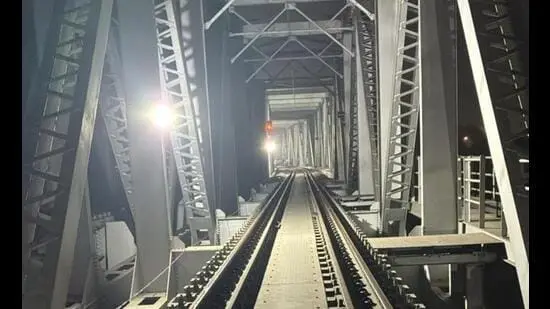
The new Yamuna bridge parallel to the iconic century-old Loha Pul in north Delhi is now “partially operational,” with construction and safety trials successfully concluded, and will be fully operational within the next fortnight, senior Northern Railway officials said on Thursday.
Once fully operational, likely by the end of March, the new bridge will replace the historic iron bridge that has served the Capital for more than 150 years.
The bridge has two rail lines – Up and Down. While the Down line connecting Old Delhi Railway Station from Shahdara and Ghaziabad has been made operational, railway officials told HT that movement on the Up line will begin within a fortnight after pending construction and maintenance work is completed.
“On March 28 and 29, train services will be blocked on the new bridge for the scheduled pending construction and maintenance work. The blocking of the bridge will be done during the night hours when frequency of train services is lesser as compared to daytime. After the final round of work, the bridge will be fully operational. This transition will mark a new era for the city’s east-west connectivity, providing a high-speed, high-capacity link essential for the region’s growing transit demands,” said a senior Northern Railway (NR) official, who asked not to be named.
The Northern Railway’s chief public relation officer (CPRO), Himanshu Shekhar Upadhyay, confirmed that the new Yamuna bridge has been “partially” opened for train services and that the old iron bridge will remain operational until the new bridge is fully ready.
“Since the iron bridge is over a century old, trains move at a speed of 20 to 25 kilometres per hour. Train services will be stopped on it when the new bridge is declared fully operational. However, vehicular traffic on the historic double-decker iron bridge will continue… Trains on the new bridge can cross the Yamuna at significantly higher speeds, a stark contrast to the restrictions required on the old one,” he said.
The nearly 1-kilometer bridge, built parallel to the old structure at a cost of ₹226.7 crore, connects Old Delhi’s Yamuna Bazaar to East Delhi’s Shastri Park. Constructed using 6,900 metric tonnes of steel and 28 girders, work on the bridge began over two decades ago but faced multiple interruptions.
Officials said that constructing a massive bridge in one of India’s most congested urban environments presented formidable hurdles. Engineers had to sink massive pillars into the Yamuna’s shifting riverbed, overcoming significant geological variations and seasonal flooding. Strict clearances were required due to the bridge’s proximity to protected historical sites and the dense settlement of the Salimgarh Fort area.
“Building the new spans without disrupting the thousands of daily commuters on the existing bridge required a ‘phased launch’ strategy, moving rail traffic over bit by bit,” said another NR official, who also asked not to be identified.
The old two-deck bridge on the Delhi-Shahdara section was constructed in 1866-67, but with the structure gradually becoming old, it was decided in 1997 to commission a new bridge on the upstream side of Loha Pul.