



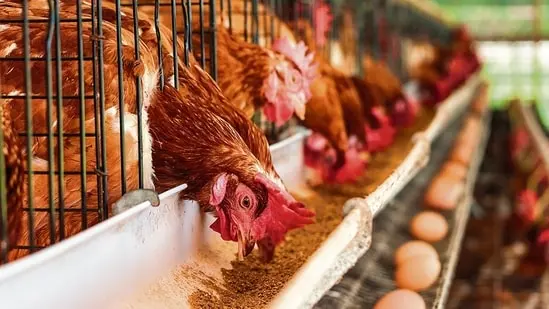
A generation ago, poultry rearing in India meant small-scale backyard farming. Today, it has all the hallmarks of industrial production, with organised production lines, including climate-controlled sheds, automated feeding and manure collection systems, and flocks of tens of thousands of birds managed by a workforce that is inadequately protected under the country’s labour law framework.
A forthcoming scoping study by ALPN Research Foundation shows how inter-state migrant workers and other vulnerable groups, such as women and children, live on-site in close proximity to the bird sheds. They face multiple vulnerabilities, such as wage exploitation, gender wage disparity, and occupational hazards. This growth has been a result of a series of developments over the last 70 years, driven by private investments and government policies to increase the productivity of the sector. This exponential growth in poultry production, however, comes with increasing risks for workers.
The growth of the sector has also created significant employment opportunities. It is estimated that around five million people work in the poultry sector. Globally, India ranks second in egg production and poultry meat contributes to nearly half of the country’s total meat output. With a value estimated to be around ₹2636 billion in 2025 and projected to grow to about ₹8433 billion by 2034, the sector contributes significantly to the Indian economy.
Backyard farming is being overtaken by commercial farming with increasingly intensive production practices. Until 1980, farms raising birds for meat and eggs would average 200 to 500 birds per cycle. Now, farms with less than 5,000 birds are uncommon, with a majority of farms housing more than five lakh birds. Commercial egg farming contributes to roughly 80% of the national egg output, with household and backyard poultry operations meeting the remaining demand.
Findings from the scoping study in a district in Karnataka indicate that large poultry farms rely on labour-intensive production to meet the increasing demand for poultry products. Workers engage in tasks ranging from artificial insemination, daily egg collection, manure cleaning, and feed production, among others. Constant exposure to a large number of birds in confined spaces leads to various occupational risks, such as increased vulnerability to diseases like respiratory illness, musculoskeletal disorders, and increased exposure to zoonotic pathogens and antimicrobial-resistant bacteria.
Contract breeding farms surveyed, for example, employ between 30 to 35 workers. These farms are heavily mechanised with powered equipment such as automated feed, egg, and manure collection systems. Under the Occupational Safety, Health and Working Conditions (OSH) Code 2020, the minimum number of workers for categorising establishments as factories has been raised from 10 to 20 workers with powered machinery and from 20 to 40 workers without powered machinery. Thus, the surveyed farms meet the legal definition of a factory. Recognising these farms as factories would enable more comprehensive coverage for workers under the OSH Code, guaranteeing 48-hour maximum weekly work, mandatory weekly holidays, overtime payment at twice the ordinary wages, and health protections.
Despite evidence of rising industrialisation in the poultry sector, its classification as an agricultural or allied activity is leaving vulnerable populations outside of the scope of protection under the labour law framework and essential worker protections. The government, along with research institutes, should assess possible adverse effects of poultry rearing on workers who are in proximity to birds in industrial settings for prolonged periods.
Other legal avenues, such as recognition as shops under state-specific Shops and Commercial Establishments Act, should be considered to cover workers in smaller groups that are left unprotected under the revised factory threshold. This would afford them access to basic protections such as regulating hours of work, annual leave, wages and compensation, employment of women and children, enforcement and inspection, etc.
The beedi and construction industries also offer a useful parallel of how legal protections can be extended to a fragmented, informal yet vulnerable workforce. These industries have sector-specific laws owing to the conditions created by small-dispersed units, temporary employment arrangements, uncertain working hours, inadequate basic amenities, and extensive use of informal and migrant labour, similar to the situation in the poultry sector. The above legislations regulate wages, creches and access to drinking water.
The commercial poultry sector is expected to continue growing steadily in the coming years. Regulatory mechanisms must keep pace with economic realities and evolve with the sector.
(The views expressed are personal)
This article is authored by Pallavi Krishnappa and Vaishnavi Vasanth, researchers, ALPN Research Foundation.