



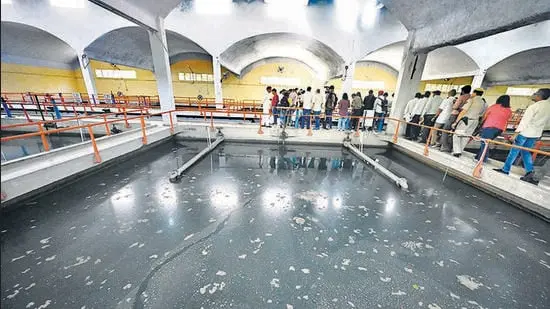
The Delhi government is preparing a comprehensive water master plan to overhaul the Capital’s drinking water supply system by dividing the city into nine zones, each anchored by a major water treatment plant (WTP) that will function as a command centre, said officials on Saturday.
Officials said the plan aims to streamline supply, replace ageing pipelines and ensure equitable distribution of potable water across Delhi. The command centres will be linked to the WTPs, where supply networks, billing systems and household connections will be monitored and managed.
Water minister Parvesh Verma said the project is designed to address long-standing issues such as contamination, leakages and uneven water pressure in different parts of the city.
“Delhi’s water supply system is at least four decades old in several areas and requires systematic upgradation. Under the new master plan, each water treatment plant will act as a command centre overseeing supply infrastructure in its command area covering 10-15 assemblies,” Verma said.
He added that consultants will be appointed for each zone to prepare detailed reports identifying pipelines that need repair or replacement and also to identify areas where new connections are required.
According to officials, one of the first projects under the framework is already underway in the command area of the Chandrawal WTP. The project includes replacement of around 1,044 km of pipelines, construction of 12 new underground reservoirs (UGRs) and rehabilitation of nine existing reservoirs. It will also create 147 district metered areas (DMAs) to monitor and manage water distribution more efficiently.
Officials said the redesigned network aims to maintain a terminal water pressure of about 22 metres at the tail end so that supply can reach households without the need for private booster pumps.
The upgrade is expected to address contamination issues in several areas including Sarai Rohilla, Gulabi Bagh, Patel Nagar, Shadipur, Naraina Vihar, Nehru Nagar, Baljit Nagar, Punjabi Basti, Sadar Bazar, Karol Bagh and Paharganj. Localities in Old Delhi such as Kashmere Gate, Jama Masjid, Turkman Gate and Daryaganj are also expected to benefit, said officials.
Similar projects are planned for eight other major WTPs: Wazirabad (134 MGD), Haiderpur (241 MGD), Nangloi (44 MGD), Okhla (21 MGD), Dwarka (52 MGD), Bawana (20 MGD), Bhagirathi (112 MGD) and Sonia Vihar (143 MGD). Officials said these WTPs collectively form the backbone of the new water master plan.
Officials said private firms will be engaged to execute the work across the nine zones. These firms will conduct detailed studies of local requirements, assess existing infrastructure, groundwater conditions and future water demand before replacing old pipelines and laying new transmission and distribution lines. The exercise is expected to begin within the next seven months.
Officials said preliminary project reports have already been prepared for improvement works in the Wazirabad WTP command area, while DPR preparation has begun in the west and south-west zones.
“The idea is to move towards a modern water management system where supply networks are mapped, monitored and upgraded zone by zone. This will help reduce losses and leakages, eliminate contamination and improve pressure in areas that currently face irregular supply,” Verma said.
Officials said the works will be executed in phases across Delhi and are expected to take around three years to complete once contracts are awarded in 2026-27.