



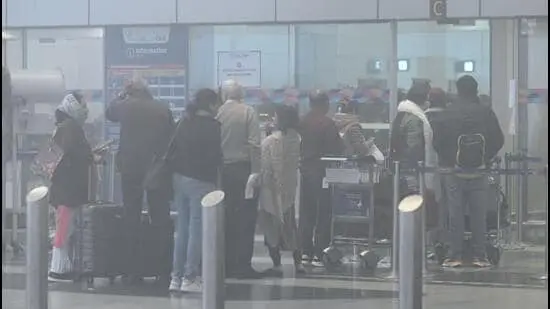
Delhi’s air quality was in the ‘severe’ range on Monday as a thick layer of fog spread across the Indo-Gangetic plains, impacting both flight and rail operations. Visibility dipped to 50 metres at both Safdarjung and Palam, with dense fog recorded for close to six hours, the India Meteorological Department (IMD) said.
Over 150 flights were delayed at Delhi’s Indira Gandhi International (IGI) airport till 8am as per the flight tracking website FlightRadar24, with another six cancelled. The situation is expected to worsen through the day due to cascading delays and cancellations — particularly at other impacted airports. Several trains were also running at a delay.
“At 2.30am, visibility fell to 50 metres at Palam and remained so till 8am before increasing marginally to 100 metres. At Safdarjung, visibility remained at 5 metres till 8.30am,” said an IMD official, stating zero visibility was recorded at Hisar, Ambala, Chandigarh, Amritsar, Jammu, Agra, Pathankot and Gwalior.
The ministry of civil aviation also posted on X, stating fog was disrupting operations across North India. “Due to fog conditions across parts of Northern India, flight operations at select airports may be impacted, leading to possible delays. Passengers are advised to stay updated through official airline communication channels, allow additional time for airport arrival and check-in procedures, and plan their travel accordingly..” it said at around 8:30 am on Monday.
Delhi meanwhile remained in the grip of toxic air, with pollutants combining with fog to create smog. The 24-hour average AQI stood at 402 at 8am. The average AQI was 390 at 4pm on Sunday, but with wind speeds low and fog starting to form, it had crossed 400 and touched severe at 9pm on Sunday itself.
Out of the 37 active ambient air quality stations, 22 were in severe condition at 8am. The worst impacted locations were Vivek Vihar (456) and Anand Vihar (455), Central Pollution Control Board (CPCB) data showed.
At present, stage-3 measures under the Graded Response Action Plan (Grap) — which halt private construction and bans playing of BS-3 petrol and BS-4 diesel vehicles in Delhi — are already in place across NCR.
For stage-4 measures, the AQI needs to cross 450 — or should be projected to cross this threshold. A CAQM official said they were monitoring the situation and if it continues to deteriorate further, a meeting of the CAQM’s Grap sub-committee will likely be called. “No meeting is scheduled as of now. If the AQI keeps rising, a meeting may be convened,” the official said.