



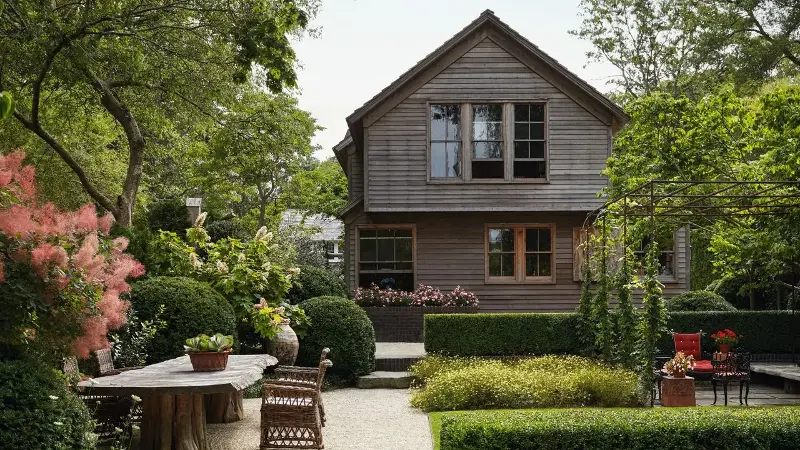
This house transports me to another world,’ muses New York–based interior designer Neal Beckstedt about the idyllic cedar-clad vacation home in Sag Harbor, Long Island, where he and his husband Paulo Braga spend blissful weekends. ‘The element of it being so different from a typical house helps us feel like we’re escaping.’
Dating from 1890, the house was built as a worker’s cottage for employees of the Bulova Watch Case Factory. ‘The property needed a lot of work, but I could see its potential. There’s wonderful craftsmanship here and that’s why I fell in love with it. It’s a very simple but beautiful house.’
Neal’s penchant for period style ensured that he was keen to restore the house design to its former glory. ‘I did a lot of research to dive into what a 1890s home would have looked like because when I bought the property, it was not like this at all,’ he explains.
‘The existing shell was here, but the exterior was painted lime green. There were asphalt shingles on the roof and the inside was painted white. Upstairs, there were existing wide-plank pine floorboards, which I kept, so I knew there must be good bones.'
'On the first floor, the beams were original, so I uncovered them. I went to great lengths to make it look like it would have originally. I knew it would have been more wood-driven and simpler, so I added character with timber.’ The original sash windows at the front were restored, with new custom designs at the rear made to match, and an addition over the kitchen provided a large bedroom with a sitting area.
The pared-back yet beguiling interior is an ode to timber, celebrating its nuances and infusing the rooms with a cozy backdrop. ‘I leaned into wood, which was a dominant material back then, and used it throughout the house,’ says Neal. He particularly relished the idea of living in a wooden house as the property is shrouded by beautiful trees. ‘I always refer to it as a tree house,’ he says. Alternating the wooden boards between vertical and horizontal on the walls in different rooms injects interest.'
'I was trying to capture this essence of patchwork, imperfection, and layers that happen in an old house, so sometimes the boards are horizontal, sometimes they are vertical. There’s cohesion but, at the same time, some differences throughout the house so it’s not too monotone.’
Distressed and stained timbers are interspersed to temper the mellow woods and imbue another level of interest, while vintage French linen sacks gracing the walls of the TV room are a playful foil and act almost like a palate cleanser.
Neal, who describes himself as a modernist at heart, was keen to ensure that there was a sense of modernity too. ‘I definitely leaned heavily into the 1890s aesthetic for the architecture and the structure itself, but I didn’t want to live in a historic society museum!’ he laughs. ‘I wanted something comfortable and livable and to showcase my favorite things. When you design your own home, you really have to think a little differently.’
The result is a melange of different styles of furniture – Danish, French, and custom, with some colonial pieces. ‘There’s a Windsor chair from Pennsylvania in the breakfast room, with a French settee, as well as a Spanish wine table. I wanted to play with the mix and push it. The decoration came about organically and subconsciously, and it all came together. The sofa in the living room is the first sofa I purchased and there are pieces I’ve bought on my travels.’
Neal did, however, embrace the period aesthetic when it came to the kitchen and bathroom. ‘I wanted to really embrace time-appropriate rooms.’ The kitchen has an Aga and freestanding furniture, including a red Swedish antique table.
‘I had the idea of a red kitchen originally, but I was trying to figure out how much red. Then I found the island and realized it was the perfect touch and any more would be too overwhelming.’
The atmospheric under-the-eaves bathroom, meanwhile, features an antique hand-hammered copper bath, the cosseting starting point for the scheme, set against a backdrop of mossy green distressed timber beading, evoking a charmingly quaint and simple aesthetic.
‘I believe in less is more,’ says Neal, ‘but looking at our house, there are definitely layers and layers, but always with restraint. There’s definitely an overall element of warm modernism.’