



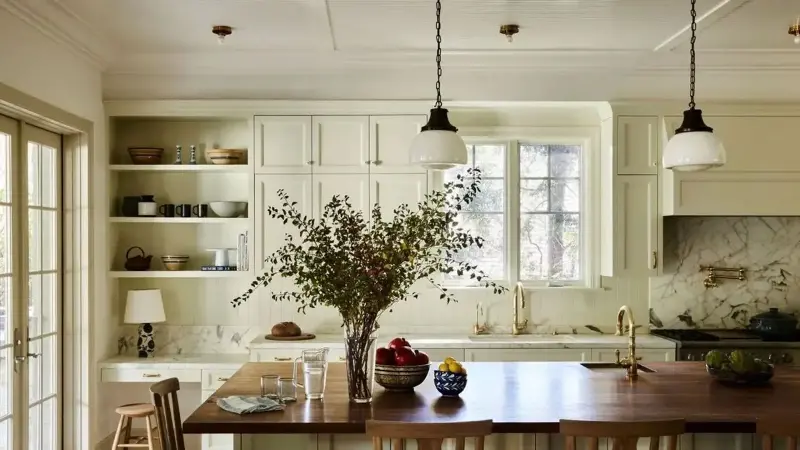
Mixing vintage and modern lighting can feel intimidating. Lighting is highly visible, often sculptural, and closely tied to a home’s architecture – which means mismatched pieces can quickly feel jarring. But when done well, blending old and new lighting adds depth, warmth, and a sense of evolution that purely period-correct schemes often lack.
Lighting is also one of the most forgiving places to experiment with mixing eras. Fixtures are relatively easy to change, highly expressive, and often collectible, making them ideal for introducing contrast without committing to a full redesign. Here, interior designers share five expert-led ways to mix modern and vintage lighting, so it feels intentional, cohesive, and timeless.
1. Balance Silhouettes and Let Shape Create Cohesion
When mixing vintage and modern lighting, designers often look beyond age and focus instead on shape. Strong, considered silhouettes help create cohesion, even when fixtures come from very different eras. A sculptural vintage lamp base might echo the curve of a modern table or pendant, while rounded sconces can soften sharper architectural lines elsewhere in the room.
New York–based interior designer Lauren Stern explains that this approach mirrors how she thinks about rooms as a whole. ‘Every room we design has a balance of materials – metal, stone, wood, upholstery – and a harmonious combination of color, dark and light,’ she says. ‘Vintage pieces echo this philosophy. They should feel cohesive in a room and bring balance and harmony.’
By repeating shapes and visual weight rather than styles, vintage lighting stops feeling like an outlier and instead becomes part of the room’s rhythm. The result is a space that feels calm and composed, where old and new sit comfortably together.
The bold, fluid silhouette of this vintage table lamp acts almost like functional art – the kind of strong, considered form that effortlessly bridges vintage and modern lighting in one cohesive scheme.
This floor lamp’s clean, arched silhouette brings sculptural presence to a room, making it an easy modern counterpoint to vintage lighting.
With its sculptural, hand-blown profile, this Murano glass suspension light brings visual clarity to a mixed-era scheme.
2. Assign Different Roles to Vintage and Modern Lighting
One of the most effective ways to mix eras is to think about lighting in terms of function. Vintage fixtures often excel as decorative or focal pieces – chandeliers, statement pendants, or characterful table lamps – while modern lighting is typically better suited to task and ambient roles.
George Kypreos and Shana Sherwood, the husband-wife team behind Los Angeles-based design studio, Sherwood Kypreos, describe lighting as a cast of characters rather than a collection of showpieces. ‘Not every light can steal the show,’ they explain. ‘Too much feature lighting can cheapen a space. Some must be supporting characters, but they’re still as important to the overall story.’ By allowing vintage lighting to provide atmosphere and personality, and modern fixtures to support everyday living, rooms feel both beautiful and practical.
Designed to be admired as much as used, this vintage Italian chandelier adds character and atmosphere as a focal feature within a balanced lighting plan.
With its clean profile and adjustable arm, this brass wall sconce offers purposeful task lighting that complements rather than overshadows decorative vintage lighting.
A softly scaled flush-mount that delivers gentle, supportive overhead light, letting more dramatic vintage fixtures remain the visual focus of the room.
3. Customize the Component
Designers rarely treat lighting as a fixed, finished object. Instead, they often see it as a collection of parts that can be mixed, matched, and tailored to suit a space. This approach is especially useful when decorating with vintage lighting, which can be adapted to feel more contemporary without losing their charm.
‘You can tailor lighting to suit your needs,’ say Sherwood Kypreos. ‘Change cord colors, change fitters, fabricate different shades – buy vintage globes from one place and chains from somewhere else to achieve the outcome you want.’
Breaking lighting down into components gives greater control over proportion, finish, and material, allowing vintage pieces to sit more naturally within modern interiors. Visually, this creates a collected, custom feel – lighting that looks designed specifically for the room rather than sourced in one go.
With its adaptable rise-and-fall mechanism and classic brass finish, this pendant set can be tailored with different globes or cords – a great way to mix personal style with functional lighting.
A pair of vintage-style twisted cloth lamp wires that let you personalize your lighting by swapping in rich colour and texture to update both vintage and modern fixtures.
A vintage mid-century brass and glazed pottery lamp base that works as a flexible foundation, ready to be personalized with a contemporary or bespoke shade to suit your space.
4. Play with Scale to Create Intentional Contrast
Scale is one of the most powerful tools for making mixed-era lighting feel deliberate. Contrasting proportions help prevent a room from feeling flat, while also ensuring that no single piece overwhelms the space.
Chicago-based interior designer Claire Staszak, founder of Centered by Design, notes, ‘Scale really makes all the difference in lighting. Varying the size of your lighting is one of the most effective ways to mix old and new.’
Playing with scale within each lighting role adds depth without disrupting function. A generously scaled modern fixture can provide even, anchoring light, while smaller vintage pieces introduce moments of softness and detail. The contrast in proportion creates visual tension that energises the room, without asking decorative or ambient lighting to do the wrong job.
With its delicate silhouette and artful balance of metal and glass, this vintage Scandinavian lamp adds subtle scale variation.
This sculptural chandelier’s staggered disc elements introduce deliberate scale shifts, helping to balance larger fixtures and smaller accent lights.
With its generous height and playful fringe, this floor lamp introduces vertical scale and tactile contrast, helping to balance other fixtures.
5. Update the Shade and Let Contrast Do the Heavy Lifting
Sometimes, the simplest way to mix vintage and modern lighting is by rethinking the lampshade. Swapping an outdated or utilitarian shade for something more refined can instantly transform a vintage base – or soften a modern one.
Ellie and Hermione Gee, co-founders of Hum London, say this idea is central to their brand. ‘Making lampshades to pair with vintage lamps is actually where we began. Antique pieces can bring so much to a space, and we’re very much in favor of mixing old and new,’ the sisters explain. ‘A great way to make a vintage lamp sing is by pairing it with a more elevated lampshade.’
They point out that many vintage lamps come with plastic-lined shades that cast harsh light, whereas thoughtfully made shades can dramatically change the mood of a room. Their perforated designs are intended to soften light and add atmosphere, proving that even subtle updates can have a significant impact. Visually, this approach makes heritage pieces feel intentional rather than inherited, while creating warmer, more inviting light
This color-blocked box-pleat shade brings structure and refined detail, instantly modernizing a vintage lamp.
This handcrafted stained-glass shade adds character and warmth to a modern fixture, showing how a vintage shade can transform the look and light quality of contemporary lighting.
A fabric-trimmed, scalloped shade that softens harsh light and refreshes a vintage lamp’s presence.
Mixing vintage and modern lighting is less about strict rules and more about balance, contrast, and repetition. When shapes relate, finishes complement one another, and each fixture has a clear role, rooms feel layered and personal rather than chaotic.
Experiment slowly, mix in pieces with vintage character alongside true antiques, and don’t be afraid to customize. When done well, mixed-era lighting brings warmth, depth, and a sense of history – creating interiors that feel genuinely lived-in.