



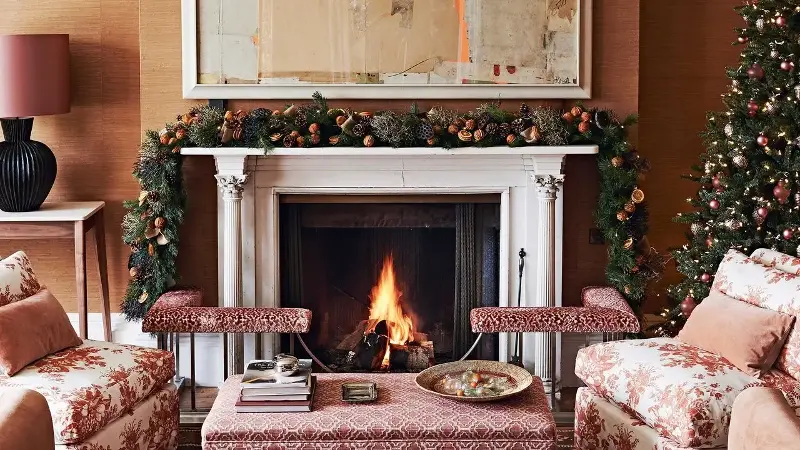
A fireplace is the ultimate cozy addition to a home, but all too often, some of that precious heat disappears up the chimney.
Luckily, home-heating experts say there are six quick tweaks you can make right now that will dramatically improve how much warmth your fireplace actually delivers inside your home. From simple airflow changes to small add-ons, these fixes can help to keep the heat where you need it most.
These are the best ways to make your heating more efficient when using your fireplace, and save money this winter.
6 Ways to Instantly Get More Heat From Your Fireplace
1. Keep the Surrounding Area Clear
We totally get the appeal of decorating your fireplace ideas to make your home look extra cozy, but putting things too close to your fireplace can impact how warm your home feels. Plus, it is a serious home fire hazard.
Eli Zimmer, heating pro and CEO of Luxaire HVAC Services, explains, 'Something that always helps is keeping the area around your fireplace as clear as possible. Anything placed in front of it or around it closely will block some of the hot air coming out, so make sure that furniture, for example, is placed around the edge of the room.'
This is especially important when adding your Christmas decor ideas, particularly your festive mantel decor ideas. Never hang anything directly over your fireplace to prevent accidents and aid better air flow.
2. Use a Fireplace Fan
One of my military dad's favorite tricks for keeping a home warm without turning up the heat is to use a fireplace fan from Amazon. These small non-electric fans sit on top of a wood-burning stove, and the radiating heat 'powers' it. It, in turn, pushes the hot air back into the room, rather than up and through the chimney. It also helps with directional heating. For instance, my dad points the fan in the direction of the room's door to help push some of the heat beyond the living room and through the house.
Arthur Kulchitskiy, designer and founder of JDI Construction, explains, 'These thermoelectric stove fans do not need batteries or electricity; they produce their own electricity through the thermal difference existing between their base and top fins. They will push the hot air into the room without making much noise.'
3. Run Ceiling Fans Clockwise
Ceiling fans are not just good for cooling a room with fans; they can also be great tools for recirculating heat, so long as you know how to differentiate between the best fan direction to cool a room and to heat one.
Eli says, 'Heat rises. Running your ceiling fan clockwise on a low speed helps to push warm air back downwards, catching any of that rising heat before it dissipates on your ceiling. It helps you to feel more of it
4. Use the Right Fuel
Picking the right fuel for your home heating type is essential to avoiding wasting heat (and to avoid damaging your fireplace). The most common type of fireplace for homes is a wood burner.
The best way to cost-effectively run a log burner, Arthur explains, is to use seasoned hardwood. 'The fuel you are burning makes a huge difference in British Thermal Units (BTUs). Just burning any old wood simply will not do.
'Seasoned means wood dried to a moisture content of less than 20 percent. Wet wood absorbs most of your fuel's energy in boiling off, creating steam, smoke, and creosote, the stuff of nightmares and trouble in your chimney.
'Oak, Maple, and Hickory woods are dense hardwoods and will provide more BTUs than pine wood, meaning you will get a better bargain for your money because they will burn hotter and longer. Oak wood burns approximately 24 million BTUs per cord compared with pine wood, which burns 15 million.'
You can find seasoned kiln-dried hardwood at The Home Depot. For convenience, you can then stack them neatly beside your fireplace for easy access. This black log basket from Wayfair is a chic addition for easy organization that keeps your wood off the floor.
Beyond that, learn how to start a fire in a fireplace correctly, too, to get the most out of your fuel to prevent waste and save money on heating.
Arthur continues, 'Our technique is Top Down Fire. Rather than building the kindling at the bottom, you start with your largest wood on a single level on the grate. Add smaller wood, kindling, and finish with your fire starter on top. The result is a much cleaner burn, from top to bottom. Smoke will be minimal, providing lots of heat without needing constant attention.'
5. Pick the Right Size Insert
When adding a fireplace to a house, it is vital that you pick the right-sized insert. Not only will this make the best use of the available space, but it will ensure the best chance of heating your home thoroughly, and it is safer, too.
Arthur explains, 'Seriously, if you want to cut your heating bill, this is the best investment you can make. A conventional fireplace has an efficiency rating of 10 percent. Most of the warming effect is simply lost going up your chimney. A high-efficiency insert is simply a heavy-duty wood stove or pellet stove right-sized to fit an existing fireplace opening. They can be constructed with a secondary burning chamber and a glass door.
'With this easy conversion, you dramatically increase your efficiency to over 70 percent. The insert burns fuel much more completely and also uses fans to pull cool air from your room over the hot metal surface of the insert. Then it blows this warm air back into your room, thus making your old fireplace a real heating appliance for your home.
'Look for an insert with an EPA certification. They will be more expensive in the beginning, but will pay for themselves with lower heating bills in a short span of a few years.' The Master Forge 2000-sq ft. EPA Wood Stove, from Lowe's, is a good example.
6. Install a Fireback or Heat Exchanger
If you have the budget, installing a fireback or heat exchanger is the best long-term fix for getting more heat from your fireplace.
Tamer Sayed, lead HVAC and furnace expert at Tamas Mechanical, explains, 'With any of these two, your fireplace can collect the heat that would have been lost and send it back into the room. A fireback is a thick metal plate that sits at the back of the fireplace and reflects heat into the room. In contrast, a heat exchanger actively captures heat from the fire and uses tubes or a fan to push warm air into the room instead of letting it escape up the chimney.'
You can buy heat exchanges, such as the AB Plate Heat Exchanger, from Amazon, Tamer says, but if you are not a DIY whiz, it might be a task to call a pro for. It is a more intensive fix than a simple fan, but it is a worthy investment for keeping a home warm all day throughout the colder months, and will benefit you, and keep bills down for years to come.
What to Shop
Editor's pick
I have seen firsthand just how effective a stove fan can be for distributing heat from a fireplace around a room. It is my dad's favorite fireplace accessory, and he wouldn't be without it.
Keeps floors clean
This chic firewood stacking basket is perfect for keeping your floors clean when you have a log burner, with the handle making it easy to take out to your wood store to collect supplies.
Magnetic
This magnetic thermometer helps you keep track of the temperature of your log burner so you know when to add fuel for optimum heating and to avoid overheating.
Added safety
No matter if you have an open fire or a log burner, a fireplace screen is a great added safety feature that can protect children and pets from getting too close.
38-45 Lbs
Available in oak, cherry, and hickory wood, these dried logs are the perfect fuel for your fireplace to get the most heat.
Safety essential
Any home with a fireplace should have at least one carbon monoxide detector nearby to alert you to toxic air should your chimney not work as intended.
Meet the Experts
As with any heating type, it also helps to know where to insulate your home to keep it warm all winter to make the most of the heat your fireplace generates.