


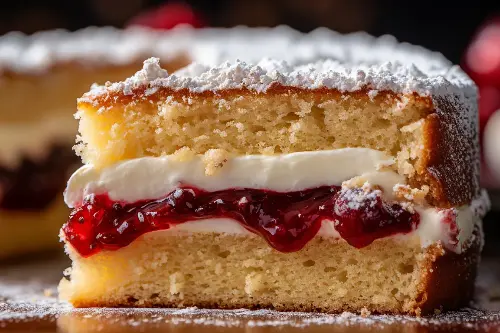
The Victoria sponge cake, a quintessentially British bake, named after Queen Victoria herself, has a royal heritage as rich as its flavor. It’s a cake that carries with it a nostalgia for afternoon teas and the delicate clink of china on a sunny garden patio. Yet, what is it that makes the perfect Victoria sponge, and why does this seemingly simple cake hold such esteem in the palates of both amateur and seasoned bakers alike?
Firstly, let’s understand what comprises a Victoria sponge cake. Traditionally, it's made with equal weights of eggs, butter, sugar, and flour – a simple recipe but one that requires precision and care. The aim is to achieve a light, airy sponge with a golden crumb, sandwiched together with just the right amount of jam (and sometimes cream) oozing from the middle, hinting at the lushness within.
One secret to the perfect Victoria sponge is in the eggs. They should be room temperature, to ensure they mix easily with the butter and sugar, creating a smooth, emulsified batter that traps air and rises beautifully in the oven. Whisking is crucial and often underestimated. A vigorous whisk will incorporate air into the batter, but over-whisking can collapse those bubbles you’ve worked hard to create. The balance is delicate and depends much on the power of one's whisking technique.
On to the sugar and butter – another pivotal moment in the making of a Victoria sponge. Creaming them to a pale and fluffy consistency is not just a step but a milestone. It is this process that forms the backbone of your cake's structure, allowing it to rise evenly and obtain that classic light and tender crumb. Patience is of essence, as the mixture often requires several minutes of beating to reach the optimal stage.
Flour choice also plays an integral role. A low-protein, finely milled flour, such as cake flour, is often preferred by bakers seeking to avoid a dense and heavy sponge. Since gluten development can be the downfall of the light texture we aim for, the flour should be sifted and gently folded into the batter, avoiding overmixing at all costs.
When it comes to baking, uniformity is king. Dividing the batter equally between two tins and smoothing the tops ensures an even rise and equal layering once filled. Preparing the tins with a lining or careful greasing can mean the difference between a cake that softly springs out or one that stubbornly clings and falls apart upon release.
Temperature and timing in the oven are not to be underestimated. A moderate heat allows the cake to rise without the crusts browning too quickly, which can cause the rising to halt prematurely. And while recipes often give an estimated cooking time, the true judge of doneness is the cake itself—the spring-back to a gentle touch, the skewer that emerges clean, and the slight shrinkage from the sides of the tin.
Once the cakes are baked, resist the temptation to immediately remove them from their tins. The cooling process is as critical as the mixing and baking. A cake that cools too quickly may become dense or moist, while one left to gently cool in its tin will maintain its structure and lightness.
Now to the filling – traditionally, raspberry or strawberry jam gives a wonderfully sweet tartness that complements the vanilla-infused sponge. Homemade jam can be a show-stopper, offering a true burst of fruitiness. The addition of whipped cream is a more modern and decadent touch, providing a lush contrast to the firmly set jam and yielding a luxuriously soft mouthfeel with each bite.
The finishing touch, a sifting of caster sugar on the surface, is more than aesthetics; it’s the signal that the sponge cake is ready to be devoured. The rise and fall of one's fortunes with the Victoria sponge makes it a baking challenge indeed, but the satisfaction of achieving a balance of flavors, structure, and textures is worthy of a baker’s crown.
In essence, the perfect Victoria sponge is an embodiment of balance – it takes equal measures of ingredients, a disciplined yet gentle approach to preparation, and patience in baking and cooling. Each step brings you closer to creating a cake that not only pays homage to its namesake but also stands as a testament to the timeless art of baking. Whether enjoyed with a cup of tea or as a celebratory centerpiece, the pursuit of Victoria sponge perfection is one that continues to capture the hearts – and stomachs – of cake connoisseurs worldwide.