


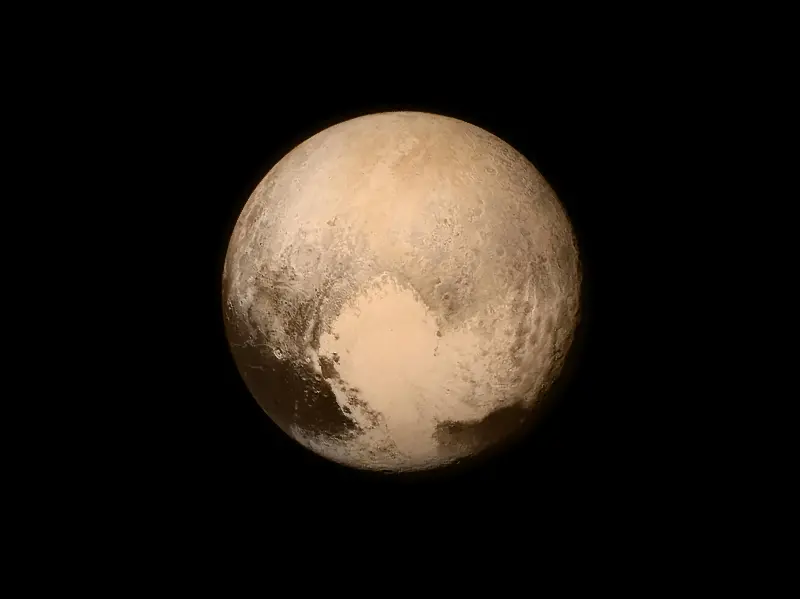
Pluto—the tiny, frosty world lurking at the edges of our solar system—has triggered one of modern astronomy’s most spirited debates. Wasn’t Pluto once the ninth planet we all learned about in school? How did it fall from planetary grace, and why are astronomers still torn? The debate boils down to this deceptively simple question: What do we really mean by “planet”—and who decides?
At the crossroads of discovery and definition, Pluto sits as both a victim and a symbol: our urge to categorize the Universe can sometimes clash with the boundless surprises it reserves for us.
A brief, glittering reign as planet number nine
Since its discovery in 1930, Pluto enjoyed planet status for 76 years. Classic textbooks celebrated it as the outermost boundary of our planetary system. Yet, Pluto’s reign was always a little odd—its orbit, elongated and tilted, sometimes bringing it closer to the Sun than Neptune. It’s also tiny, smaller than Earth’s Moon, and made primarily of ice and rock.
Astronomers whispered against its planetary status almost from the start. But in the 1990s and early 2000s, new discoveries in the Kuiper Belt—a ring of icy bodies beyond Neptune—including the Pluto-sized Eris, forced astronomers into a corner. If Pluto stayed a planet, so would Eris, and perhaps dozens of other similar objects.
Defining “planet”: more than just a name
In 2006, the International Astronomical Union (IAU) convened in Prague to settle the matter, unveiling a new, three-point definition for planets in our Solar System:
- Orbits the Sun.
- Is massive enough for gravity to pull it into a nearly round shape.
- Has “cleared the neighborhood” around its orbit.
Pluto failed the last test. It shares its orbital region with other icy bodies and hasn’t swept its path clean. Thus, Pluto was rebranded a “dwarf planet,” along with Eris, Haumea, and Makemake.
For many, Pluto’s demotion didn’t just shrink the planetary club—it challenged our attachment to familiar cosmic landmarks.

Astronomers speak up: the meaning behind their words
But what’s fascinating is that not all astronomers agree! Some claim the IAU’s definition is arbitrary, especially the “cleared the neighborhood” clause. Planetary scientist Alan Stern, who led NASA’s New Horizons mission to Pluto, argues for a broader meaning—any celestial object large enough to be rounded by gravity, regardless of its neighbors, should be a planet.
Consider these intriguing facts:
- Many exoplanets discovered around other stars would not qualify as “planets” under the IAU’s strict rules.
- Jupiter, the largest planet, actually shares its orbit with thousands of small asteroids (the Trojans), yet retains planet status.
- The word “planet” itself comes from ancient Greek for “wanderer”—reflecting objects that moved across the sky, not their ability to clear orbits!
Why this matters: science’s evolving frontier
You might wonder—why does it matter what Pluto is called? The debate isn’t just about one lonely, icy world. It’s a window into how science works: definitions adapt as knowledge grows, and language both shapes and limits our understanding.
Classifying Pluto pushed astronomers to reevaluate what it means to be a planet, shining a spotlight on the dynamic and democratic nature of science.
- Our yearning to sort and define goes hand-in-hand with curiosity—a reminder that the Universe defies easy labels.
- As we explore farther, we may discover new worlds that force us to revisit this debate again and again!
Redefining our place in the cosmos
The Pluto planet debate is a cosmic conversation in progress, echoing from classrooms to observatories worldwide. Its story urges us to stay open, to question, and to imagine what might still lurk beyond the boundaries we draw. In a Universe as vast and surprising as ours, perhaps the greatest discovery isn’t about what Pluto is, but about how our definitions evolve with every new glimpse into the unknown.