


In the intricate ballet of social graces, the language of cutlery remains one of the most nuanced and subtly eloquent forms of communication. Beyond mere instruments of culinary function, your knife and fork serve as extensions of your manners, signalling your comfort with etiquette and even your sentiments about a meal. Let us delve into the intricacies of cutlery language and uncover what the positioning of these dining tools can convey.

The origins of cutlery etiquette can be traced to the palaces and manor houses of Europe, where feasting was not just about the enjoyment of food but also about the performance of status and refinement. Over time, this conduct has evolved into a complex system of signals that, to the uninitiated, might appear as cryptic as an ancient code.
When you pause between bites or conversations during a meal, the way you place your knife and fork can send intentional or unintentional messages. A common 'rest position' is with the fork tines facing down and the knife blade turned inwards, both positioned at an angle, with the handles resting on the bottom edge of your plate. This arrangement communicates that you are not finished eating and plan to continue.
On the other hand, if you have completed your meal, standard practice in Western dining etiquette is to place your knife and fork together diagonally across the plate, with the handles at the bottom-right corner. This position not only indicates to the waiter that you have finished, but also that you have appreciated the meal.
Now, if we look closer, the variations can have particular meanings. For instance, resting your knife and fork in an inverted 'V' position can indicate a pause, suggesting that you're perhaps conversing or taking a brief rest from eating. The alignment of your cutlery in this setting should still point to your plate, communicating that you're not ready for it to be taken away.
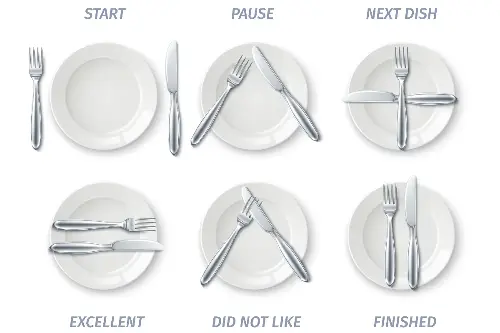
Astute observers may even deduce more nuanced sentiments from the cutlery's position. A knife and fork crossed in the centre of the plate can sometimes denote a negative response to the meal, subtly allowing the diner to express dissatisfaction without the need for words.
In some cultures, such as France, there's an entirely different set of cutlery positions that communicate specific messages. Here, placing your knife and fork parallel but separated in the centre of the plate indicates a meal thoroughly enjoyed.
Beyond etiquette, the way one handles cutlery can reveal characteristics of the diner themselves. Those who wield their knife and fork with confidence and grace are often perceived as well-mannered and sophisticated. Conversely, a diner who fumbles with their utensils may unwittingly give off an impression of discomfort or unfamiliarity with dining decorum.
Furthermore, holding a knife like a pencil is seen as more delicate and controlled, while gripping it firmly can indicate decisiveness or, perhaps, tension. Psychologists might go so far as to suggest that such minute behaviours at the dining table could reveal aspects of one's personality, such as whether they are more inclined to be cautious or assertive.
In a more global view, it's essential to recognise that cutlery language varies significantly from culture to culture. For example, in some Asian countries, the use of knives at the dining table is uncommon, and understanding the etiquette surrounding chopsticks becomes crucial. Here, placing chopsticks back on the rest signifies a pause, while standing them upright in a bowl is a faux pas as it resembles incense sticks burned for the deceased.
Eating etiquette and the language of cutlery have an undeniable place in modern social interactions, transcending cultures and languages to communicate universal human nuances. A well-set table speaks of anticipation and respect, while the careful choreography of knife and fork performs a silent ballet of courtesy and societal norms.
Whether dining in a high-end restaurant or enjoying a meal at a friend's home, being aware of the subtle communication through cutlery position can enrich your dining experience and potentially enhance your social standing. After all, in the words of cultural anthropologists, it's not only what you eat but how you eat it that can articulate your pedigree, politeness, and prowess in the art of table manners.