


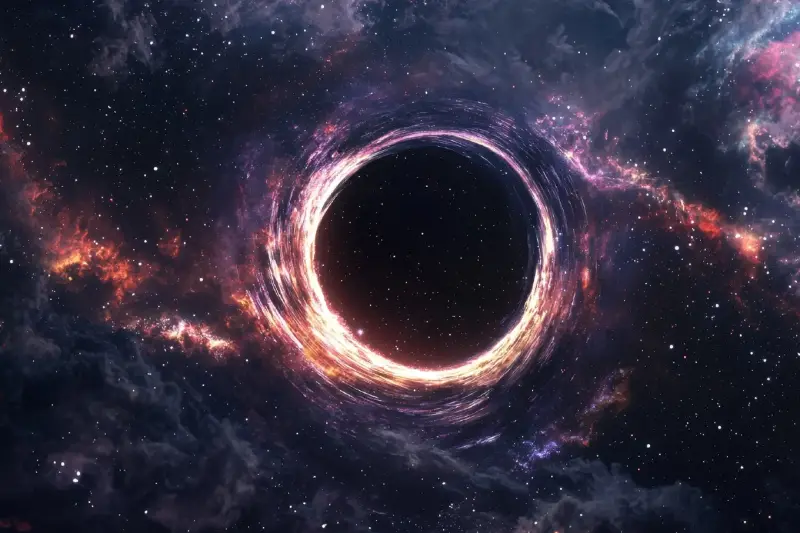
Imagine standing on the edge of one of the universe’s most mysterious objects—a black hole—and peering into the unknown. What would happen to time as you get closer to that point no light or information can escape: the event horizon? Black holes, among the most fascinating celestial objects to capture both scientific and public imagination, warp not just space, but time itself. Let’s delve into the adventure of what truly happens to time inside a black hole, and why this puzzle has confounded even the greatest minds.
The Nature Of Black Holes And Event Horizons
Black holes originate from the collapse of massive stars, where gravity crushes matter into an infinitely dense point called a singularity. Surrounding this point is the event horizon—the invisible boundary that marks the “point of no return.”
Physically, once anything crosses the event horizon, there is no turning back. But what happens to time at this boundary? According to Einstein’s theory of general relativity, black holes have such intense gravitational effects that they deeply influence time itself. Time does not tick at the same rate for everyone in the universe; it is flexible and shaped by gravity. The stronger the gravitational field you are in, the slower time passes for you compared to someone farther away.
Time Dilation: Slowing Down Near The Edge
As you approach the event horizon of a black hole, the effects of this “gravitational time dilation” become extreme. If an astronaut were to approach a black hole, people watching from far away would see their clock ticking more and more slowly. To an outside observer, it would almost look as if the astronaut freezes in time at the very edge.
Here’s an interesting fact: from the viewpoint of a distant observer, even light from the astronaut near the horizon would become increasingly redshifted, growing dimmer and dimmer, perhaps vanishing altogether. From the astronaut’s perspective, however, time feels normal—but the rest of the universe outside would appear to rush forward at an astonishing pace. Minutes spent near the black hole could mean centuries or eons pass in the universe beyond.
This is not just science fiction; it was accurately portrayed in the movie Interstellar, reflecting real calculations by astrophysicist Kip Thorne. The phenomenon is so striking that a few hours near a supermassive black hole’s event horizon could equal years on Earth.
Inside The Black Hole: A One-Way Journey
So, what if you dare to cross the event horizon? First, no one can see this happen—the event horizon shields all beyond its veil. Once inside, the rules become even stranger. General relativity predicts something astonishing: at the event horizon, the very fabric of time and space twists.
For the observer who crosses the event horizon, time and space swap roles. That’s right—the direction you were moving through space to get closer to the singularity becomes your inevitable “future.” You can’t stop moving toward the singularity, because that forward movement is now as compulsory as moving forward in time outside the black hole. It’s as if the singularity becomes your next moment, inevitable and inescapable.
And yet, for that observer, their personal clock still seems to tick normally. It’s the rest of the universe that seems wildly distorted, distant and unreachable. Inside the event horizon, you could not even send a message to say what you found—the information is forever lost to the outside world.
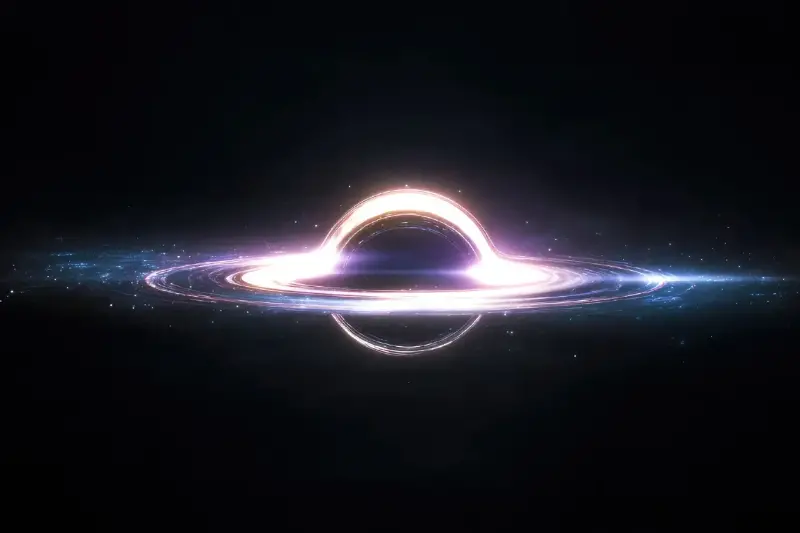
What Happens To Time At The Singularity?
Reaching the singularity at the core of the black hole is where physics as we know it breaks down. The equations of general relativity predict infinite curvature of spacetime—a place where gravity compresses all matter, and time, to a single point. Because time and space become so warped, the very concept of “before” and “after” loses meaning.
To make things even more mind-bending, many physicists believe that we need a quantum theory of gravity—something that unites the rules of the subatomic world with those of general relativity—to truly understand what happens at the singularity. Until then, what happens to time at the very center remains one of science’s greatest mysteries.
Black Holes, Time And The Future Of Physics
Black holes are not simply cosmic vacuum cleaners sucking in matter and light. They act as portals to some of the deepest questions in physics: what is the nature of time? Can information ever truly be destroyed? And could we use black holes to journey through time, or even between universes?
Modern research is bringing us ever closer to answers. From snapping the first direct images of a black hole’s “shadow” to detecting gravitational waves from cosmic collisions, our understanding of these objects continues to grow. Perhaps one day, as our theories develop, we’ll unlock the full truth behind time inside a black hole.
For now, black holes remain enigmatic gatekeepers at the edges of science, showing us that time is far from absolute. It can stretch, warp, and even stop altogether—at least from the outside—when confronted by the power of gravity. And wherever time and space become fluid, human curiosity is sure to follow.