


Throughout history, the phenomenon of a solar eclipse, where the moon passes between the Earth and the sun, casting a shadow over our world, has been a source of wonder, fear, and profound curiosity. The temporary darkness of a solar eclipse has sparked a wealth of myths, legends, and interpretations across different cultures, each seeking to understand or explain the dramatic celestial event. Let us embark on a journey across time and geography to uncover six intriguing cultural takes on solar eclipses.
Interpretations from the Land of the Pharaohs
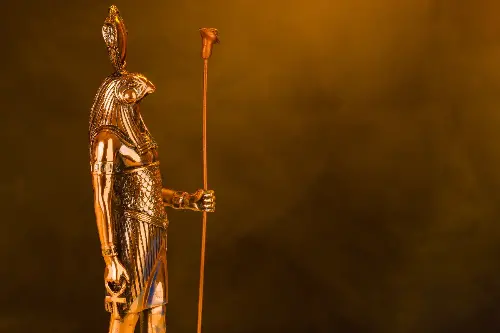
In ancient Egypt, solar eclipses were both awe-inspiring and terrifying. They were understood through the myths of the deities they worshipped, most notably the sun god, Ra. The Egyptians believed that during an eclipse, the sun god was under attack by an enemy, often depicted as the serpent Apophis. The eclipse symbolised the eternal battle between order and chaos. Priests would perform rituals to aid Ra in his struggle, and when the sun emerged, it was a cause for celebration, signifying the triumph of order once again.
Celestial Dragons in Chinese Mythology

The Chinese also saw solar eclipses as an act of cosmic aggression, but their imagined assailant was quite different—a celestial dragon. It was thought that the dragon, attempting to devour the sun, was responsible for the darkening skies. In an effort to save the sun, people would band together, creating as much noise as possible with drums and pots, hoping to scare the dragon away. This practice underscores the proactive role people felt they had in restoring the cosmic balance.
Viking Skies: Wolf Chases and Cosmic Destiny
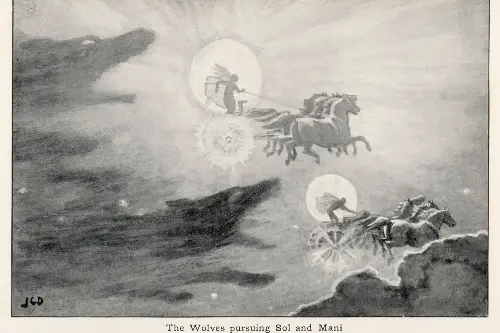
Norse mythology presents yet another vivid image: a wolf named Skoll was believed to be chasing the sun. The eclipse occurred when Skoll finally caught up with his prey. The Norse saw eclipses as foreboding omens of Ragnarök, the end of the world. The eventual consumption of the sun by the wolf signalled the beginning of the dark times that would precede the world's rebirth. Despite its ominous nature, this belief also encapsulated the idea of cyclicality and rebirth in Norse culture.
The Hindu Demon and the Divine Nectar
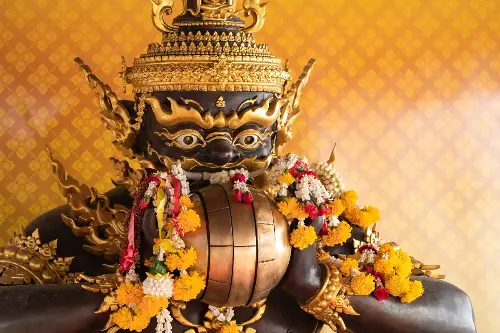
In Hindu mythology, solar eclipses carry a tale of deception and betrayal. As legend has it, demon Rahu disguises himself and joins the gods in consuming the nectar of immortality. The sun and the moon spot the impostor and alert Vishnu, who decapitates Rahu just as he swallows the nectar. His head becomes immortal, and Rahu's vendetta against the sun and moon is played out during eclipses, as he tries to devour them, only for them to reappear after slipping out from his severed neck.
Renewal and Balance in African Mythology
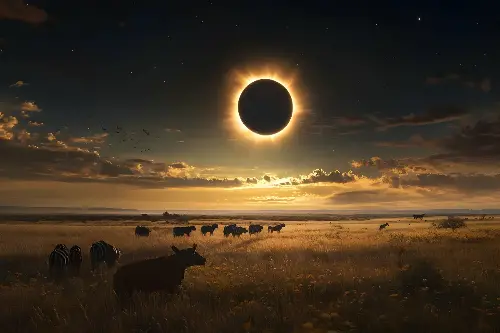
The Batammaliba, whose eclipse myth also promotes resolution and peace, see the solar eclipse as a time for renewal. The eclipse is interpreted as a period during which the sun and moon are in conflict, and it is the duty of the people to encourage these celestial bodies to cease their feud. This mediation restores harmony not just to the skies but also within their communities, demonstrating a profound connection between celestial events and social behaviour.
The great diversity of stories and interpretations associated with solar eclipses illustrates how humanity has sought to understand the mysteries of the cosmos. From fearsome dragons and battling deities to divine chases and celestial unions, each culture brings its flavour to the rich tapestry of eclipse lore. Today, armed with scientific understanding, we still gaze at eclipses with wonder, and perhaps somewhere deep inside, we feel the echoes of the ancient awe that once turned every eye skyward when day turned to night.