


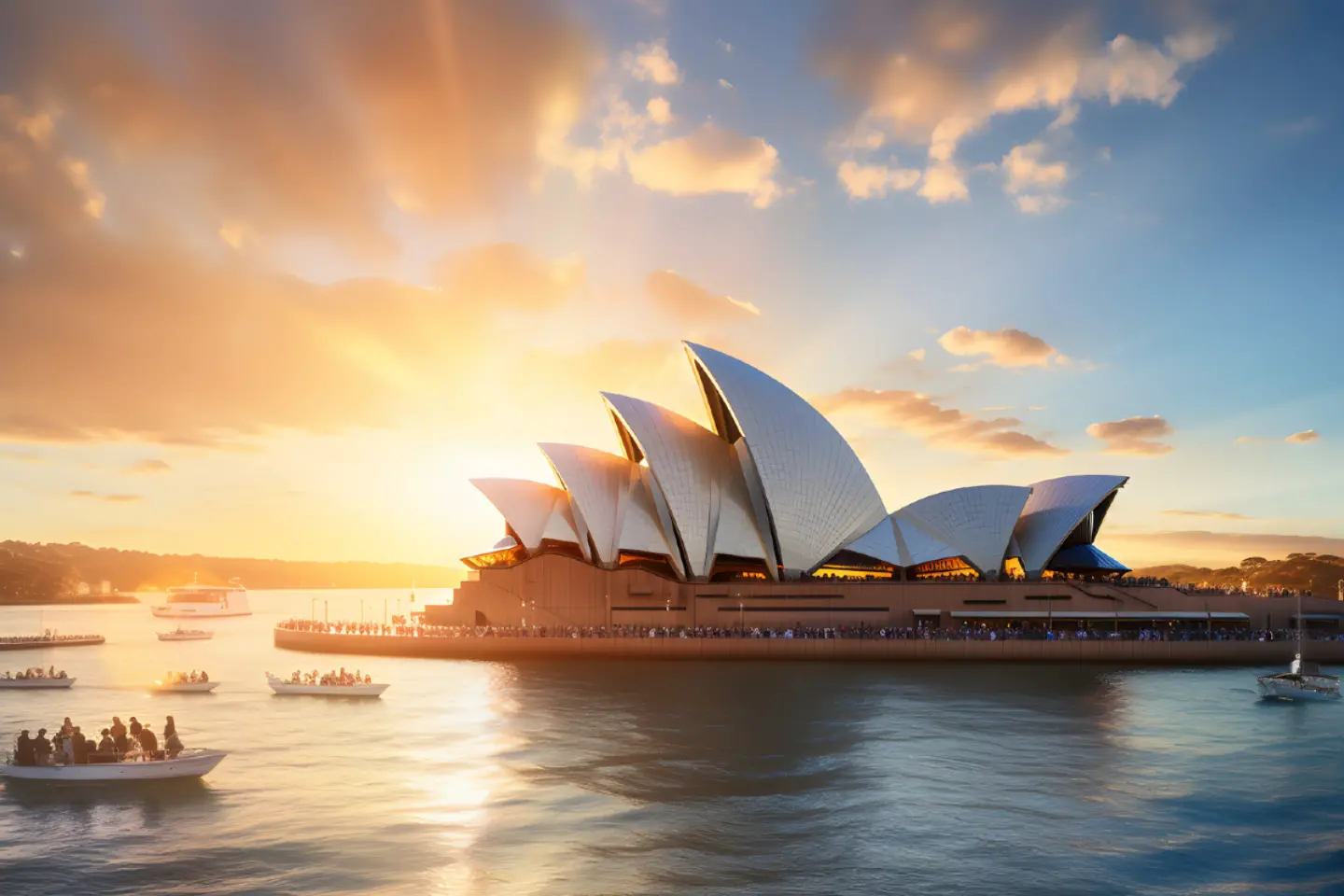
Perched majestically on Bennelong Point, graced by the waters of Sydney Harbour, stands one of the world’s most distinctive and iconic buildings: the Sydney Opera House. Known for its unique use of a series of gleaming white sail-like shells as its roof structure, the Opera House has become an emblem of both the city of Sydney and Australia as a whole. While its image is universally recognized, there are many aspects of this architectural marvel that remain less well-known. Here are some fascinating facts about the Sydney Opera House that will enhance your appreciation for this architectural masterpiece.
The origins of the Sydney Opera House date back to the 1950s, when Eugene Goossens, the Director of the New South Wales State Conservatorium of Music, advocated for a dedicated venue for large theatrical productions. The project officially kicked off with an international design competition in 1956, which attracted 233 entries from 32 countries. The winning design was submitted by a then relatively unknown Danish architect, Jørn Utzon. His vision would challenge engineering principles and construction methods of the era.
Contrary to what the name implies, the Sydney Opera House is not solely an opera venue. It houses multiple performance spaces which collectively host over 1,500 performances each year including opera, theatre, dance, classical music, and more. The largest internal performance space is the Concert Hall, which is home to the world-renowned Sydney Symphony Orchestra and boasts one of the largest mechanical tracker action organs in the world, with over 10,000 pipes.
Construction of the Opera House was a saga of ambition clashing with reality. Initially estimated to take four years and cost AU$7 million, the project took 14 years to complete and cost over AU$100 million. The innovative design of the shell-shaped roofs, in particular, proved to be a challenge. Engineers had to come up with a new approach to achieve the architect’s vision. The solution was to design them as sections of a sphere, allowing them to be constructed uniformly.
The distinctive tiles that cover the Opera House’s shells are not merely white but are actually a subtle chevron pattern made up of glossy white and matte cream tiles. All 1,056,006 tiles were made by Swedish company Höganäs AB, which were chosen specifically because they could self-clean and retain their colour despite the harsh Aussie sun.
While Utzon’s design was visionary, his relationship with the project was fraught with controversy. Ongoing conflicts with the New South Wales government about costs and design modifications eventually led to his resignation in 1966, and he never returned to Australia to see his completed masterpiece. It wasn’t until 2003 that the Opera House Trust formally reconciled with Utzon, and he was made a design consultant for future works.
The Sydney Opera House isn’t just a building; it also hosts a significant biodiversity within its structure. The Sydney Opera House seawall features a ground-breaking artificial reef, known as the Opera House Habitat Structure, which has enhanced the marine biodiversity of the harbour. The structure supports a variety of sea life including fish, molluscs, and crustaceans, contributing to the ecological health of the harbour.
When you think of the Opera House, you likely picture spectacular performances and grand events, but beneath its sails lies a labyrinthine support system. It contains a recording studio, five rehearsal studios, two main auditoriums, a proscenium theatre, a cinema, and numerous bars and restaurants, making it a veritable beehive of cultural activity.
Unlike many monuments, the Sydney Opera House is a living building in a state of constant evolution. In 2017, it embarked on the largest building upgrade since it opened in 1973. This renewal project aimed at improving acoustics, accessibility, and technical equipment, ensuring that the Opera House remains at the forefront of performance technology.
The lighting of the Sydney Opera House sails is a spectacular sight, especially during the annual Vivid Sydney festival, where they become canvases for dazzling light installations and projections. Many do not know that these artistic illuminations are critically considered to ensure they do not impact the surrounding environment, especially the marine life and migratory birds of the harbour.
In a poignant heritage act, the Sydney Opera House was inscribed on the UNESCO World Heritage List in 2007, a remarkable 34 years after its completion. It was recognized as a great architectural work of the 20th century and one of the most famous and distinctive buildings of the modern era, reflecting the creativity and innovation of its design.
Understanding the trials, triumphs, and ongoing story of the Sydney Opera House enriches the experience of beholding it, whether in person or in pictures. This paragon of design is not just a static landmark but a vibrant cultural hub that continues to evolve and inspire. It represents the indefatigable human spirit for innovation, the arts, and community, standing as a testament to the cultural aspirations of not only Australia but of the world at large.