


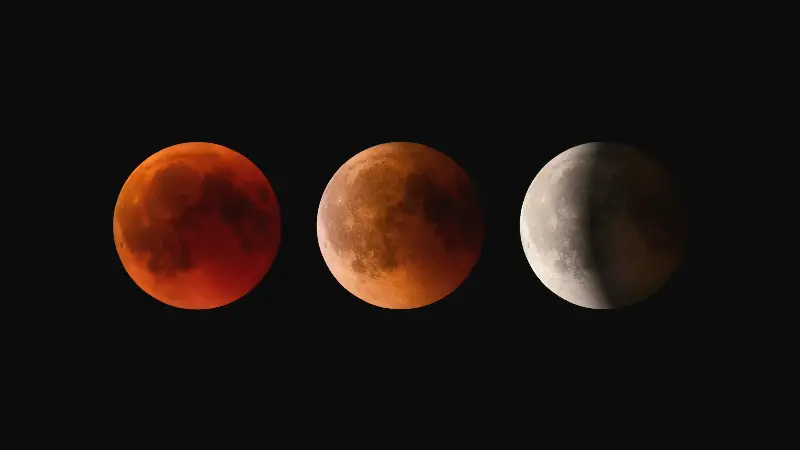
Have you ever looked up at the night sky during a lunar eclipse and marveled at the moon's haunting red glow? While most celestial events are easy to miss, a total lunar eclipse turns the familiar full moon into an eerily beautiful, coppery orb—often called a "blood moon". But why does the moon glow red instead of simply vanishing when Earth comes between it and the sun? The answer is a fascinating blend of physics, atmospheric science, and ancient lore. Let’s dive into the science, history, and beauty behind one of the sky’s most enchanting spectacles.
THE PHYSICS OF THE CRIMSON ORB
During a total lunar eclipse, the Earth slides exactly between the sun and the moon, blocking the direct sunlight that usually illuminates our closest neighbor. You might expect that with a giant planet in the way, the moon would simply disappear into the blackness of space. Yet, the opposite happens—it transforms into a glowing ember.
This phenomenon is caused by Rayleigh scattering, the same physical process that makes our sky blue and our sunsets red. As sunlight hits Earth’s atmosphere, the gas molecules scatter the light:
- Shorter Wavelengths: Blue and violet light are scattered outward in all directions, which is why the daytime sky looks blue.
- Longer Wavelengths: Red and orange light pass through the atmosphere more easily, bending (or refracting) around the edges of the Earth.
During an eclipse, Earth’s atmosphere acts like a giant lens. it filters out the blues and bends the remaining red-tinted light toward the moon. If you were standing on the lunar surface during the height of the eclipse, you would look back at Earth and see a fiery ring consisting of every sunrise and sunset happening on the planet at that exact moment.
SHADES OF RED: WHY NO TWO ECLIPSES ARE THE SAME
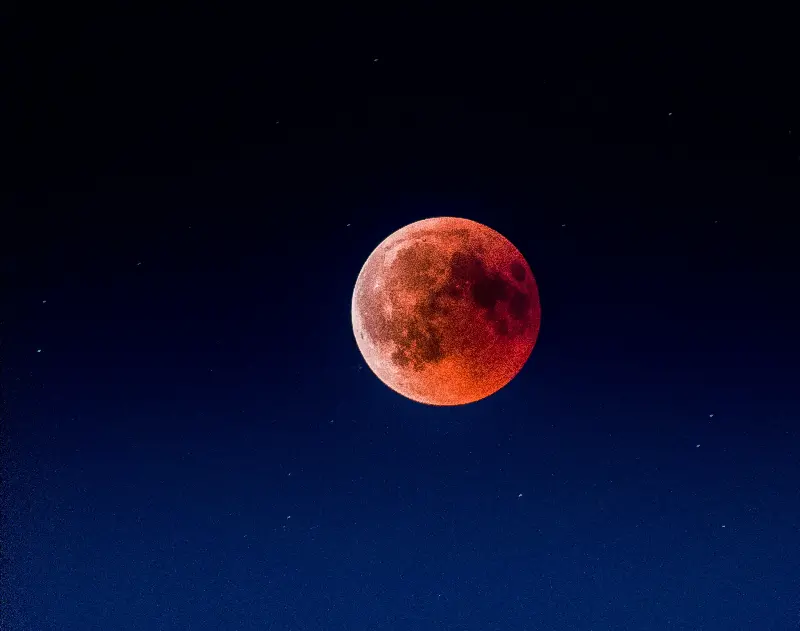
While most total eclipses bathe the moon in red, the specific palette can range from a pale orange to a deep, dark crimson or even a dusty brown. What determines this cosmic variety? It all comes down to the current state of Earth’s atmosphere.
Several environmental factors influence the moon's appearance:
- Volcanic Ash: Major eruptions can pump massive amounts of dust into the stratosphere, blocking light and turning the moon an incredibly dark, almost invisible red.
- Cloud Cover: Heavy clouds around the Earth's "terminator" line (the edge between day and night) can dim the refracted light.
- Pollution and Humidity: High levels of aerosols or water vapor can shift the color toward a deeper copper or rust tone.
Astronomers use the Danjon Scale to measure these variations, ranging from $L=0$ (a very dark eclipse) to $L=4$ (a bright copper-red or orange eclipse). Because our atmosphere is constantly changing, no two blood moons are ever exactly alike.
A HISTORY FULL OF MYSTERY AND MYTH
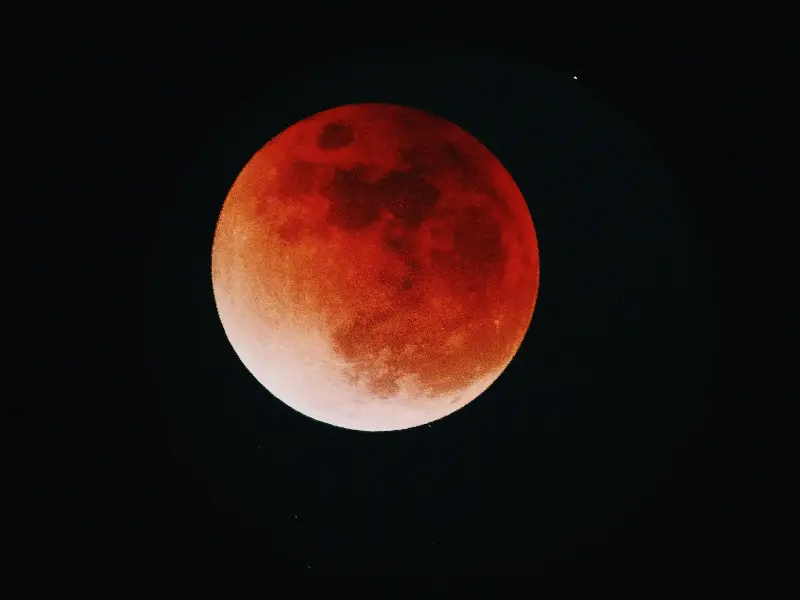
Long before modern telescopes explained the mechanics of orbits, ancient civilizations viewed the reddening of the moon with a mixture of awe and terror. In many cultures, the blood moon was seen as a profound omen:
- The Incas: They believed a celestial jaguar was attacking the moon. To stop the assault, villagers would howl, shout, and shake spears to scare the predator away.
- Mesopotamia: Ancient astronomers viewed the eclipse as a direct threat to their king. They would often install a "proxy" king to endure any bad luck while the real monarch went into hiding.
- Ancient China: The crimson hue was often interpreted as the work of a heavenly dragon devouring the lunar disc.
Today, these myths have been replaced by precise mathematical calculations. We can now predict eclipses centuries in advance, yet the primal sense of wonder remains unchanged.
HOW TO WITNESS THE SPECTACLE
One of the best things about a lunar eclipse is its accessibility. Unlike a solar eclipse, which requires specialized "eclipse glasses" to prevent eye damage, a lunar eclipse is perfectly safe to view with the naked eye.
To get the most out of your viewing experience, keep these tips in mind:
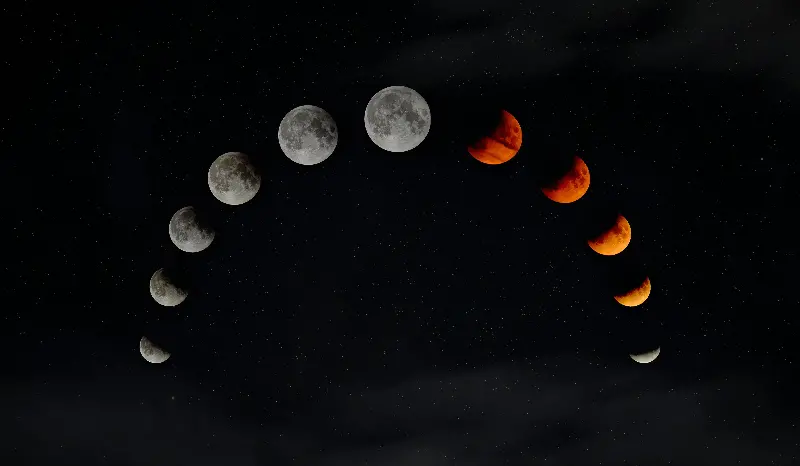
- Check the Timing: Totality (the period when the moon is fully red) can last anywhere from a few minutes to over an hour.
- Find Dark Skies: While you can see an eclipse from a city, the colors are much more vibrant if you move away from heavy light pollution.
- Use Binoculars: While not necessary, a simple pair of binoculars will help you see the dramatic color gradients along the moon's craters.
A lunar eclipse is more than just an astronomical alignment; it is a vivid reminder of how intertwined our planet is with the rest of the solar system. The next time the moon begins to blush, take a moment to step outside and enjoy one of the universe's greatest unscripted performances.