


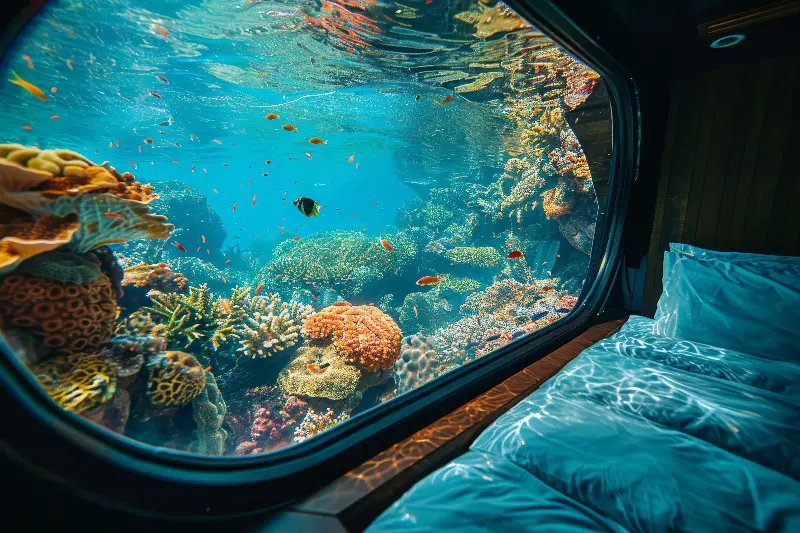
It is a fantasy that has captivated travelers and dreamers alike: falling asleep beneath rippling waves, watching vibrant fish glide outside your window, and feeling safely enclosed yet entirely part of the underwater world. Underwater hotels have transformed from whimsical sketches in science fiction novels to reality, luring luxury travelers with the promise of surreal nights in the deep blue.
But how exactly did these aquatic sanctuaries turn from imagination to architecturally possible? More importantly, how safe are these dreamlike retreats? The truth is captivating, packed with far more engineering and innovation than meets the eye.
UNDERWATER HOTELS: FROM CONCEPT TO CONSTRUCTION
The concept of underwater living first gained public imagination as early as the 1960s, appearing in books and futurist renderings of how humans might live with—and not just on—the oceans. Yet, it wasn’t until 1986 that Jules’ Undersea Lodge in Key Largo, Florida, became the world’s first true underwater hotel. Accessible only by scuba diving down 21 feet, its cozy quarters remain a quirky favorite among diving enthusiasts.
Since then, the notion has dramatically expanded, especially in luxurious destinations:
- The Muraka (Maldives): A residence featuring a master bedroom submerged five meters below sea level.
- Atlantis, The Palm (Dubai): Offers "Underwater Suites" with floor-to-ceiling views into a massive aquarium lagoon.
- Resorts World Sentosa (Singapore): Two-story townhomes that provide a private window into one of the world's largest aquariums.
What transformed the vision into a possibility was significant advancement in construction technology. These structures aren't just sunken boxes; they are high-tech habitats requiring millions of dollars in investment—sometimes costing upwards of $15 million per suite.

A CLOSE LOOK AT ARCHITECTURAL INNOVATION
Designing for the underwater world is unlike any other architectural challenge. The aquatic environment presents continuous pressure, potential for leaks, humidity, and the threat of unpredictable marine life contact. To tackle this, engineering teams must analyze:
- Water Movement: Assessing currents and wave action to ensure stability.
- Geological Stability: Checking the sea floor’s ability to support immense weight.
- Salinity Levels: Choosing materials that won't corrode in salt water.
Crystal-clear acrylic is the unsung hero of these hotels. Often up to 17 inches thick, it provides near-panoramic ocean views while withstanding tremendous external pressure. Unlike glass, acrylic is more flexible and impact-resistant. Furthermore, most rooms are assembled on land and "dry-tested" for integrity before being lowered into the ocean with weighted ballasts.
SAFETY ASSURANCES: FACT OR FICTION?
Amid their allure, underwater hotels must constantly reassure potential guests that staying beneath the sea is as safe—or safer—than being on land. These hotels employ redundant safety systems, meaning every critical life-support function has a backup.
- Atmospheric Control: Advanced filtration systems manage humidity to prevent fogging and ensure a fresh air supply.
- Pressure Monitoring: Automated sensors detect even the slightest change in internal or external pressure.
- Emergency Egress: Many suites are designed with pressurized escape pods or direct vertical access to the surface.
- Backup Power: Massive generators ensure that lighting and life support remain active even during a total local power failure.
Interestingly, while the fear of a leak is common, guests are statistically more likely to encounter a plumbing disaster in a traditional high-rise. This is because underwater properties are built to maritime standards, similar to submarines, where every seal and joint is inspected with relentless scrutiny.
THE UNSEEN SIDE: ENVIRONMENTAL IMPACT AND ETHICS
No story about underwater hotels is complete without considering their impact on marine ecosystems. Reputable establishments often go above and beyond to ensure sustainability. Some properties use their artificial structures as new habitats, allowing coral and sponges to grow directly on the exterior, essentially creating a new reef.
Energy efficiency is also a major focus. Leading hotels integrate solar panels and advanced water treatment systems to ensure that as little waste as possible enters the surrounding ocean. Many even employ full-time marine biologists to monitor the local fish populations and ensure the hotel’s lights do not disrupt natural nocturnal behaviors.
From the first visions of futuristic underwater utopias to today’s jaw-dropping reality, these hotels occupy a unique space in luxury travel. They are part architectural marvel and part immersive experience. If your travel bucket list includes a night in the company of seahorses and parrot fish, rest assured—engineering has made that dream both spectacularly beautiful and surprisingly safe.