



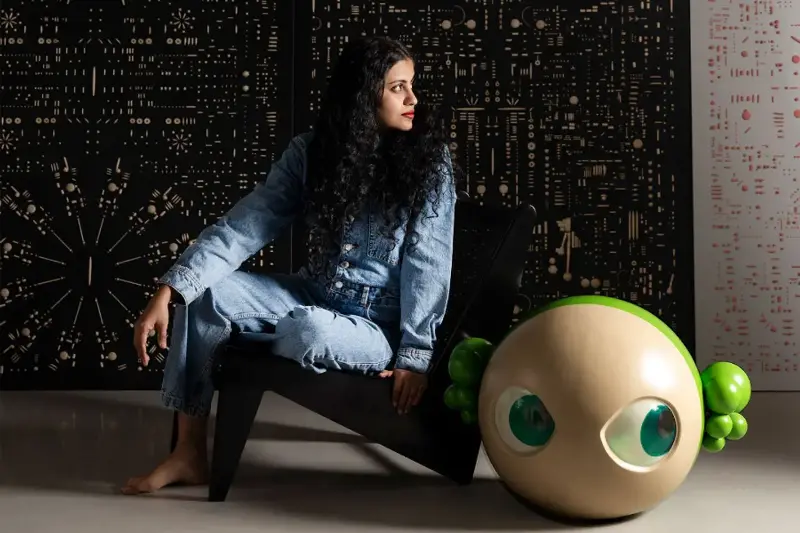
India, March 12 -- In contemporary Indian art, where visibility is often currency, Natasha Preenja spent years doing the opposite. She created a character: Princess Pea, a woman with a bulbous, oversized pea for a head and allowed that figure to circulate freely through galleries, performances, and images while the artist herself remained largely unseen.
Princess Pea wasn't merely a gimmick but a character that moved through different spaces and bodies, allowing it to become many women at once. Looking back, Natasha Preenja describes that shift (from solitary character to collective presence) as the moment the work truly changed shape. "In 2015, I began expanding the character to embody many women," she says. "The headgears were passed on, inviting each woman to step into a breathing, evolving artwork. In embracing the headgear, they became living sculptures, extensions of my own self, yet wholly themselves. The simple gesture of passing the headgear opened new pathways for connection, for witnessing, and for understanding life through collective experience," she says.
The interactions that followed were rarely theatrical but intimate ones over long conversations and cups of tea. "These encounters often led to deeply sensitive conversations, some of which were quietly heartbreaking," Preenja recalls. "As we held back emotions and built empathy over cups of chai, the work revealed its true purpose: a space for care, solidarity, and tenderness within a socially restricted world." Over time, Princess Pea became less a singular artwork and more a living archive. "The work was no longer just about representation," she says. "It transformed into a living archive of shared resilience."
When asked whether there was a moment when she felt she had broken through professionally, she responds with a gentle refusal of the premise. "I don't know what breaking a ceiling means," she says simply. "But I am happy where I am." The ambition, if it exists, appears directed elsewhere: toward learning, toward craft, toward possibility. "To see new possibilities and develop new work, learn from traditions, and share knowledge," she says. That, for her, seems to be real work.
Still, recognition has arrived along the way. In 2025, Preenja was named the inaugural recipient of the Swali Craft Prize, an award celebrating contemporary practices rooted in craft traditions. The news reached her during a particularly practical moment. "I was installing my solo at Traq gallery when I received the call," she recalls. "Certainly, it was a moment when I got to know that I am the inaugural winner of the Swali Craft Prize."
The recognition was meaningful not simply because it was an award, but because of the collaborative process behind it. The large sculptural work associated with the project was created alongside the artisans of the Chanakya School of Craft, whose embroidery traditions have quietly shaped some of the most extraordinary textile work emerging from India today. "Chanakya School of Craft has built a skilful workforce which is rare and unique in the world," Preenja says. "This world-class faculty is built over time and care. I felt extremely humbled to be a part of the community of skilled embroiderers who helped me make a large sculpture. With Karishma and her amazing team, they took the proposal and steered the process, enriching and satisfying."
At first glance, Princess Pea appears whimsical and almost cartoonish. But beneath the softness of the form lies a body of work that is deeply attentive to the invisible pressures shaping women's domestic lives. "I feel being a woman has been tough throughout our history," she says. "We have seen our mothers working all day to make a home and take care of their families. Visibility is tied to validation and approval, often controlled by families and the societies we belong to," she explains. "They maintain an invisible checklist of norms, coded since childhood, dictating how women should behave, act, obey, walk, talk, and operate in specific ways."
These expectations are persistently embedded in daily interactions. "The idea of the male gaze is essentially a man's playground, defined by his rules and how he chooses to perceive women," she says. "We encounter it daily - at home, in schools, and at any event we attend. From the postman to the security guard to the driver, its presence is felt everywhere. Sometimes it seems less significant, but it is always present."
Princess Pea, with her slightly absurd silhouette, becomes a way of observing that world from the inside and the outside at once both as a participant and a witness.
A different kind of feminism
Preenja does not describe her work through rigid ideological frameworks. Instead, she speaks of feminism as something deeply personal about something that evolves through lived experience. "Every feminist journey is different," she says. "I was fortunate to pursue the arts, and that became my language. As an artist, I've always been driven to challenge the conventional vocabulary and mediums of art, especially its performative possibilities."
Princess Pea emerged from that impulse: "Princess Pea emerged as my alter ego," she says. "A creation that allows me to confront and question the status quo of Indian society, where women's experiences are often constrained. Through her, I explore these limitations and advocate for the freedom and authenticity of women's lives."
If she could offer one piece of advice to her younger self, the message would be brief and unsentimental. "Be unabashed," she says. "Be unapologetic."