



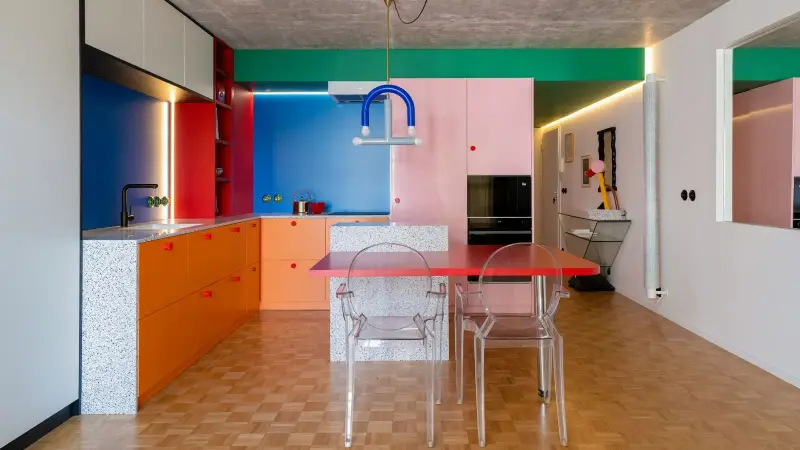
Tucked quietly away, east of the French capital, the neighborhood known as La Campagne à Paris — 'the countryside of Paris' — reads like a village hiding within the city. And this home, set back behind an ordinary front door, lands with a deliberate "twist" of surprise, like a shock of color set loose inside its sleepy cobbled streets.
For Lyon-based designer Célia Reubrecht, the brief was clear and the collaboration "easy" — owing to her client's confident, design-literate point of view. Reimagining the aged apartment of her late mother, the pair's creative starting point was an existing collection of eclectic treasures, many from the seventies and cast in Memphis-like shape and form.
Much of the remade space — which retains nothing but the same wooden floor — now feels like their rightful showcase, each room staging a different piece of the private trove.
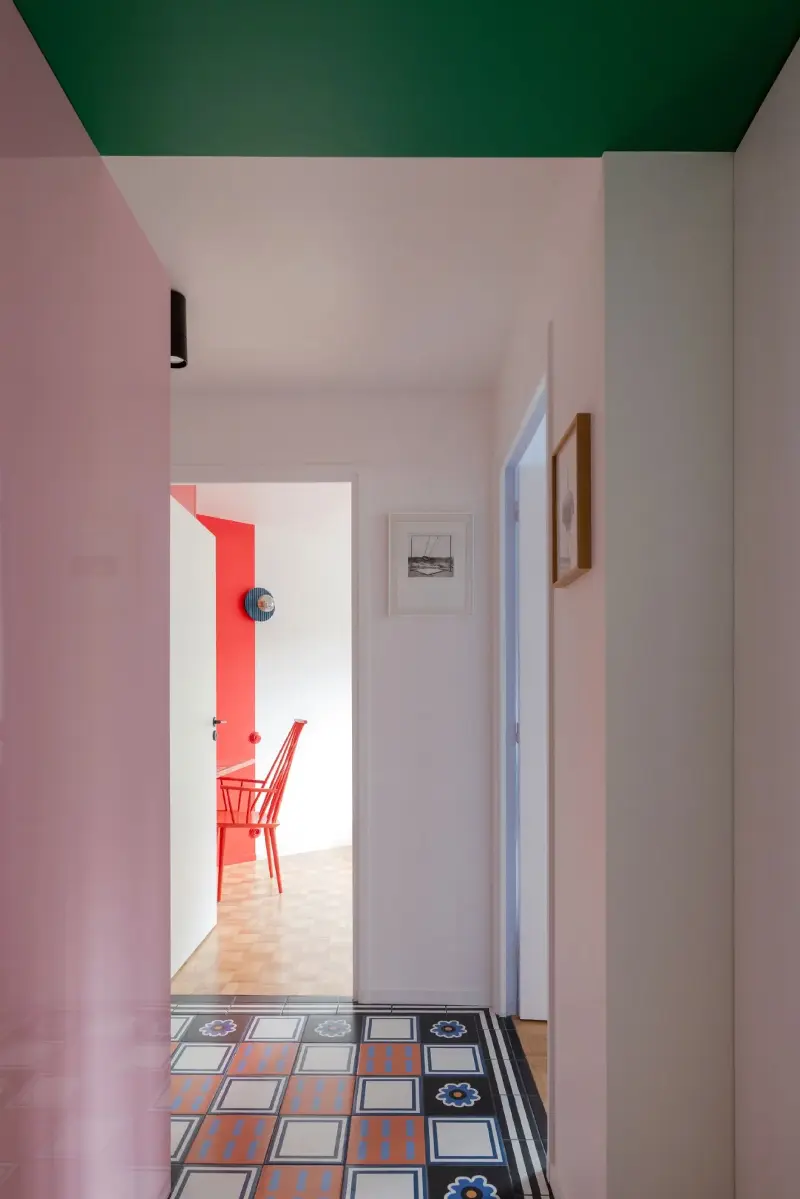
Step inside, and the first thing you'll do is look up — at a deep green ceiling that beams down from above. And then you'll look down — at a checkerboard tiled flooring that spills out across the corridor, luring you beyond it.
The rooms that follow have been entirely reconfigured. Rather than opting for a more standard, resale-friendly two-bed split, the owner — who lives alone — was "determined to design something more bespoke," committing to a single luxurious master suite, with a smaller second room as an office.
A convert from Instagram, and an admirer of Célia's work, she came with clear convictions of her own. It was, in that sense alone, a rather fitting match — the designer, herself, has long backed her individual creative instinct. "I've always had my own way of thinking about design, so I only wanted to work for myself," she says, on founding a studio at an early age.
"Honestly, I wasn't sure I'd be able to work any other way.”
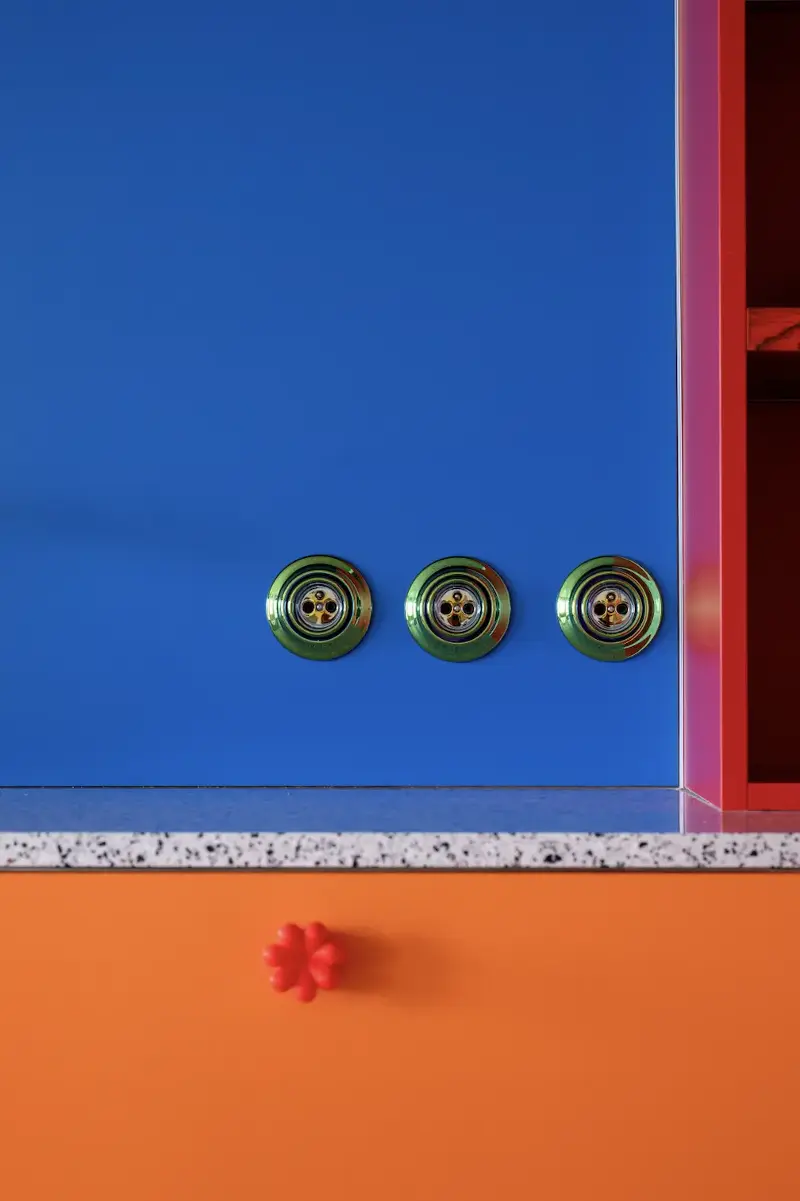
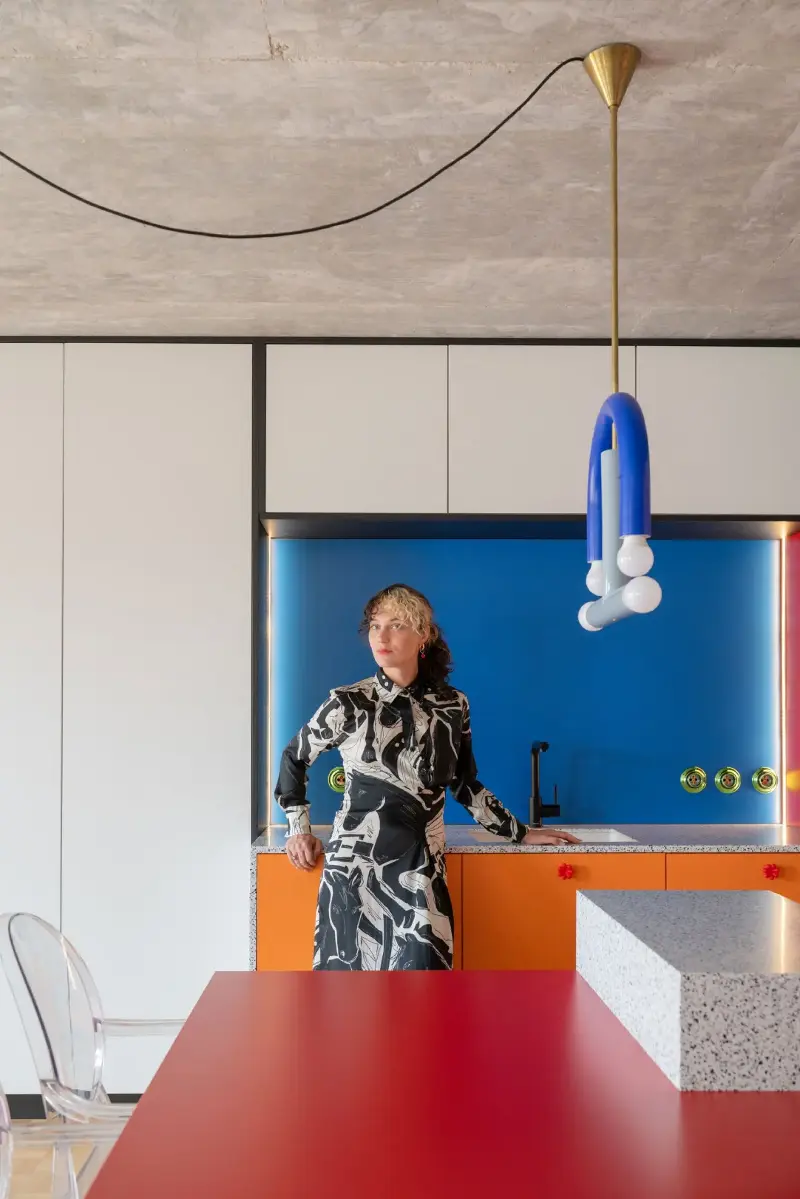
The kitchen is, perhaps, the loudest answer to the brief: cobalt-blue lacquer runs behind the counter, burned-orange cabinetry sits below it, a blush-pink row of units catches the light from a wardrobe-mirrored door. Everywhere you look, there is color — apart from on the walls, which are quite deliberately white, allowing each item of furniture and statement fitting to hold your attention.
And that they certainly do. "You see one detail, before you turn your head and suddenly spot something else," Célia explains.
Indeed, it's difficult to know exactly where to focus — on the centered, tubular pendant, metallic green socket covers, or the scarlet, flower-shaped handles dotted across the cabinetry. Two transparent Ghost chairs, designed by Philippe Starck for Kartell, are the only exception: allowed to disappear from view.
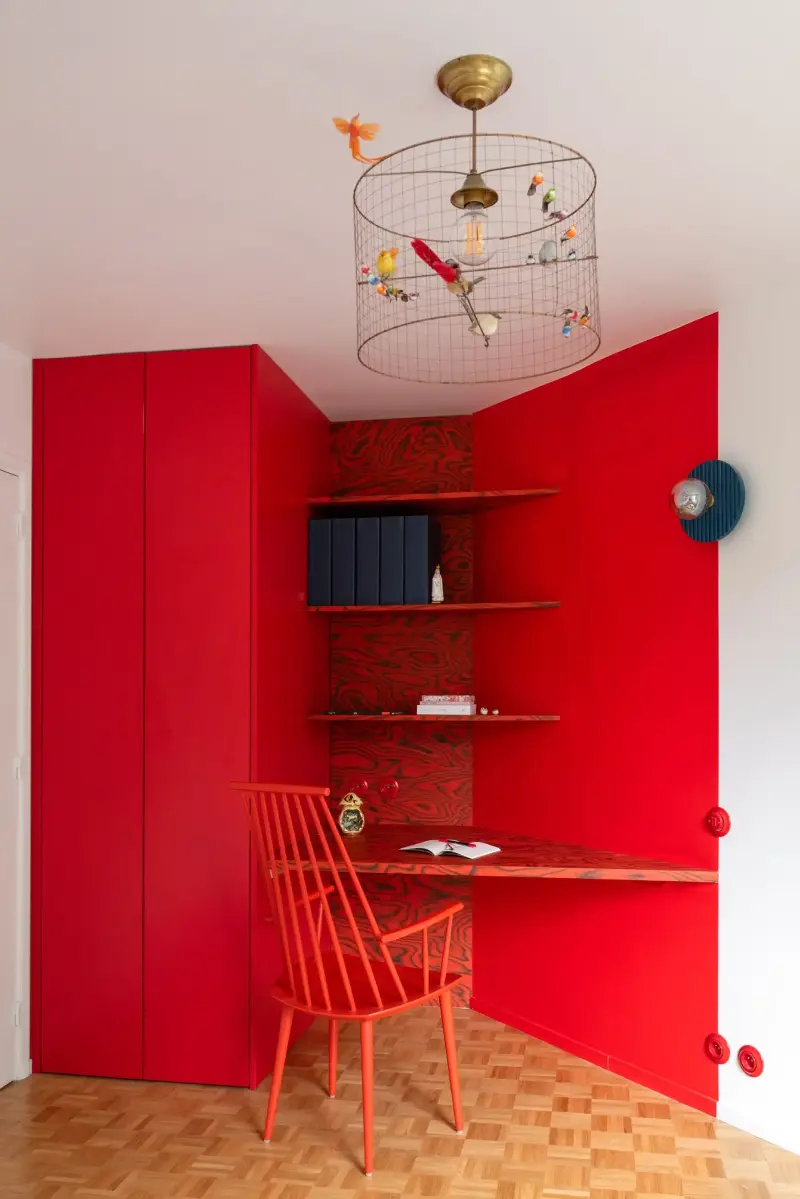
Where the kitchen scatters its colors across a canvas, the study commits to just one. Walls, cabinetry, even the desk itself, are lacquered in the same deep glossy shade of red — an immersive and uncompromising decision in an apartment that otherwise refuses to sit still.
A woodgrain tabletop and shelving have the feel of a deliberate postmodern material reference, while a spindle-back Windsor-style chair, in the same reddish tone, plays the traditionalist against them. But it's the wire pendant, strung with painted birds, that gives the room its centerpiece — and one more surprise.
Already a focal piece in the owner's collection, Célia was honest about her hesitation from the start: "I wasn't a fan at first. I was worried it wouldn't match the style." The light eventually found its way into the office anyway, a rather suitable pairing with the booth beneath it.
"It adds a real pop of color," the designer admits now, "and a twist you might not see coming."
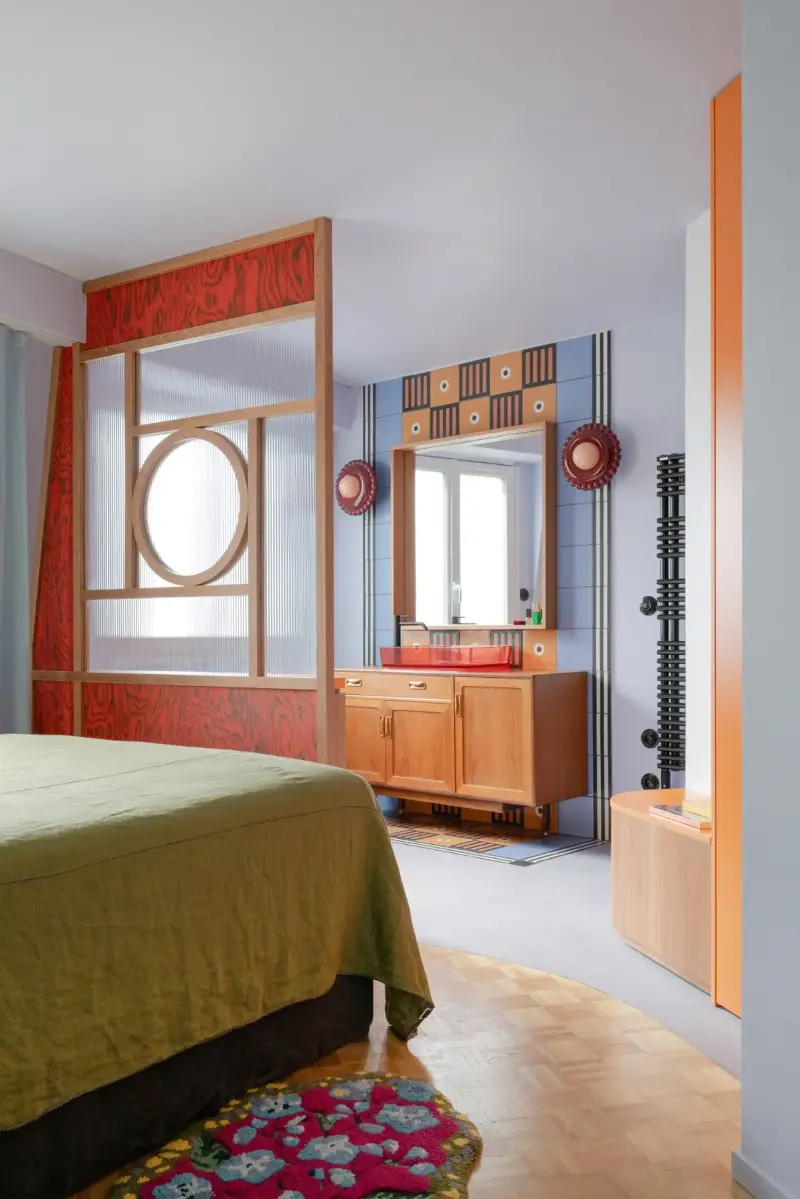
Underfoot, the same herringbone parquet continues into the linchpin — the space an entire apartment has been reorganized around. One continuous suite now holds bedroom and bathroom together, divided only by a partition of red woodgrain with a circular porthole of reeded glass cut into it.
Here, for a moment, the home begins to quieten: an olive-green bedspread, a floral ruffle in soft pink and blue, walls left relatively plain. But step through, and the bathroom beyond picks the noise back up — admittedly in a more muted tone of voice.
A vintage teak sideboard, repurposed as the vanity, holds a molded resin basin, while a checkerboard tile, patterned with circles and stripes, climbs the wall around the mirror. Two scalloped wall sconces flank the sink like a pair of theater lights.
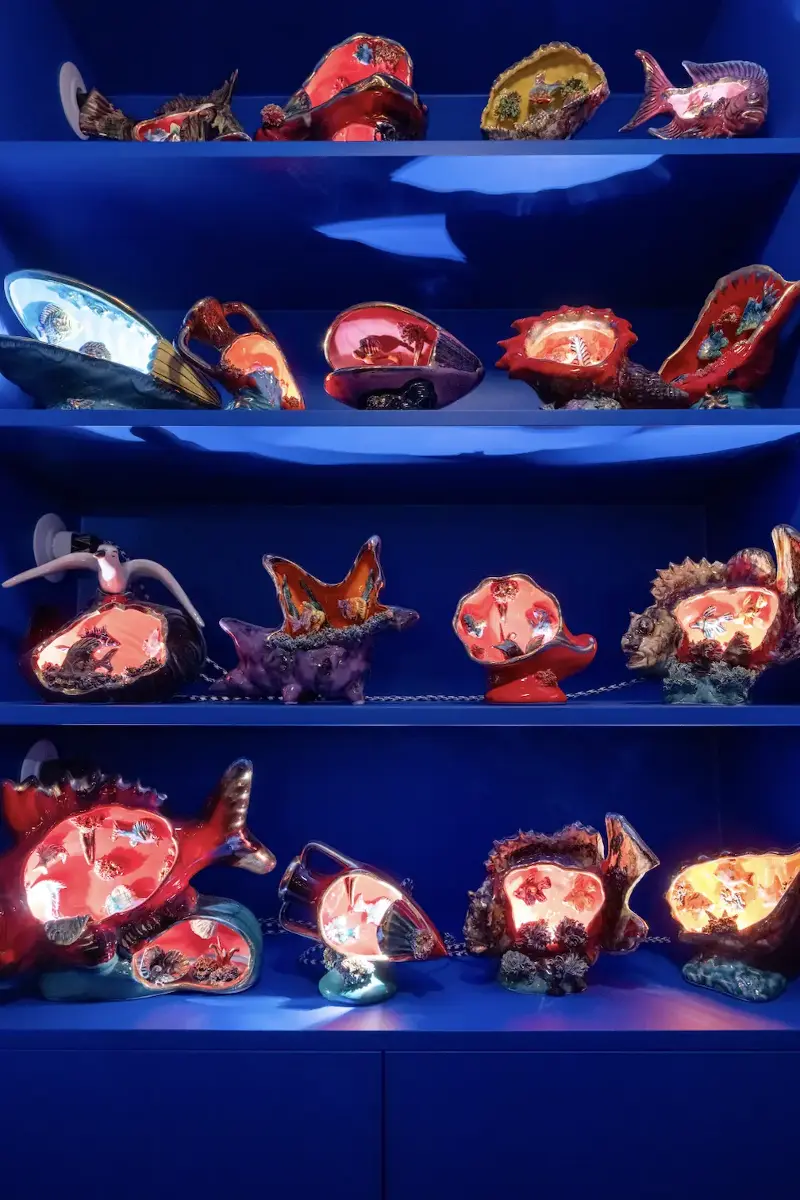
The tucked-away toilet is Célia's favorite room yet, where the smallest space is working the hardest. Blue wraps the walls, floor to ceiling, deep and immersive, almost oceanic. A prominent collection of the owner's shell-shaped lighting features only further that undersea feeling — staged on the shelves like something surfacing from below.

Many of these creative moves find their footing with relative ease in Paris, but would raise eyebrows back in the designer's home city, Lyon. Tastes often veer "quite bourgeois, old-style," she explains — although Célia senses that's beginning to change.
She's one of the few designers on the scene pushing boundaries, from street to salon; three years ago she opened a concept store beneath her studio, selling a characterful and curated selection of interior accessories. The local response has been better than she expected, and Célia is encouraging boldness, rug by rug, tile by tile.
"I can see that people are interested in different pieces, colorful pieces," she says. "Often it's about starting small — with objects and decorative accents — before eventually being tempted into architecture and full-scale renovation."
Two more apartments in Paris are already underway, alongside new work back in Lyon. A hotel, too, is on the cards — though for now it remains just that. "It's my dream project," Célia says. "Thinking about every room, the public spaces, the whole artistic direction. That would be the dream."
But all of it can wait. Like the unhurried streets that shelter this apartment from the churn of the city, this designer isn't in a rush.
Revisit more stories like this in our modern homes archives, or take its playfully iconic atmosphere home with you with this curated selection of interior design buys.
For more Parisian joie de vivre, dig into our edit of the most beautiful restaurants in the French capital, or mark these local coffee shops in your diaries for when you are next in town