



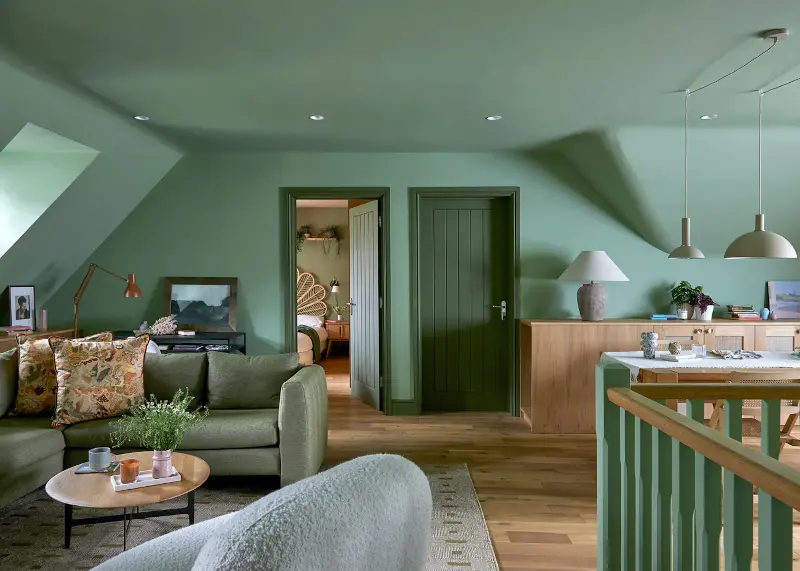
With exposed beams, sloping ceilings, and awkward proportions, loft conversions don't exactly naturally lend themselves towards a comfy, cozy setting. But, with the right design, there's no reason this attic room can't be the most inviting spot in the home.
While there will be specific structural elements you'll have to work around with every room, these features may feel extra prominent up in your loft. And with all the sharp lines and harsh features that arise in loft conversions, making the space feel relaxing and cozy is all the more difficult. Because of the unique nature of these spaces, the rules are a little bit different, and what the experts would suggest for a cozy ground-floor living room may not be the same as what they'd recommend you do in your loft.
So, to take out the guesswork, I reached out to our experts and asked them exactly what they'd do to make a modern loft conversion feel as cozy as possible, and their answers have me feeling relaxed just thinking about them.
1. Soften Your Space
The biggest obstacle to achieving maximum coziness is the sharp angularity so often present in many types of loft conversions. When we think of coziness, we think of softness. So, finding ways to bring this softness into your space and counteracting any existing harshness is always a good place to start.
You'll want to begin by identifying the most dominant angular forms in your space and finding ways to work against them in your design. For example, John Law, from Woodhouse & Law, suggests, "The sharp lines of sloped ceilings can be balanced with tactile elements such as rugs underfoot, draped curtains, and generously upholstered furniture to introduce a sense of softness."
Thick, rich materials with plenty of texture and movement can instantly bring depth and complexity to a space, which is particularly important in modern extensions and loft conversions. Search for plush rugs and carpets in rich, inviting tones, and window treatments that bring movement and warmth. These elements offer a foundation of warmth that will immediately soften your space.
Your furniture, too, can help mitigate any lingering harshness in the room. John recommends seeking out "softer, more organic forms" for a more welcoming effect. In a living room, a curved sofa can do this with ease, or, for loft bedrooms, John says, "Curved or arched headboards that run the full width of the wall can help the space feel warmer, as well as using radius corners on joinery to soften the look and avoid harsh angles."
This combination of soft, organic forms and warm, rich materials is a surefire way to ensure instant coziness in even the most modern conversion project.
2. Layer Your Lighting
There is no design tool more powerful than a good lighting scheme. Once you understand the effect lighting has on a room, the entire process of curating a space changes. And the first rule any designer will tell you when it comes to curating your lighting is that layering is key. Gone are the days of a one-and-done approach; nowadays, it's all about building complexity through soft, intentional layers.
For John, this comes before all else. "We always start with lighting, layering warm, ambient sources instead of relying on a single overhead fixture, so the room feels inviting," he tells me.
Overhead lighting may seem like a safe bet, but in actuality, this is the main culprit making your room feel unwelcoming. It's unflattering, harsh, and does nothing for the atmosphere of your space.
A layered lighting scheme, on the other hand, will feel instantly cozier, providing that depth and warmth a loft conversion desperately needs.
To achieve this, Chris Murphy, staging and design specialist at Waterfront Homes, says, "Instead of a single ceiling light that makes the loft feel flat and cold, use layers. Wall lights near the bed, a floor lamp in a reading corner, and warm LED strips under shelves or inside alcoves." This combination of practical, task lighting, and soft, atmospheric lighting is the key to a space that is both functional and beautiful.
3. Don't Be Scared of Going Dark
When you think of a loft conversion, the first image to enter your mind is likely that of a sleek, bright, industrial-style space, all glass surfaces and white finishes. But, interior designer Uriel Tannen argues, "I find that, counterintuitively, the cosiest loft conversions are the ones that resist the white-and-skylight cliché."
By nature of their construction, loft conversions are typically rich with natural light, something that is then often exaggerated through the design. However, as Uriel says, "Natural light is abundant up there, so you can afford to go darker and warmer than you'd dare on a lower floor without the room feeling oppressive."
Without the fear of your space feeling cramped or dingy, you can have full freedom to explore dark, rich color palettes, so you may as well lean into this. This could look like a full color-drenching moment, or just some more subtle pops.
So, step away from that beige color scheme, and "go darker and warmer," encourages Uriel.
4. Power of Zoning
The problem with loft conversions, and open plan designs more generally, is that without any clear boundaries, the entire room can end up suffering from a lack of definition.
We need some sense of separation in our spaces to feel truly comfortable in them. When this isn't present, you can easily feel overly exposed, even just in your own bedroom.
Interior designer, Vicky Hardwick, says, "I believe the best way to make a loft conversion feel cozy is to make it appear lived-in, rather than newly built. I do this by zoning the space into sections with different purposes and then adding character and interest."
Introducing zones into your space helps to create the illusion of homeliness, working against that slick modernity you so often find in modern constructions. This doesn't just fulfill a visual function, either; it can also help you get more out of your available space. Your 'zones' of choice will be reflective of the overall intention you have for this space. For example, John suggests "a reading corner, or a sleeping nook," though, for some, a small home office setup may feel more practical, or even a dedicated home gym area.
5. Let The Architecture Lead
Instead of desperately trying to work against the natural design of your loft conversion, why not take the opposite approach and lean into it instead?
As architect and designer Kristine Sulca -Rust argues, "A loft only becomes a real room when you stop treating it as leftover space and let the architecture lead."
So often, we treat our home extensions as nothing more than an add-on, using them to fill the gaps left by the main structure. But when you adjust your approach and let the room take the lead, the resulting design can feel far more considered and appealing.
"The light, the slopes, and the head height need to be designed alongside how the room should feel and function," says Kristine, "When architecture and interior design are developed together, every detail becomes intentional, and coziness is the natural result."
This all starts with a clear vision for how this room will be used. Build up an outline of the room's key functions and the atmosphere you want to create within it. This, Kristine explains, will be the "backbone of the design."
From there, Kristine says, "Plan the big moves early – the bed, the circulation, the light – and tuck the practical storage into the eaves. Once those decisions are set, the structure starts to support the way you want to live. That’s when the loft stops being an overflow space that is difficult to furnish and becomes somewhere you actually spend time: a place to think, unwind, or simply breathe. When the architecture is doing the heavy lifting, lofts often become the most cherished rooms in the house."
While these tips will be helpful no matter the setting, if you want some more specific advice, these cozy bedroom ideas will come in handy if you're planning on turning your loft into a spare room, or even a roomy master, or, if you're designing a loft living room, these cozy living room ideas are exactly what you need.