



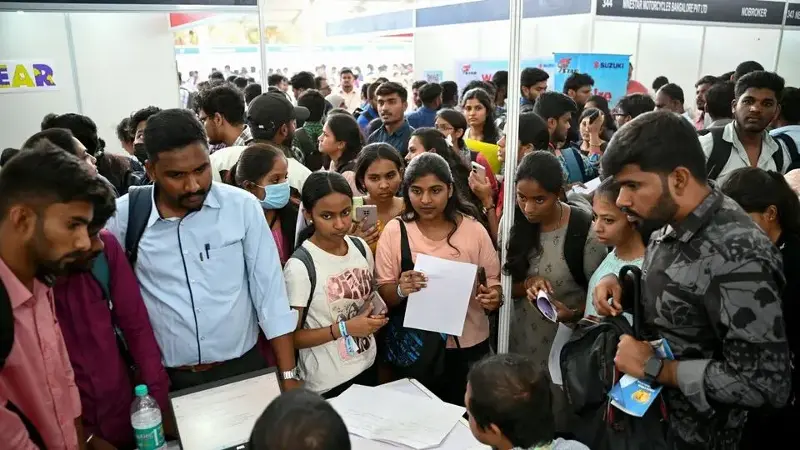
India’s unemployment rate for those aged 15 years and above remained stable at 4.8% in December, rising marginally from 4.7% in the previous month owing to almost static joblessness in rural areas.
The unemployment rate in rural areas remained stagnant at 3.9% in December, with joblessness unchanged among both rural men and women, according to the latest periodic labour force survey monthly bulletin released by the statistics ministry on Thursday.
While rural unemployment remained static during December, urban unemployment rate edged up slightly to 6.7% from 6.5% in November, underscoring the persistent strain on these labour markets, the survey showed.
According to the survey, the unemployment rate remained low and stable at 4.1% in December 2025 for rural males aged 15 years and above, but rose from 5.6% in November to 5.9% in December for urban males.
The urban female unemployment rate moderated to 9.1% in December from 9.3% in November, while the rural female unemployment rate increased to 3.6% in December from 3.4% in November. The unemployment rate in the remaining gender sector increased slightly, though it remained below where it was during the middle of the year, the survey noted.
Labour force participation rate
According to the survey, the overall labour force participation rate (LFPR) for people aged 15 years and above trended upward, coming in at 56.1% in December compared to 55.8% in November. In rural areas, the LFPR was estimated at 59% in December, up from 58.6% in November. The urban LFPR experienced a slight dip to 50.2% from 50.4% over this period, the survey noted.
The LFPR is the percentage of the country's working-age population (aged 15 and above) that is either employed or actively looking for work. It's a key economic indicator that shows how many adults are engaged in the economy, excluding full-time students, retirees, or caregivers not seeking jobs, and helps assess labour market health beyond just unemployment figures.
In December, the survey noted, overall labour force participation for females aged 15 years and above edged up to 35.3% from 35.1% in November, the highest yearly figures. In rural areas it increased to 40.1% during December from 39.7% in the previous month, and in urban areas it slipped slightly to 25.3% in December from 25.5% in November.
Rishi Shah, partner and economic advisory services leader, Grant Thornton Bharat, said, “Recent labour market data suggests a gradual normalisation rather than any softening. Participation and employment indicators are improving, indicating better labour absorption, but the pace remains measured. Given the short data history and inherent volatility in high-frequency labour metrics, it is too early to infer structural strength. A durable assessment will require confirmation from longer-term trends and improvements in job quality and productivity.”
Worker population ratio
The survey noted that the worker population ratio (WPR) for those aged 15 and above showed a gradual improvement in December.
WPR edged up to 76.0% from 75.4% in November among rural males, and fell to 70.4% in December from 70.9% in November among urban males, taking the overall male WPR to 74.1%.
Rural female WPR rose marginally from 38.4% to 38.6% over this period, while urban female WPR was around 23.0%, leading to an overall female WPR of 33.6% in December from 33.4% in November.
The overall WPR remained steady, rising marginally to 53.4% in December from 53.2% in November, the survey showed.
WPR is the percentage of a country's total population that is employed, calculated by dividing the total number of workers by the total population and multiplying by 100. It indicates how effectively human resources are utilized in productive economic activities, with a higher ratio suggesting greater engagement.
The PLFS for December was based on information collected from 3,73,990 people across India, including 2,13,216 in rural areas and 1,60,774 in urban areas.