



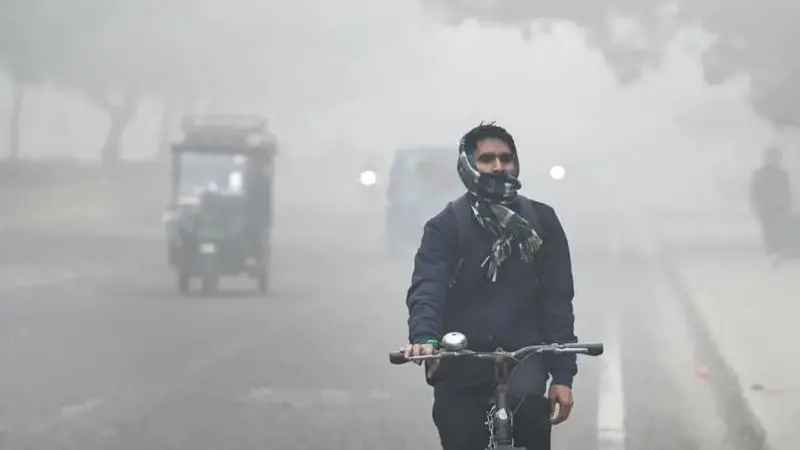
Delhi woke to marginally cleaner air on Tuesday, but the improvement has done little to ease a growing public health dilemma: does exercising outdoors still make sense when pollution levels remain dangerously high? New international research suggests the answer is nuanced — exercise still helps, but toxic air can blunt its benefits.
On Tuesday morning (16 December), Delhi’s air quality index (AQI) stood at 377, an improvement from 498 a day earlier, according to official data. Despite the drop, air quality remained firmly in the “very poor” category, with thick smog reducing visibility as temperatures dipped to 8.3°C. Several parts of the city continued to record “severe” pollution levels.
With many residents heading to parks such as Lodhi Gardens for morning walks or jogs, the question has become increasingly urgent: is outdoor exercise helping or harming health in such conditions?
How bad is Delhi’s air right now?
Data from the Central Pollution Control Board (CPCB) showed that by 9 am, air quality across the capital was still classified as very poor. Over the previous two days, AQI levels crossed 400 at multiple locations — a range considered severe.
Out of 40 monitoring stations on Tuesday, 11 reported severe air quality. Areas including Jahangirpuri, Mundka and Wazirpur recorded AQI readings of 426, among the highest in the city, according to the CPCB’s Sameer app.
Does polluted air cancel out the benefits of exercise?
A new study published in the medical journal BMC Medicine suggests that while exercise remains beneficial, its protective effects are significantly weakened by long-term exposure to polluted air.
The research, conducted by an international team including scientists from University College London (UCL), analysed data from more than 1.5 million adults across the UK, Taiwan, China, Denmark and the United States, tracked over more than a decade.
The researchers found that regular physical activity continued to reduce the risk of death from all causes, including cancer and heart disease. However, for people living in areas with high air pollution, these benefits were noticeably reduced.
What role does PM2.5 pollution play?
The study focused on fine particulate matter known as PM2.5, tiny particles less than 2.5 micrometres in diameter that can lodge deep in the lungs and enter the bloodstream.
Health benefits from exercise weakened significantly when annual average PM2.5 levels reached 25 micrograms per cubic metre (μg/m³) or higher — a threshold exceeded by nearly 46% of the world’s population.
At even higher pollution levels, above 35 μg/m³, the benefits declined further, particularly in relation to cancer mortality. Around 36% of the global population lives in areas exceeding this higher threshold.
What exactly did the study find?
Pooling data from seven studies, the researchers found that people who completed at least two and a half hours of moderate or vigorous exercise per week had a 30% lower risk of dying during the study period compared with inactive individuals.
However, among those living in highly polluted areas, this reduction in risk fell to 12–15%. At very high pollution levels, the protective effect of exercise against cancer-related deaths was no longer statistically robust.
Should people stop exercising outdoors amid worsening AQI?
Experts are clear that people should not abandon physical activity altogether.
Lead author Professor Po-Wen Ku of National Chung Hsing University in Taiwan said:
“Our findings emphasise that exercise remains beneficial even in polluted environments. However, improving air quality can greatly enhance these health gains.”
Similarly, Professor Andrew Steptoe from UCL’s Department of Behavioural Science & Health warned that pollution undermines — but does not erase — the benefits of exercise:
“Our study shows that toxic air can to some extent block the benefits of exercise, although not eliminate them. The findings are further evidence of the damage that fine particle pollution can do to our health.
“We believe clean air and physical activity are both important for healthy ageing and so we encourage greater efforts to curb health-harming pollution levels.”
What practical steps can exercisers take?
Researchers advise moderation rather than avoidance. Professor Paola Zaninotto, from UCL’s Department of Epidemiology & Public Health, said:
“We don’t want to discourage people from exercising outdoors. Checking air quality, choosing cleaner routes, or easing off intensity on polluted days can help you get the most health benefits from your exercise.”
For cities like Delhi, where PM2.5 levels routinely exceed the thresholds identified in the study, experts suggest exercising during periods of relatively lower pollution, opting for less trafficked areas, or shifting to indoor workouts on the worst days.
Are there limits to the findings?
The authors acknowledged several limitations. Most of the data came from high-income countries, meaning the results may not fully apply to regions with even higher pollution levels, where PM2.5 concentrations often exceed 50 μg/m³. The study also lacked detailed information on indoor air quality and participants’ diets.
Nevertheless, researchers accounted for a wide range of variables, including income, education, smoking habits and existing chronic illnesses.
What does this mean for Delhi residents?
For now, experts say exercise is still worthwhile — but Delhi’s persistent pollution is eroding its full health potential. As the city grapples with recurring smog episodes, the study adds weight to calls for urgent policy action, making clear that clean air is not just an environmental issue, but a prerequisite for healthy living.