



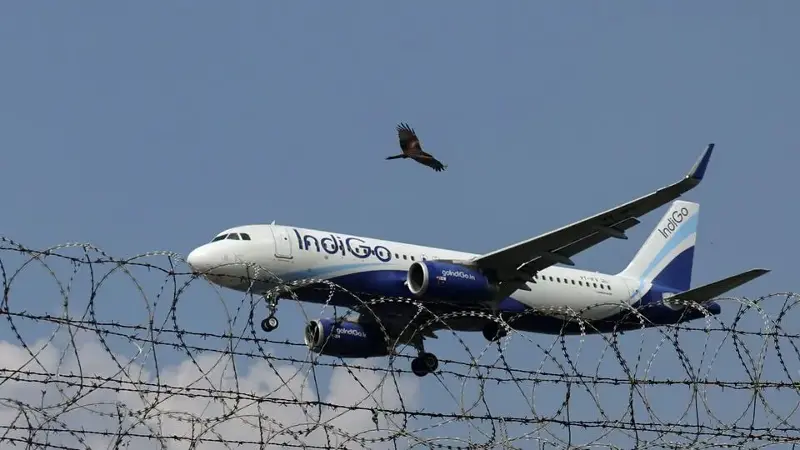
IndiGo has admitted to the aviation regulator that it “misjudged” the operational impact of India’s new flight duty time limitations (FDTL) norms, after close to 200 of its flights were cancelled per day over the past few days due to acute pilot and crew shortages, among other factors.
According to a statement issued by the Directorate General of Civil Aviation (DGCA) on Thursday, the airline has told the regulator that planning gaps contributed to its ongoing disruptions, and it has committed to implementing corrective measures, with full operational stabilisation targeted by 10 February 2026.
Till that date, India’s largest airline has also sought exemptions from specific provisions of the FDTL norms, which are aimed at overhauling duty schedules, night-landing plans and weekly rest charts.
In the meantime, IndiGo will also reduce its number of daily flights starting 8 December to minimise disruption. The DGCA said the carrier has averaged 170-200 cancellations per day since late November, well above normal levels.
The development follows unruly, chaotic scenes at airports nationwide on Thursday, as IndiGo struggled to manage irate travellers across airports. Protests broke out across terminals and fistfights were reported in Kolkata, prompting CISF intervention in Bengaluru and Mumbai.
The turbulence follows weeks of mounting disruption. Since 1 November, after the second phase of the new FDTL norms went live, IndiGo has cancelled more than 1,550 flights, including 1,232 in November; 755 of these were caused due to crew shortage from the revised crew rostering rule.
The cancellations and delays have severely dented its on-time performance (OTP). India’s most punctual airline, with an OTP of more than 87% until the end of October, saw that metric plunge to 67.7% in November, 35% on Tuesday (2 December) and 19.7% on Wednesday, according to the ministry of civil aviation. This implies that one in five flights of the carrier reached their destination on time.
OTP measures the percentage of flights that depart or arrive within 15 minutes of their scheduled time.
IndiGo did not comment on Mint’s questionnaire.
The airline’s shares ended 2.8% down to close at ₹5,437.6 on Thursday, even as the BSE Sensex ended marginally 0.2% higher.
Tough times
For now, IndiGo is battling to get its operations back in order, as its chief executive asked employees to work together to help the airline overcome what is probably its biggest operational challenge.
“We have faced tough moments before, but we turned challenges into triumphs, proving our resilience, strength and unity,” IndiGo chief executive officer (CEO) Pieter Elbers said in a message to employees on Thursday. “This moment will be no different… This is the time for all of us to come together, prove our mettle once again and showcase what IndiGo truly stands for.”
IndiGo has attributed its operational meltdown to a variety of factors, including the newly imposed FTDL norms, minor tech glitches, and weather conditions. The new crew roster scheduling norms were seen as the key reason that the airlines took a hit in operations.
According to the company’s FY25 annual report, its roster of pilots totalled 5,456, the most of any airline in India.
Adding more pilots would entail additional costs, as the airline’s chief financial officer, Gaurav Negi, said in a post-earnings call on 4 November. “There will be some incremental cost” related to implementing new crew roster scheduling norms, he had said.
An analyst said, requesting anonymity, that the impact of such cancellations on the company's quarterly performance will depend on how long the disruptions last. “Generally, cancellations have a 6-7% impact on the topline if they persist for the full quarter,” this analyst said.
According to Mark D. Martin, chief executive of Martin Consulting, airlines need to revise their “lean manpower strategy” to comply with the FDTL norms. “There will be an impact on costs, which will go up. The exact amount is yet to be worked out.”