



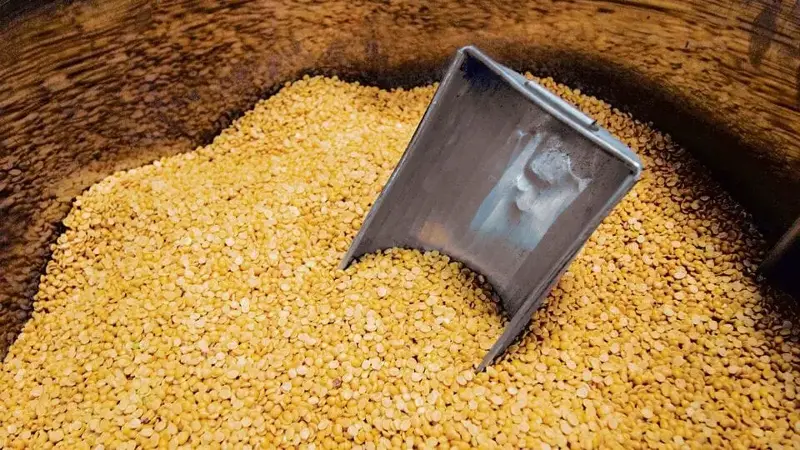
NEW DELHI: The Centre plans to buy 1 million tonnes of chana (gram) to build adequate buffer stocks to manage potential supply shortfalls and ensure steady availability in the open market, two officials said.
The purchases through the Price Stabilisation Fund are part of graded measures to keep prices of essential food grains stable and prevent market volatility amid forecasts of a below-normal monsoon this year and the possibility of El Niño, a weather phenomenon that increases the risk of drought and reduced crop yields.
“The procurement drive will be carried out under existing price support mechanisms, with agencies stepping in to buy from farmers both to support farm-gate prices and to maintain retail price stability,” one official said.
India’s chana production climbed 6.2% to 11.8 million tonnes in FY26, with the yield up 1.6% to 1,238 kg per hectare.
“Chana production has improved significantly this crop year compared to last year, largely due to the import duty on chana and yellow peas. This has supported domestic prices and encouraged higher sowing. We are also working towards building a comfortable buffer stock to ensure price stability in the coming months,” the official said.
However, irregular rainfall may reduce chana output, which could push up prices and add to food inflation pressures.
“It is good that the government has started taking a graded response. Pulses and oilseeds, which are largely rain-fed crops, remain vulnerable to erratic rainfall,” said K.J. Ramesh, former director general of the India Meteorological Department.
The country’s former chief weatherman suggested that the government should ensure adequate availability of edible oils and cereals, as a below-normal monsoon could impact the production of these key commodities in the essential basket.
Buffer stock management
“Building buffer stocks now and releasing them on time will help keep prices stable through the year,” said Rakesh Arrawatia, professor at the Institute of Rural Management Anand and dean of the School of Cooperative Banking and Finance.
Queries sent to the ministry of consumer affairs remained unanswered till press time.
The price of chana dal was ₹83.37 per kg as of 19 April, about 4.7% lower than ₹87.47 per kg a year ago, according to data from the consumer affairs ministry.
“Chana is a key raw material for the FMCG industry and better availability along with stable prices provides visibility on costs,” an executive of a leading FMCG company said, asking not to be identified. “This helps companies avoid frequent price revisions, manage costs more efficiently and keep product pricing steady while focusing on volume growth.”
Pulses carry a weight of about 2.5% in the Consumer Price Index, so any sustained increase in chana prices directly adds to food inflation.
India’s pulses consumption is 26 million to 28 million tonnes annually, with chana accounting for the largest share, Niti Aayog said in a report released in September 2025.
The major chana-producing states in India are concentrated in the central and western regions, where rabi conditions suit the crop. Madhya Pradesh is the largest producer, followed by Maharashtra, Rajasthan, Uttar Pradesh and Karnataka. Other notable producing states include Andhra Pradesh, Gujarat, Chhattisgarh, Telangana and Bihar.
India also imports chana. The country’s chana imports rose sharply to $1.11 billion in FY25 from $111.71 million in FY24. The import data for FY26 is not yet available.