



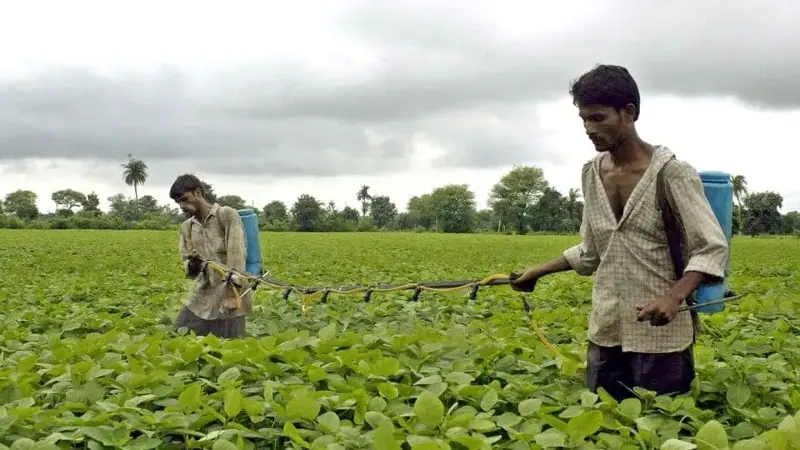
New Delhi: Buoyed by higher exports, India’s agrochemical industry is set to consolidate its revenues with a likely 6-7% growth this fiscal year, Crisil Ratings said in report on Monday. A revival in global demand and the gradual clearing of excess stocks across key markets have perked up exports in the sector, the report said. After a 3% decline in FY24, revenues were up 5-6% in FY25, as per Crisil.
Domestic sales, however, remain subdued due to a prolonged monsoon that weighed on kharif season offtake, delayed field readiness for the next crop and also led to product returns, the report said.
India's agrochemical market is dominated by insecticides (41% share in FY24), followed by herbicides (22%), fungicides (21%), plant growth regulators (6%), biostimulants (8%) and seed treatment products (2%), as per a September report of the Agro-Chemicals Federation of India (Acfi) and Deloitte.
The industry’s return to its long-term growth range of 8-10% next fiscal year will depend on whether exports sustain the current momentum and domestic demand strengthens from this year’s weak base, Crisil said.
Export data shows a clear turnaround. After rising to $5.37 billion in FY23, agrochemical exports fell sharply to $4.19 billion in FY24 amid global destocking and lower price realizations. They recovered marginally to $4.27 billion in FY25 as demand improved in Latin America, North America and Europe. In the first half of FY26, exports have already touched $2.09 billion.
Crisil’s assessment is based on a study of about 60 companies that together account for nearly 90% of the sector’s annual revenue of around ₹90,000 crore. Domestic and export markets continue to contribute almost equally to the topline.
India's key agrochemical manufacturers include UPL, PI Industries, Rallis India, Sumitomo Chemical India, Coromandel International and Sharda Cropchem, which together account for a significant share of India’s manufacturing and export base. As per the commerce ministry-led India Brand Equity Foundation, the domestic agrochemical market was valued at about $ 7.82 billion in FY24.
Global demand is firming up because buyers are finally moving past the inventory glut that had stalled purchases for nearly two years, said Kalyan Goswami, director general of the Agro Chem Federation of India (Acfi). “Distributors in Latin America and Europe have started replenishing stocks as consumption has normalized and prices have stabilized," Goswami said. "The stronger farm outlook in several key markets is also supporting fresh orders. These factors together are lifting export demand after a long period of correction.”
The industry's operating margins are expected to hold steady this fiscal year and the next, supported by stable raw material prices, steady realizations and only a limited impact from the US tariff hikes, Crisil's report said. With modest capital spending and more predictable working capital cycles, companies are likely to keep debt under control after a few years of pressure on their balance sheets, it said.
The export turnaround follows two volatile years marked by supply chain disruptions and inventory corrections. Over 65% of India’s agrochemical exports are headed to Latin America, North America and Europe. The demand in Latin America has improved modestly, Europe is stabilizing as the inventory levels fall back to the normal levels, and the US market has remained steady with 80–85% of Indian shipments exempt from the latest tariff hikes, it said.
India has retained its position as a key supplier to the US, which sources nearly 70% of its agrochemical imports from China and India combined.
“Improved farm sentiment globally will drive up export revenue by 8-9% this fiscal. Domestic demand will continue to feel the impact of excess rainfall, which damaged crops and disrupted the sales cycle. With realizations stabilizing after two years of sharp cuts, the 6–7% industry growth this year will be driven more by volumes than prices,” said Anuj Sethi, senior director at Crisil Ratings.
Prices in the domestic market have also steadied as China’s excess inventories have tapered. The sector's realizations from Chinese imports of inputs are hovering around $5 per kg on an average, in line with last year. With environmental enforcement in China maintaining steady supply and inventories now balanced, Crisil expects prices in sector to remain stable through the year.
“Operating margins are expected to remain at 12.5–13% (in FY26), still below the pre-pandemic peak of around 15%. The stability follows the sharp correction in fiscal 2024 and is supported by better operating leverage, softer input costs and tighter cost controls. Annual investments of around ₹5,500 crore in import substitution, new registrations and debottlenecking will continue, while steady cash accruals and disciplined working capital will keep borrowing needs low,” said Poonam Upadhyay, director at Crisil Ratings.
For the companies tracked, debt-to-Ebitda is likely to improve to around 1.3 times and interest coverage to about seven times this fiscal year and the next, compared with 1.5 times and six times last year, the report said.
The Acfi-Deloitte report highlighted the need for policy support to sustain this growth momentum. ACFI has urged the government to introduce a production-linked incentive (PLI) scheme and tax holidays for the sector, noting that these measures could reduce their dependence on imports of key molecules and help develop large-scale manufacturing hubs.
It also emphasized the importance of greater public-private cooperation in research and development, along with stronger support for micro, small and medium enterprises (MSMEs), to enhance India’s global competitiveness.