



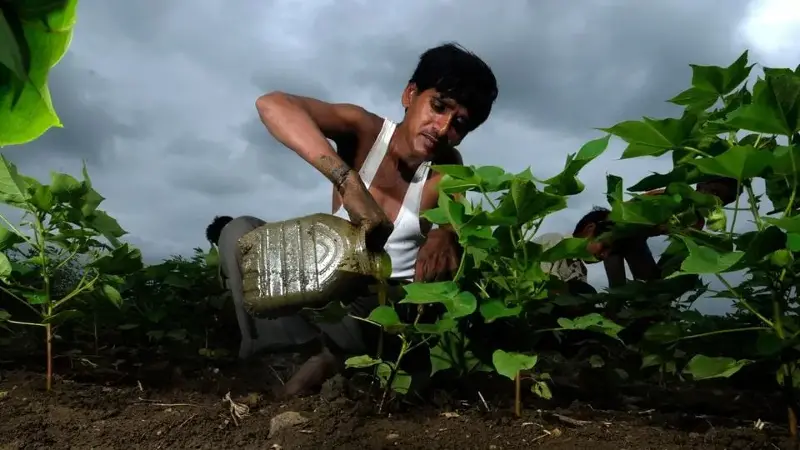
Indian Farmers Fertiliser Cooperative Ltd (IFFCO) Managing Director K J Patel has projected the company's net profit is set to rise by 10% in the financial year ending 2025-26, despite fewer farmers in the country using its flagship nano fertilisers. The MD also said that the cooperative aims to focus more on training farmers to boost adoption.
Patel, who has spent nearly four decades at IFFCO and recently took over from US Awasthi after his 32-year tenure, spoke about a broad, people-focused strategy built around the cooperative's “crown jewel” — its deep-rooted bond with 36,000 cooperatives and more than five crore farmers across the country.
“Our motto is to make sure that fertilisers are manufactured and they are also delivered to farmers with enough explanation how to use them, when to use them,” Patel said in an interview with PTI.
What are nano fertilisers?
Nano fertiliser, which was launched four years back, is promoted as an eco-friendly alternative to conventional chemical fertilisers. It remains IFFCO's most exciting innovation and also its toughest challenge.
In FY24, the product's sales stood at 3.64 crore bottles against production of 4.56 crore bottles. In contrast, conventional nitrogenous and complex fertilisers recorded sales of 1.13 crore tonnes against production of 0.93 crore tonnes.
Patel openly acknowledged that he is unhappy with the mere 15% capacity utilisation at IFFCO, which has the ability to produce 29 crore bottles annually. He attributed this under-utilisation effect to the low awareness of nano fertiliser among farmers and application challenges such as the need for foliar spraying.
Does nano fertiliser really help farmers?
Trials conducted by the Indian Council of Agricultural Research (ICAR), state universities and farmers have delivered mixed results, with uneven yields and concerns over possible impacts on soil and the food chain.
Critics argue that nano fertilisers may be doing more to ease IFFCO's subsidy burden than to deliver clear benefits to farmers. Rejecting this criticism, Patel said the ₹2.5 lakh crore subsidy largely covers imported raw materials like natural gas, sulphuric acid and rock phosphate.
“My country is losing” to imports, he said, adding that nano fertilisers are meant to reduce this dependence on imports. On questions around effectiveness, Patel said third-party independent studies are “not of much importance to us.”
However, in a significant step towards transparency, Patel said that IFFCO has contributed ₹4 crore to a ₹70-80 crore, five-year study led by ICAR and supervised by the agriculture ministry to study all nano products.
Labs will be ready in six months for crop-soil-climate trials with public results. “Doodh ka doodh, paani ka paani ho jayega,” Patel told PTI.
What is IFFCO doing to get more sales?
To address the issue of slow adoption among farmers, IFFCO is rolling out more field assistants to train at the village level on correct timing, seed treatments and the use of sprayers.
It is also subsidising drone services through “Drone Didis” — women pilots provided with free drones, batteries and electric autos — and holding weekly marketing reviews to prevent misuse such as mixing nano fertilisers with conventional urea.
Compared to domestic adoption, the prospects appear brighter on the International front with IFFCO building a new plant in Brazil, where response has been “too good,” Patel said, with exports gaining traction.
IFFCO is also upgrading its production facilities to cut energy costs, including the use of AI integration at vintage plants like Phulpur and Kalol to improve efficiency and safety.
In addition, solar power contracts at the Kandla and Kalol units are expected to make these plants largely independent of the grid within a year.
What's next for the cooperative?
Looking ahead, Patel said IFFCO is working on new products for their 2026 launch, including organic fertilisers, cow dung-based inputs and biochar.
Patel said he plans to carry forward three principles laid down by his predecessor Awasthi: a focus on technical innovation, strong team spirit and continued support for nurturing cooperatives.