


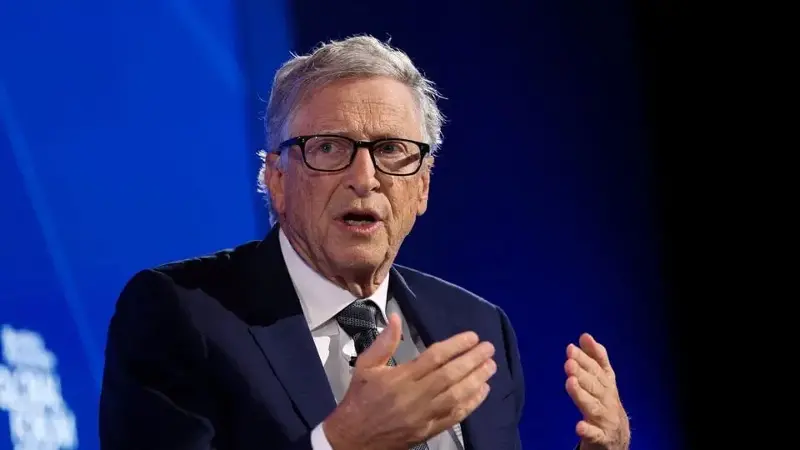
Microsoft co-founder Bill Gates has warned about the potential misuse of AI by bad actors to create bioweapons, along with the threat it poses to the job market. Gates made the remarks in his annual letter for 2026, where he said that he remains an optimist, partly because of the innovations being accelerated by artificial intelligence.
“We are far better off than when I was born 70 years ago. I believe the world will keep improving, but it is harder to see that today than it has been in a long time,” Gates said. “Of all the things humans have ever created, AI will change society the most. It will help solve many of our current problems while also bringing new challenges very different from past innovations.”
The billionaire then went on to note that while timelines for artificial general intelligence (AGI) are being missed, advances in the field of AI will “not plateau before exceeding human levels”.
He then outlined what he sees as the two biggest challenges posed by the technology.
“The two big challenges in the next decade are the use of AI by bad actors and disruption to the job market. Both are real risks that we need to do a better job managing. We will need to be deliberate about how this technology is developed, governed, and deployed,” he added.
Gates cited his 2015 TED talk, where he warned that the world was not ready to handle a pandemic, and said that if the warning had been taken seriously, the amount of human suffering could have been dramatically lower. He then noted that there is now an even greater risk than a pandemic: the possibility of a non-government group using open-source AI tools to design a bioterrorism weapon.
“The second challenge is job market disruption. AI capabilities will allow us to make far more goods and services with less labour. In a mathematical sense, we should be able to allocate these new capabilities in ways that benefit everyone. As AI delivers on its potential, we could reduce the work week or even decide there are some areas we do not want to use AI in.”
“The rate of improvement is already starting to be enough to disrupt job demand in areas like software development. Other areas like warehouse work or phone support are not quite there yet, but once the AIs become more capable, the job disruption will be more immediate,” he added.
Gates on the positives of AI:
Gates also highlighted the positive effects AI could bring, particularly in improving healthcare across countries.
“I believe we can improve healthcare dramatically in all countries by using AI not only to accelerate the development of innovations but also directly in the delivery of healthcare,” he noted.
“We are not quite there yet. Developers still have work to do on reliability and on how we connect the AI to doctors and nurses so they are empowered to check and override the system. But I am optimistic that we will soon begin to scale access globally,” he added.