




I acted like a 27-year-old Hyderabad-based professional struggling with money anxiety. I asked ChatGPT a pointed question: “Am I bad with money, or simply exhausted by overthinking it?”
My ChatGPT Prompt
I'm a 27-year-old salaried professional living in Hyderabad, earning reasonably well. But I have a psychologically unhealthy relationship with money. I constantly oscillate between two exhausting extremes:
- Overspending impulsively and feeling guilty afterwards
- Becoming excessively restrictive and anxious about spending anything
Help me design a guilt-free money system covering rent, social life, travel, food delivery, subscriptions, and family responsibilities. Please cover:
- How much should automatically go toward emergency funds, investments, retirement, insurance, and guilt-free spending
- How to structure bank accounts intelligently
- How to prevent lifestyle inflation while still enjoying life
Also analyse:
- Why people spend emotionally after stressful workdays
- Whether tracking every rupee increases anxiety more than it improves outcomes
- How social media distorts financial expectations
Then build me a realistic anti-budget framework with a salary-day automation strategy and simple rule-based approach.
Finally, challenge my assumptions honestly:
- Am I bad with money, or emotionally exhausted by overthinking it?
- At what point does financial discipline become financial anxiety?
ChatGPT’s Response
ChatGPT thinks I’m “probably not bad with money”.
“You are mentally exhausted by treating every spending decision like a character test. That distinction matters enormously,” it said.
ChatGPT suggested “Anti-Budget” to me.
An anti-budget is not a licence to spend carelessly. It means automating long-term financial priorities first, then covering obligations responsibly. Then, removing obsessive micromanagement entirely afterwards.
The system says: if future-you is already protected, present-you does not need constant guilt. Psychologically, this changes everything. Traditional budgeting focuses on restriction, tracking, and control. Anti-budgeting focuses on automation, systems, and behavioural simplicity. The goal is not perfect optimisation. The goal is sustainability, according to ChatGPT.
“Humans are not spreadsheets. Detailed tracking works briefly because novelty creates temporary discipline,” ChatGPT said.
But, long-term, constant monitoring creates decision fatigue and emotional depletion. It produces financial perfectionism and shame around every small mistake.
Then, one emotionally-difficult week arrives. A stressful workday, loneliness, exhaustion or social pressure trigger everything. Suddenly, Zomato orders spike and shopping increases significantly.
Impulsive spending appears without warning or logic. Not because logic disappeared entirely, but because emotional regulation weakens under pressure.
Money behaviour is heavily emotional, not purely rational.
Emotional Spending
“Your brain is actively seeking recovery after demanding days. After cognitively exhausting workdays, humans naturally seek stimulation, convenience, and reward. That is why online shopping feels soothing, and food delivery feels deserved. Gadgets feel emotionally symbolic in moments of stress,” ChatGPT said.
The purchase itself is often entirely secondary. The emotional relief is the real product being purchased. Understanding this changes how you respond to your own spending patterns.
The anti-budget only works if front-end automation is genuinely strong. Before guilt-free spending begins, essential future systems must already be in place.
“The moment your salary arrives, move money immediately and automatically,” suggests ChatGPT.
“Immediately transfer investments, emergency savings, insurance, and a travel fund. Move all of this out of your primary spending account instantly,” it added.
This creates a powerful psychological separation between future security and present spending.
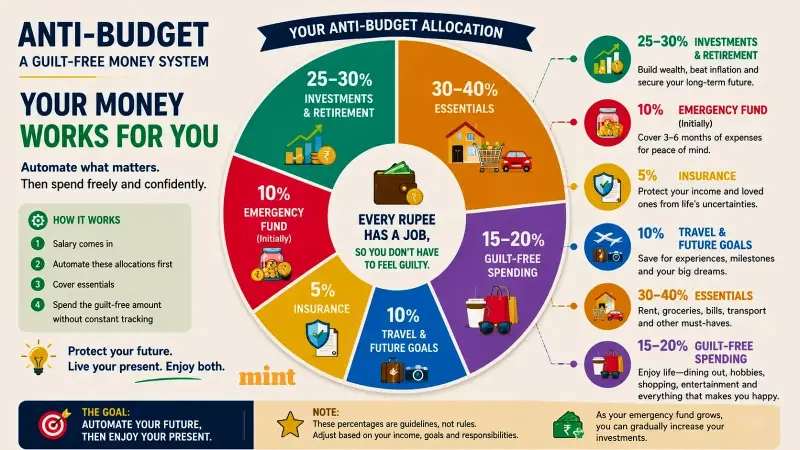
Here is the recommended allocation structure to follow each month:
Investments and retirement should receive 25-30%. The emergency fund receives 10% of the initial amount. Insurance takes approximately 5%.
Travel and future goals receive around 10%. Essentials consume 30-40%. Guilt-free spending gets 15-20% remaining.
“Once your emergency fund stabilises fully, redirect that portion into investments instead,” AI suggests.
Bank Accounts
Separate bank accounts help enormously, not financially, but psychologically. ChatGPT asked me to use four distinct accounts with clear, separate purposes.
The first is the income account. Salary lands here and nowhere else. The second is the wealth account. SIPs, emergency funds, and investments sit here. It asks me to go for automatic transfers only, never manual. The third is the ‘bills’ account. Rent, utilities, subscriptions and insurance come from here.
The fourth account is the guilt-free spending account. This one is absolutely critical. Once money enters this account, there is no guilt, no tracking, no justification required.
That freedom is what prevents binge-rebellion behaviour later. The boundaries are already built into the system itself.
According to AI, guilt-free spending is any spending that does not damage future stability. It stays within predefined limits and does not create debt dependency.
“Yes, this can include dining out, travel, gadgets and hobbies. Experiences, luxury purchases and occasional treats all qualify completely,” ChatGPT said.
“The anti-budget is not anti-enjoyment. It is anti-chaos. Enjoyment is actually the entire point of building the system,” it added.
Lifestyle Inflation
Hyderabad, or any Indian metro city, makes upward lifestyle creep feel very subtle over time, according to ChatGPT. Suddenly, cafes become routine, premium subscriptions become normal, and food delivery becomes the default. Expensive socialising starts feeling entirely expected and unavoidable.
The problem is not spending occasionally on nice things. The problem is converting temporary luxuries into permanent monthly obligations.
That quietly and quickly destroys financial flexibility. The rule is simple: upgrade the lifestyle more slowly than the income actually grows. That single habit massively changes long-term wealth outcomes.
Should I Track Every Rupee?
No. Track major patterns, savings rate, investment consistency, and recurring leakages. Do not track every chai, every Uber, or every emotionally driven snack.
Excessive tracking often creates anxiety without proportional financial improvement. The return on obsessive tracking is simply not worth the psychological cost.
ChatGPT asked me to ask myself one honest set of questions regularly:
- Can I spend moderately without guilt?
- Can I enjoy money occasionally without panic?
- Am I optimising life, or am I simply constantly fearing uncertainty?
If financial planning removes spontaneity, joy, generosity and peace, the system is no longer serving you. You are serving the system instead. That is the wrong arrangement entirely.
Some financially disciplined people are not disciplined at all. They are afraid. There is a meaningful and important difference between the two.
Final Framework
These are ChatGPT’s final suggestions:
Your goal should not be to maximise every single rupee. Your goal should be future security, present stability, psychological calm, and sustainable behaviour.
A good money system should feel boring, automated, and emotionally breathable. Not like permanent self-surveillance. The anti-budget works because it respects human psychology. It stops pretending humans behave like perfectly disciplined machines. Build the system. Then let the system do the work for you.