



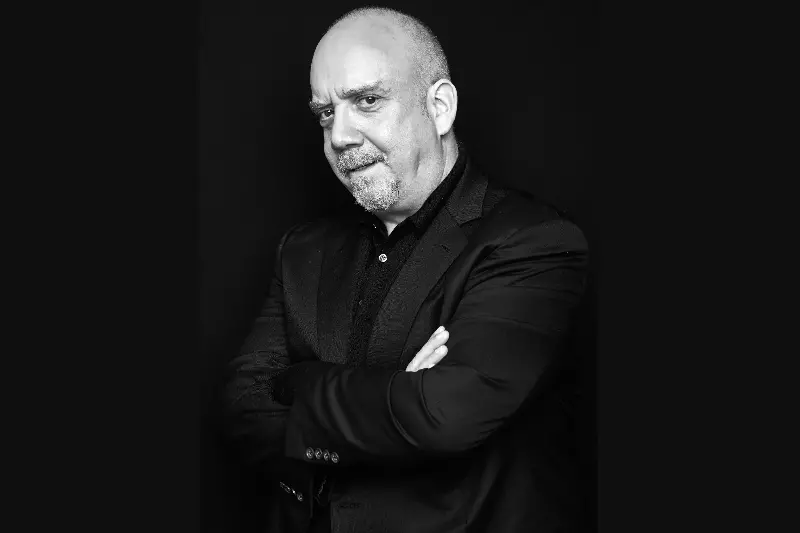
“The joy of seeing yourself suddenly become a monster like that—they collaborated with me in a lot of ways.”
The actor on joining Star Trek, his “dream role” playing a Klingon pirate, reflecting on The Holdovers and the persistent myth that he’s won an Oscar (he hasn’t, but should).
Editor’s Note: This conversation has been edited and condensed for publication.
So first off, I have to say—and I told you this before we started—I have been such a big fan of yours. You’ve done so many amazing things in your career, but to this day, because of you, I cannot say “NBC” any other way than the way you did in Private Parts.
Yeah, that was great! You did it great. That was just me imitating Don Imus.
The impact that you’ve had in so many roles—both small and very large—is wild for an actor at this point in your career. What do fans recognize you from most often? There are so many things!
That’s true, and I never know. It’s always surprising to see. Frequently, I think I know what a person is going to recognize me from, and it’s not necessarily the case. It’s all kinds of things. I get a lot of fans from a kids’ movie I did, Big Fat Liar. I used to get the “WNBC guy” all the time, and the John Adams thing I did on HBO. I did a Christmas movie a couple years ago, The Holdovers. It’s always a different thing.
When I’m watching something like My Best Friend’s Wedding—which was so early in your career…
That was a great little scene. Yeah, that was a nice little scene.
Where were you in your career at that moment? Because I watch that now and I’m like, “You’re Paul f***ing Giamatti! What is happening in this?”
I was acting mostly in theater. I thought I was going to be a theater actor, and that’s what I was doing. I would get these small parts like that, and I was very lucky to get them. I was moving along doing the theater stuff, and I’d get something like that—it was great. I’d go out to Chicago for a couple of days, work for a day, and then fly back. I didn’t even know… I just had that scene! I didn’t know what the movie was about or anything. They just gave me the scene, and I was like, “Okay, I got the job.” So I went out and did it.
What I find so poignant about you—and don’t worry, I have lots of questions about Star Trek—but I have to geek out on you in other ways, too! You have that scene early in your career, and it’s so sweet; there’s so much emotion to it even though it’s such a small moment. Then fast forward—after you’ve gotten an Oscar nomination and done John Adams—you have something like Saving Mr. Banks. I’m watching it thinking, “Why is Paul just doing this small part?” But then I get to the end of the film…
Oh, it’s a great part. I loved playing that part. That movie is really interesting and fun. I’ll also tell you that from My Best Friend’s Wedding until that role, I probably didn’t play any “nice” people. I was a little bit like, “Oh, I get to play a nice guy!” That was thrilling. I don’t play a lot of nice people, so hey, whenever the opportunity is there.
Why do you think that is?
I don’t know. I think it’s just that somebody sees you be a son of a b****, and then that’s what they want you to do over and over again. I remember there was a whole conversation where I had to meet the director, and he had to ask if he thought I could play a nice person. I thought, “My God, what a question!” I was like, “Yes, of course I can play a nice person!” So I loved it. That’s a great movie.
For me, those parts define you as an actor. Even though you could easily say no to small parts, you have that connection with Emma Thompson’s character at the end—that moment regarding her daughter—and it just hits you. It makes the whole movie make sense!
He’s the only person she likes; he’s the only person she gets along with. It makes sense. I have no problem playing a smaller part; if it’s a good part, it’s great. Sometimes those are the more colorful and varied things. The supporting stuff I’ve done is really varied. The leading things I’ve done are more similar, so I’ve always loved supporting roles because there’s more variety.
You are in a place in your career where you could easily say, “I want this part to be bigger,” yet that doesn’t seem to be important to you.
It’s not an issue for me.
Is it because of what the writer has crafted?
Yes. I look at that little part, and I go, “This guy matters. He really matters in the story.” Early on, I did lots of stuff where it didn’t really matter in the movie, and that’s a harder slog. But if it matters to the film, I don’t care what size it is. I really don’t.
For fans like myself, that endears us to you even more. I talk to a lot of actors, but you are the one where I have no idea what the hell you’re going to do next, ever.
That’s great.
You always surprise us.
Well, I’m lucky that I get to do that. I’m lucky that a lot of different things are offered to me. I see it as part of my job to be in as many different things—not just characters, but different kinds of stories. Because then I have fun, and hopefully that fun channels into the story and makes it fun for the audience. If I’m having a good time, hopefully the audience does, too.
Speaking of good times: Star Trek. Never on my bingo card did I think Holly Hunter and Paul Giamatti would be in a Star Trek series. I literally would have put money on that not happening. How did that happen?
They came to me with it! I guess I had said somewhere that my dream role was a Klingon. I’m not kidding! But I didn’t think anyone would actually let me be a Klingon. So they came to me and said, “Really? Do you want to be in Star Trek?” I’m a huge, lifelong fan. Huge. I still can’t believe I got the chance to do it. Another selling point was when they said, “We’re talking to Holly Hunter about being the Captain!” It’s so funny because you’re right—who would have ever thought of Holly Hunter? And yet, the second they said it, I thought, “What a brilliant idea!” What a great idea for the head of Starfleet Academy. It made so much sense. Her involvement was a big selling point.
Had you worked together before?
No!
And did you know each other?
No, I’d never met her.
Really? That’s so surprising to me. When I heard it, I thought to myself, “Where did this Captain [Hunter] get that accent?”
That’s always true in those shows, though. You watch and you figure that’s just what the aliens talk like. They have an accent that happens to sound like a Georgia accent from the 21st century.
But she also makes it so real!
She does! And it works somehow, in a great way. The way she sits in the chair, barefooted—the “crunchy” educator but also an authoritative Captain? She pulls it off really well.
You’ve been a fan of the franchise since the 1970s. What first appealed to you as a kid watching with your dad?
Well, part of it was wanting to do what my dad was doing—sitting there with him while he was enthusiastic. But I definitely think my father looked at me and my two siblings and thought, “You are very weird, you’ll like this show.” And he was right. I liked monsters and aliens, the adventure of the ship, and the Captain. I really fell in love with Spock in a huge way. It’s a great character. At the time, he was just “Spock.” He wasn’t “Leonard Nimoy” until I got older and started thinking, “What a great actor.”
And director!
What an amazing melding of character and actor. Just everything about it. My interest in sci-fi grew because of Star Trek.
Your dad was a literature professor. One wouldn’t necessarily expect him to be a “Trekkie.”
He was a major academic, but one of his areas of expertise was the legends of King Arthur. I think when he watched Star Trek, he saw King Arthur and the Knights of the Round Table going off on adventures. There was a kind of “Holy Grail” sense to them. That all sounds very high-minded, but that’s how my father thought about stuff. That’s sci-fi in a lot of ways. He was ahead of the curve as an academic being interested in pop culture.
Do you think his uniqueness rubbed off on you and the parts you choose?
Probably. I’m not as smart as my father was, but I certainly absorbed that by osmosis. It colored how I looked at and thought of things. I can’t necessarily nail down exactly why, but it definitely did.
For this new series, Starfleet Academy, where do we meet your character?
The story is set after “The Burn,” which is a catastrophic event that recalibrated the galaxy. Starfleet Academy is being re-amped up and the Federation is getting back in gear. They bring in Holly Hunter to re-up Starfleet’s game. It’s all about the students and cadets. I play a pirate—a space pirate, space biker, lowlife—who has a very intense, menacing axe to grind with the Federation. You find out why by the end of my run, but I play a guy with a beef who comes back to cause problems. He’s a troublemaker named Nus Braka. He runs an organization like the Hells Angels called the Venari Ral. He’s a smuggler and a lowlife. I liked that he’s not a “grand cosmic evil emperor.” He’s just a lowlife. I think he’s a little drunk or on something a lot of the time. He’s just a wreck who likes to create chaos because he’s got a lot of chaos in him.
Is that fun for you to play?
Sure! I don’t get to play out-and-out bad guys very often. I play unpleasant people, but they’re usually just “difficult” people.
Assholes.
Some, yes. Assholes are just difficult people. I don’t often get to play “Psychopath-Destructo”—the guy who’s going to kill everybody because he’s angry at the world. So that’s a huge amount of fun. Especially this! I’m an alien. I’m half-Klingon, half-Tellarite.
You must have had so much kid-joy getting into that Klingon makeup.
One hundred percent. It is just kid-joy connecting to that. I love wearing the makeup—the transformation of it. You look like a monster! That whole “I want to be a werewolf” desire gets carried out. When they asked what I wanted to be, I said a Klingon. Then they came back and said, “What if he’s half-Tellarite?” If you’re a Trek person, that’s funny because you don’t see those guys very much. They’re these weird, disputatious pig-people. I thought, “Okay, that’s good!”
You’re one of the few actors who hears “pig-people” and thinks, “Sign me up!”
Oh, totally! Absolutely.
How long did it take to get into the getup?
The makeup artists were very fast. I was only in the chair for about two hours. I’ve done heavier makeups in the past—I did a Planet of the Apes movie where I was head-to-toe in makeup and that took about three hours. The materials now are very pliant and thin; you can be very expressive with it.
Does it help you get into character?
When you see your face transform like that, it is monstrous. They collaborated with me on the look. I thought, “He’s a pirate,” and I was thinking about the guys on whaling ships in Moby Dick who would get tattoos and ritual scars as they encountered different cultures. So he’s got scars from one race, his ears clipped by another, crazy things on his fingers, and tattoos from all the jails he’s been in. He’s a map of everywhere he’s been. He’s a motley rover—this drunken sailor guy. The fact that they went with that helped me because they facilitated my imagination. There’s a real tradition in Star Trek of seeing the actor and working with what they want to do.
It’s so different from John Adams.
Is it that different? I don’t know if it is! When I did John Adams, there’s a scene where he meets George III, and I thought, “This is like Captain Kirk meeting the Klingon!” Both are very grand. There is a grandeur to the drama and the language. There’s a sense that everything is of great historical importance. They scratch a similar itch. And the culture of John Adams is somewhat “alien”—you’re writing with quill pens and learning behaviors that are very different from today.
I’ve watched John Adams many times. For many people, that is the representation of him. Similar to Daniel Day-Lewis in Lincoln, you seem to become possessed by the character. Did you feel that?
I did. I don’t consider myself a “method” actor, but that was almost enforced-method because of the intense work schedule. It was total immersion. And, similar to Star Trek, the sets were complete environments. The room where the Constitutional Congress met was amazing, with everyone deeply engaged. That keeps you in it.
How did John Adams change your career?
To be honest, I think when I first got cast, a lot of people were like, “What? That guy’s going to play the President?” There was understandable skepticism. Now, people are like, “Well, who else could do it?” For me, it made me realize I could handle that volume of work. Before that, I was “the guy in the Howard Stern movie” or the guy in Sideways. People weren’t sure about me in a powdered wig saying, “I object!” It changed things because people went, “Oh, he can do something like that.”
I remember when Sideways came out, the level of anger people had when you didn’t get an Oscar nomination was palpable. Do you remember that?
I had no expectation of being nominated. It was never on my radar, nor did I think I deserved it. What was interesting was how nice it was that people were so outraged. I almost felt bad, like I disappointed all these people! I was like, “I didn’t think I was going to get it, guys! I feel bad that you’re disappointed!”
It’s wild how many people think you do have an Oscar.
I have to correct people all the time! People say, “Oscar winner…” and I’m like, “Actually I’m not, but thank you!” It’s a great compliment, but it’s also a testament to how there’s too much information in the air. Nobody can keep anything straight.
The Holdovers was such an emotional experience. Your character fights so hard against becoming a “normal human” until the very end. What was that role like for you?
It was great. Again, talking about my father—this character is the sort of intellectual I grew up around. [Director] Alexander Payne is a friend who knows me well, so he knew I would respond to this. It’s funny—and I feel arrogant saying this about my own movie—but when I saw it, I had the feeling that the movie had been around forever. Like it had existed for 40 or 50 years.
It became an alternative holiday classic.
It feels so lived-in. Not just the movie itself, but the sense that the story has been here for decades.
In watching that, it felt like a totally different “Paul Giamatti character.”
I’m glad to hear that. When Alexander showed me a rough cut, I thought I wasn’t “doing any acting.” I thought I didn’t do enough. I was just sitting there. Maybe I just gave a good, straight performance without “hamming it up.”
Did you put enough Klingon in it?
Not enough Klingon! Maybe don’t always put Klingon in your acting.
I love a depressing holiday movie. It’s a Wonderful Life is essentially a depressing movie.
Super depressing! He tries to kill himself! The Holdovers is very much in that tradition of melancholy holiday movies. That’s why A Christmas Carol works—it’s a grim story in a lot of ways. I would like to play Scrooge someday.
Is there something you’re really eager to do next?
I like to be surprised. I don’t have a specific person I’m dying to work with; I like not knowing. I’d like to do a good horror thing, which I haven’t done.
I read you were going to do the Hostel series.
If that happened, I would do it. Alexander Payne has also talked about doing a Western. That would be great because he would make an interesting one—something like McCabe & Mrs. Miller. I’d like to do a Western.
If you did a horror film, would you be the “nice guy” or the villain?
I figure I’m either going to be the killer weirdo or the poor guy being menaced horribly, haunted by something awful.
Thanks so much for doing this.
It was a pleasure. Thanks.