



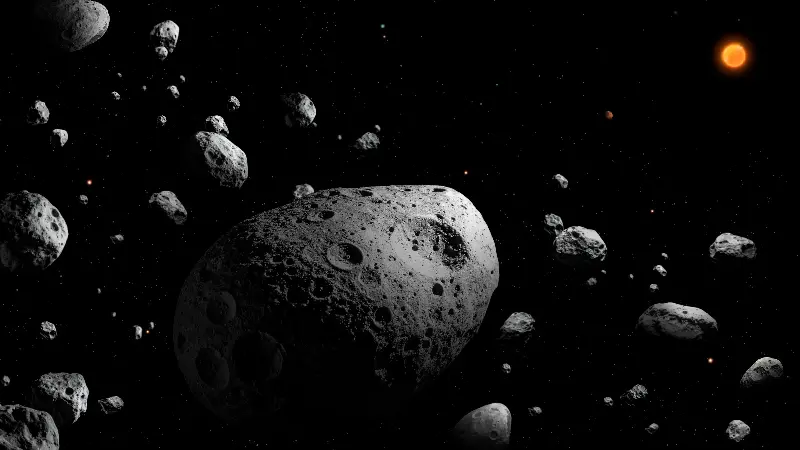
Scientists have discovered the fastest-spinning asteroid sized over 0.3 miles in diameter, which is rotating about once every two minutes. Dubbed 2025 MN45, the space rock is some 2,300 feet across and spans nearly the size of eight football fields.
The record-breaking space rock is one of 19 “super- and ultra-fast-rotating” asteroids found among around 1,900 asteroids astronomers detected for the first time last June.
The asteroids were revealed using the Legacy Survey of Space and Time (LSST) Camera—the largest digital camera in the world—which is based at the NSF–DOE Vera C. Rubin Observatory in Cerro Pachón in Chile.
The study is based on data collected over the course of around 10 hours across seven nights in April and May last year.
The study found 76 asteroids with reliable rotation periods, including 16 super-fast rotators with rotation periods ranging roughly from 13 minutes to 2.2 hours, and three ultra-fast rotators that complete a full spin in less than five minutes.
The 19 newly identified fast-rotators are each longer than an American football field, which is around 100 yards or about 295 feet long. The fastest-spinning main-belt asteroid identified, known as “2025 MN45,” has a diameter of around 2,329 feet (710 meters) and completes a full rotation every 1.88 minutes.
“Clearly, this asteroid must be made of material that has very high strength in order to keep it in one piece as it spins so rapidly,” astronomer Sarah Greenstreet, a lead author of the study, said in a statement.
She notes: “We calculate that it would need a cohesive strength similar to that of solid rock. This is somewhat surprising since most asteroids are believed to be what we call ‘rubble pile’ asteroids, which means they are made of many, many small pieces of rock and debris that coalesced under gravity during Solar System formation or subsequent collisions.”
Rubble pile asteroids have limits on how fast they can spin without breaking apart. The fast-rotation limit to avoid being broken apart is 2.2 hours for objects in the main asteroid belt. The faster an asteroid spins above this limit, and the larger its size, the stronger the material it must be made from, the researchers explained.
Other notable asteroid discoveries made by the researchers include “2025 MJ71” (which has a 1.9-minute rotation period), “2025 MK41” (3.8-minutes), “2025 MV71” (13-minutes) and “2025 MG56” (16-minutes). Along with “2025 MN45,” these five super- to ultra-fast rotators are all several hundred feet in diameter and join a couple of “near-Earth objects” (NEOs) as the fastest spinning sub-kilometer asteroids known.
“All but one of the newly identified fast-rotators live in the main asteroid belt, some even just beyond its outer edge, with the lone exception being an NEO,” NOIRLab said, adding that “this shows that scientists are now finding these extremely rapidly rotating asteroids at farther distances than ever before.”
Asteroids are small, rocky masses left over from the formation of the solar system about 4.6 billion years ago. They are found concentrated in the main asteroid belt, which lies around the sun between the orbits of Mars and Jupiter.
As asteroids orbit the sun, they rotate at various speeds, and their spin rates offer insight on the conditions of their formation billions of years ago, as well as their internal composition and evolution over their lifetimes.
Do you have a tip on a science story that Newsweek should be covering? Do you have a question about asteroids? Let us know via [email protected].
Reference
Greenstreet, S., Li, Z. (Chester), Vavilov, D. E., Singh, D., Jurić, M., Ivezić, Ž., Eggl, S., Koumjian, A., Moeyens, J., Carruba, V., Womack, M., Granvik, M., Alexov, A., Antilogus, P., Baumanć, B. J., Bellm, E. C., Boucaud, A., Bradshaw, A., Carlin, J. L., … Willman, B. (2026). Lightcurves, Rotation Periods, and Colors for Vera C. Rubin Observatory’s First Asteroid Discoveries. The Astrophysical Journal Letters, 996(2). https://doi.org/10.3847/2041-8213/ae2a30