



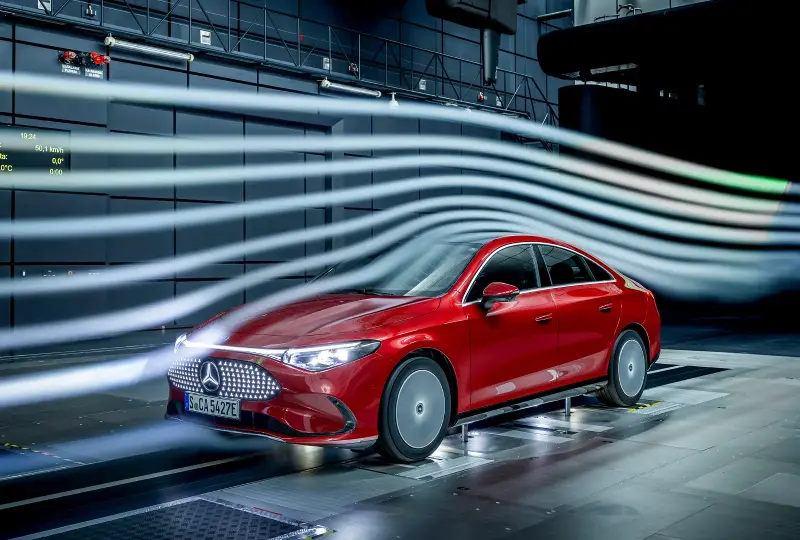
Deep below the rocky ground in Sindelfingen, Germany, a three-storey tall fan sits, enclosed by concrete walls. Its presence looms large inside the nondescript tangle of buildings in various shades of gray that make up Mercedes-Benz’s research and development headquarters.
The fan is part of a larger wind tunnel vehicle testing area where models are out through their paces before launch to optimize their efficiency versus established expectations, which vary by vehicles. Aerodynamics is a delicate ballet of design and engineering balance.
Every bit less drag a car has, the more efficient it becomes. Low air resistance makes a vehicle slip through the air with ease resulting in increased mileage out of every fill up, whether it’s with gasoline, diesel or electricity.
Aerodynamic efficiency is measured by a drag coefficient. A good drag coefficient for a modern vehicle is under 0.30. The most exceptionally slippery models are under 0.25. The Mercedes-AMG Concept AMG GT XX prototype has a outstanding drag coefficient of 0.19, a figure that helped the car secure 25 long-distance world records on the Nardò, Italy test track in August.
The maximum wind speed in the wind tunnel is 265 km/h (approximately 164.7 mph). That maximum speed is more than the threshold for the most severe Category 5 hurricane as measured by the Saffir-Simpson Hurricane Wind Scale.
While computer simulation has changed the game, speeding up the time it takes to develop a new vehicle, there are still physical simulations that are needed.
“Mercedes-Benz possesses over a 100 years of experience in aerodynamic development. The wind tunnel is an indispensable instrument for us to precisely optimize vehicle aerodynamics and therefore efficiency. Through the systematic reduction of aerodynamic drag, energy consumption is minimized, which directly contributes to increasing the range of electric vehicles and reducing energy consumption of the drivetrains,” Alexander Müller, head of aerodynamics, aeroacoustics and the wind tunnel center at Mercedes-Benz, told Newsweek.
It isn’t just efficiency that is tested in the wind tunnel. With passenger comfort in mind, the design and engineering teams are looking to minimize sound passed on to a vehicle’s passengers, bringing it to within tolerances by tweaking the vehicle’s geometric design.
Mercedes-Benz goes a step further, also working to measure the effects of rain, sleet and snow on the windshield in an aim to keep the view forward and to the side clear as often as practically possible.
While the Mercedes-Benz wind tunnel is noted for its size, Ferrari’s Wind Tunnel (Galleria del Vento) in Maranello, Italy, opened in 1997, is noted as an architectural masterpiece. It was designed by renowned architect Renzo Piano, who also notably worked on The Shard in London (2012) and Whitney Museum of American Art in New York City (2015) and The New York Times Building (2007), among others.
It is used for Formula One cars. The Ferrari F399 was the first model to take advantage of the full capabilities of the space. It was used in 1999 to get Ferrari the F1 Constructors Champion trophy.
Ferrari’s facility has also been used for tests outside of the automotive world. World champion skiiers and cyclists have utilized it, and in the Italian Olympic Committee began working with Ferrari in 2012 to test for various Olympic sports.
The Ferrari wind tunnel’s fan can provide wind at a speed of up to 250 kph for 2:1 model scale vehicles. When filled with a full-sized vehicle, wind speeds can reach up to 150 kph.