



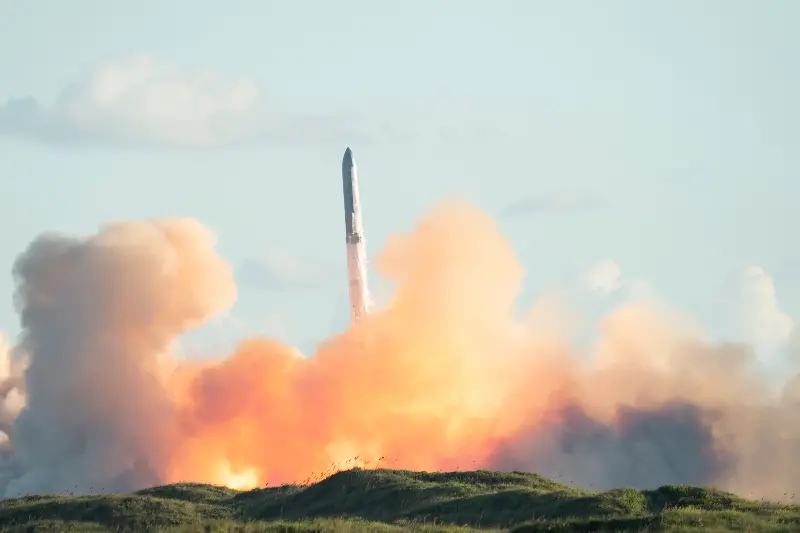
The Federal Aviation Administration (FAA) has issued a warning that space rocket launches could “significantly reduce safety” for planes.
In a safety alert for operators (SAFO) published last month, the FAA discussed the potential effects of space launch activities, including “catastrophic failures resulting in debris fields.”
The FAA said: “Past events have shown that when a mishap does occur, debris has fallen within or near the DRA [debris response areas], and pilots should exercise extreme caution near these areas.”
The SAFO is dated January 8, the same day an investigation by ProPublica, a nonprofit newsroom, highlighted pilots’ struggles to avoid debris after Starship rockets from Elon Musk’s SpaceX exploded over busy airspace last year.
Newsweek has contacted the FAA and SpaceX for comment via email.
Why It Matters
The SAFO appears to be the first-ever addressing “airspace management considerations for space launch activities” and the danger that rocket launches can pose to planes, according to the FAA website, which has published SAFOs since 2005.
The warning comes amid research showing that as little as 300 grams of debris, the equivalent of about two-thirds of a pound, “could catastrophically destroy an aircraft,” Aaron Boley, a professor at the University of British Columbia who has studied the danger that space objects pose to planes, told ProPublica in January.
What To Know
The latest SAFO warns that “as commercial and government space launch activities increase, it is imperative that airspace users account for potential disruptions due to launch operations.”
The federal aviation body said all directors of operations, chief pilots, dispatch, program managers, operational control staff, and flight crews “should ensure that the appropriate operator, pilot, and dispatch personnel are advised and trained on the impact of space launch and reentry operations and should take appropriate actions to mitigate the impact, which could significantly reduce safety.”
The FAA’s air traffic control (ATC) implements airspace restrictions and hazard mitigation measures to protect planes from potential hazards due to “launch anomalies.”
A notice to airmen is issued during “unplanned catastrophic events involving falling debris,” and ATC will reroute planes to avoid the area, according to the FAA.
The SAFO advised that in the event of “a debris-generating mishap,” ATC would issue an alert that was “broadcast to all affected aircraft informing them of the mishap, and, if known, the approximate location of the actual debris fall area.”
What People Are Saying
Representative Nellie Pou of New Jersey, a Democrat on the aviation panel of the U.S. House Transportation and Infrastructure Committee, praised the latest FAA warning, according to ProPublica, saying: “Perfect safety demands scrupulous and forward-looking attention to detail from our federal agencies and close coordination with operators. I am heartened FAA is showing both here.”
Airlines for America, a trade association for major U.S. airlines, said, per ProPublica that it is “committed to ensuring the safety of all flights especially amid the growing number of space launches.”
What Happens Next
SpaceX is seeking FAA approval for more Starship launches. This would see the rocket fly over Florida and Mexico, as well as the airspace of Cuba, Jamaica and the Cayman Islands, which is likely to disrupt hundreds of flights, ProPublica reported.
In a post on X in December, SpaceX said it was “committed to responsibly using airspace during launches and reentries, prioritizing public safety to protect people on the ground, at sea, and in the air.”
The post continued: “As we begin increasing Starship’s flight cadence and launching missions from Florida in 2026, SpaceX will continue to ensure maximum public safety while also working to integrate Starship more efficiently into the airspace, just as we’ve done successfully with Falcon 9.”