



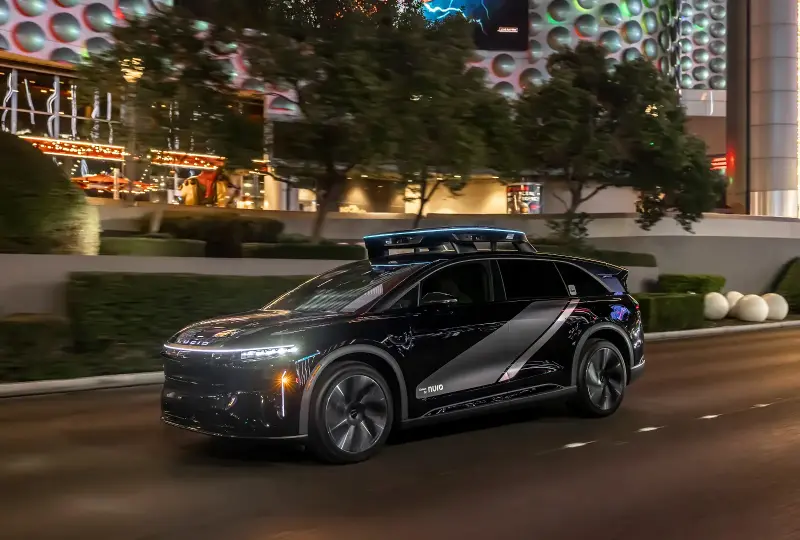
A production-intent version of an Uber global robotaxi was unveiled today during a joint press conference from electric vehicle manufacturer Lucid Motors, technology company Nuro and ride hailing service Uber at CES, a consumer electronics trade show in Las Vegas.
“This is an exciting moment for autonomous mobility, and we’re proud to partner with Lucid and Nuro to bring a state-of-the-art robotaxi to market later this year,” said Sarfraz Maredia, global head of autonomous mobility and delivery at Uber, told Newsweek. “By combining leading expertise in electric vehicles, autonomy, and ridehailing, we’re unlocking a new option for affordable and scalable autonomous rides in the San Francisco Bay Area and beyond.”
The battery-electric vehicle, based on Lucid’s Gravity SUV, features an Uber-designed in-cabin rider experience. On its roof, a halo-style sensor array acts at the vehicle’s autonomous drive technology eyes. It was designed with functionality and style in mind, with its sleek silhouette matching the style of the Gravity.
That halo features LEDs that help riders identify the vehicle they are assigned to. It displays the ride hailer’s initials and provides status updates from pickup to dropoff.
While in the vehicle, up to six riders have access to interactive screens that let them personalize their journey with heated seats, climate controls and music. And, the screen features a support contact link and the ability to request that the vehicle pull over.
There is space for luggage in the back and front trunk of the Gravity.
Nuro’s artificial intelligence software utilizes NVIDIA’s DRIVE Hyperion platform to enable SAE Level 4 autonomous driving, which is defined as a vehicle that can perform all driving tasks within specific conditions, but is unable to operate outside of specific domains, such as where it is geofenced to stay.
Prototypes of the model will undergo validation testing in the San Francisco Bay Area later this year with Nuro engineers supervising vehicle operators. Closed course and simulation testing are also part of its proving process.
Once the validation is complete, which is anticipated to happen later this year, the robotaxi is expected to go into production at Lucid’s Arizona factory.
Gravity won’t be the first robotaxi on America’s streets. Waymo and Tesla have vehicles that offer similar services to riders while shuttles by Zoox operate on the streets of Las Vegas. Some cities have also been experimenting with their own fleets of driverless shuttles, including those in Georgia and Florida. Atlanta plans to implement the shuttles in time for the FIFA World Cup later this year.