



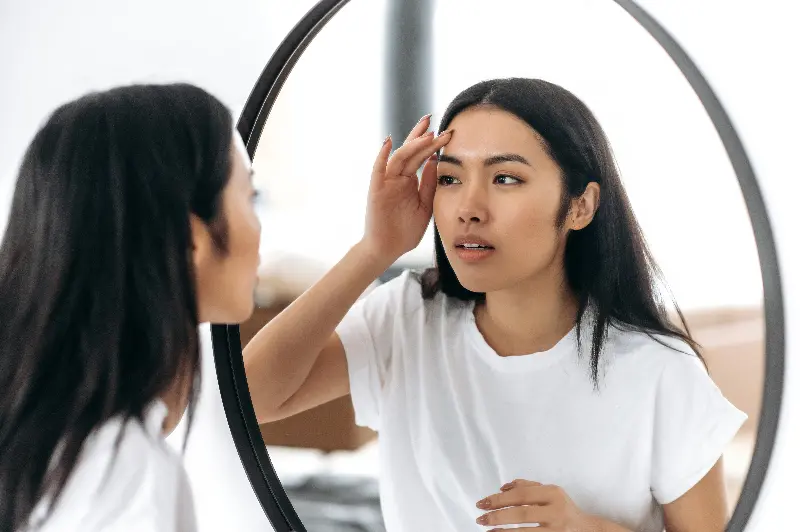
A woman’s candid moment of self‑reflection has gone viral after she shared a video about realizing her face —something people all over the globe can relate to.
In the clip, which has now surpassed one million views, TikTok user Samantha Gleave (@manthaaapanthaaa) looks directly into the camera before slowly turning her head from side to side. Text across the screen reads: “the devil couldn’t reach me so he gave me [two] faces,” a humorous nod to the fact that each side of her face looks slightly different.
But while Gleave plays the moment for laughs, her message taps into something universal: perfectly symmetrical faces are rare.
TikTok users immediately flooded the comments to share their own experiences.
“Thought I was the only one who felt this way! I look like two different people!” one viewer wrote, while another admitted they have an “uneven nose” and jaw.
Someone else added: “My face is also asymmetrical and it’s what’s stopping me from posting on TikTok because I’m self‑conscious about it!”
Gleave responded with reassurance: “I feel like people don’t notice as much as we do and I’m trying to embrace it. I’m like people see both sides of my face all day every day so they’re used to it.”
Not everyone could see the issue. One supportive viewer commented: “I don’t really see what you mean, but I hope one day you aren’t bothered by this. Society has such a push for perfectionism that it makes women forget how absolutely beautiful they are. You’re gorgeous.”
What Science Says About Facial Asymmetry
While symmetry has long been linked to attractiveness, researchers from The University of Western Australia and Monash University in Australia say the reality is far more nuanced.
Research in recent years has shown that although people tend to rate more symmetrical faces as more attractive, not all unevenness is the same. In one study that measured 35 facial features, researchers found that some differences between the left and right sides of the face were just small, random imperfections—known as fluctuating asymmetry—while others were part of a common pattern in which the right side of the face is slightly more dominant.
Interestingly, only the random, subtle imperfections had any real impact on how symmetrical or attractive a face seemed to others. The predictable right‑side differences didn’t matter at all. The researchers concluded that people subconsciously focus on the types of asymmetry that may reflect how someone developed, rather than the natural built‑in differences we all share.
Gleave’s viral moment struck such a chord because it highlights a truth many people quietly worry about: no one’s face is perfectly even, and most of the tiny differences we stress over go unnoticed by the people around us.
As science shows, a little asymmetry is not only normal—it’s universal.
Newsweek reached out to @manthaaapanthaaa for comment via TikTok. We could not verify the details of the case.