



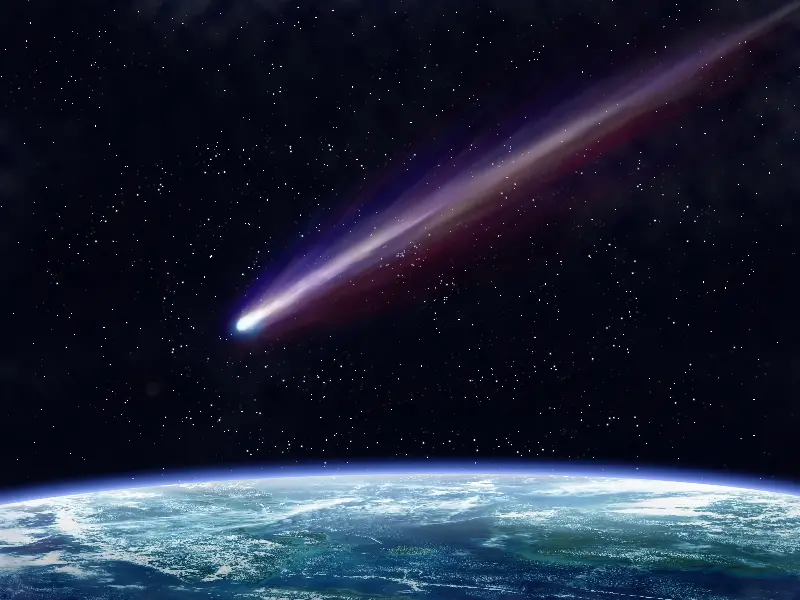
Comet 3I/ATLAS—the third interstellar object ever known to pass through our solar system—is accelerating and now approaching its closest point to Earth.
“Significant” non-gravitational accelerations (NGA) have been observed in all three components of 3I/ATLAS’s acceleration, as well as “a significant shift in the time of peak acceleration,” scientists noted in a new paper.
Despite how it may sound, however, this does not mean that the interstellar visitor is a spacecraft, as physicist Avi Loeb has notably argued. Instead, the comet is accerelating as a result of the push it is being given as the Sun causes it release gas.
“Until recently, finding non-gravitational accelerations in comets required observations over multiple orbits—which we will never have for interstellar objects,” paper author Marshall Eubanks told spaceweather.com.
“Now, using interplanetary spacecraft, we can measure these small accelerations—just a few hundred millionths of Earth’s gravity—during a single flythrough of the solar system.”
3I/ATLAS came closest to the sun at the end of October before reappearing on the other side of the sun in early December. The comet is projected to make its closest approach to the Earth on December 19.
“3I/ATLAS has an icy nucleus and a coma, which is a bright cloud of gas and dust that surrounds the comet and is emitted at increasing rates as the comet approaches the Sun,” NASA explainsed
Observations by NASA’s Hubble space telescope on November 30 showed that 3I/ATLAS was about 178 million miles from Earth.
“There is no danger to Earth from this comet,” which will come no closer than 170 million miles to our planet, NASA said.
Arriving from the direction of the constellation Sagittarius, 3I/ATLAS was first discovered in July by NASA’s ATLAS survey telescope in Rio Hurtado, Chile. It was deemed to be an interstellar object due to its high velocity and trajectory.
3I/ATLAS is on a so-called hyperbolic trajectory, “which means it is moving too fast to be bound by the Sun’s gravity and, therefore, is not following a closed orbital path around the Sun. It is simply passing through our solar system,” NASA explains.
When it was first detected, 3I/ATLAS was traveling at about 137,000 miles per hour before its speed increased to about 153,000 miles per hour at its closest point to the sun.
“When 3I/ATLAS leaves our solar system it will be at the same speed as it came in,” NASA said.
Do you have a tip on a science story that Newsweek should be covering? Do you have a question about comets? Let us know via [email protected].