



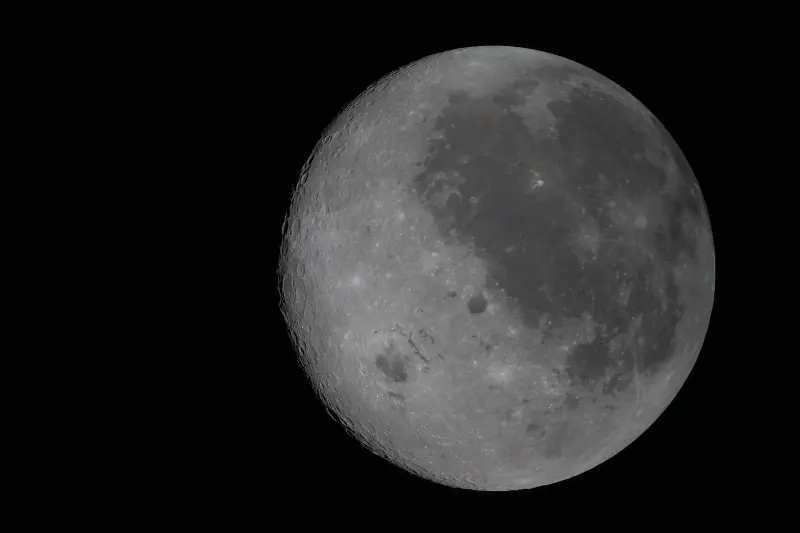
NASA has released an array of stunning images from the historic Artemis II mission which took the four-strong crew of the Orion spacecraft behind the moon on a mission which has flown humankind further away from Earth than ever before.
Why It Matters
As previously reported by Newsweek, the mission is meant to validate NASA’s new deep‑space hardware, demonstrating that astronauts can safely travel beyond low Earth orbit for the first time in over 50 years. It also marks the inaugural crewed flight of the Space Launch System and Orion spacecraft, with astronauts testing key systems including life support, navigation, communications, and manual controls.
NASA’s Orion spacecraft set off for the Moon after lifting off successfully on April 1 from Kennedy Space Center in Florida. Following the launch, Orion carried out a series of engine burns the next day to escape Earth’s orbit and begin its trajectory toward the Moon, NASA said.
NASA astronauts Reid Wiseman, Victor Glover, and Christina Koch, and CSA (Canadian Space Agency) astronaut Jeremy Hansen passed the record for human spaceflight’s farthest distance at 12:56 p.m. CDT Monday—traveling 248,655 miles from Earth, NASA said.
What To Know
One April 6 image shows the Moon fully lit, with the near side visible on the right, distinguished by dark patches formed by ancient volcanic lava flows. West of these lies the roughly 600‑mile‑wide Orientale Basin, a massive impact crater that spans the boundary between the near and far sides. The terrain beyond it marks the Moon’s far side, which is normally hidden from Earth because the Moon rotates and orbits at the same pace.
On mission day five, the Artemis II crew took a photo of the Moon through Orion’s window before going to sleep. NASA said the spacecraft entered the Moon’s sphere of influence at 12:37 a.m. EDT on April 6, when lunar gravity began exerting a stronger pull than Earth’s.
Another image, taken April 5, showed Earth as a “thin arc glowing in the darkness of space.” Sunlight can be seen outlining the curves of the oceans and clouds as the rest of Earth is covered in darkness.
In another image taken April 2, NASA astronaut and Artemis II mission specialist Christina Koch can be seen looking back at Earth through one of Orion’s main cabin windows as the spacecraft heads toward the Moon.
Other images released by the agency offered a glimpse into the astronauts’ life on board the spacecraft, including shots of sleeping bags and controls.
What People Are Saying
Lori Glaze, acting associate administrator for Exploration Systems Development Mission Directorate at NASA Headquarters in Washington said: “At NASA, we dare to reach higher, explore farther, and achieve the impossible. That’s embodied perfectly by our Artemis II astronauts—Reid, Victor, Christina, and Jeremy. They are charting new frontiers for all humanity.
“Their dedication is about more than breaking records—it’s fueling our hope for a bold future. Their mission is carrying our promise to return to the Moon’s surface, this time to stay as we establish a Moon Base.”
NASA Administrator Jared Isaacman said on X, Monday: “Artemis II has reached its maximum distance from Earth. On the far side of the Moon, 252,756 miles away, Reid, Victor, Christina, and Jeremy have now traveled farther from Earth than any humans in history and now begin their journey home. Before they left, they said they hoped this mission would be forgotten, but it will be remembered as the moment people started to believe that America can once again do the near-impossible and change the world.”
What Happens Next
NASA said the Artemis II crew is expected to “splash down” off the San Diego coast a little after 8 p.m. EDT on Friday.