



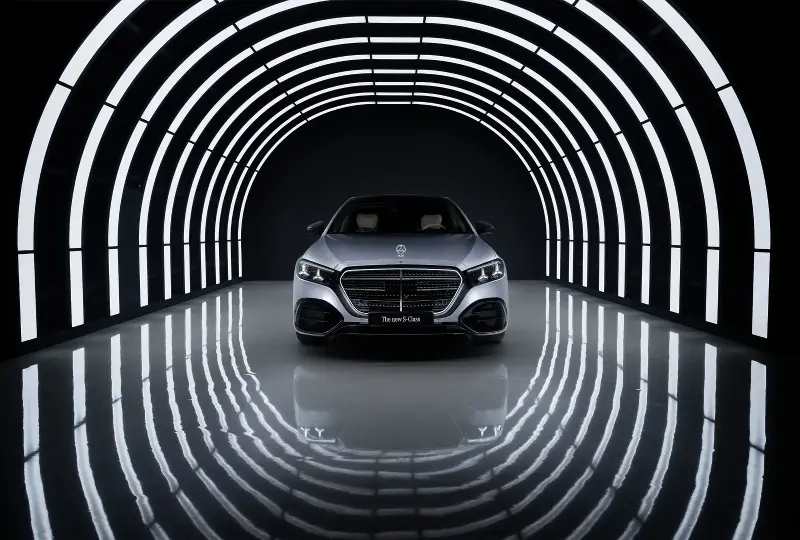
The intersection of software and artificial intelligence is what is making tomorrow’s Mercedes-Benz vehicles luxurious, the company’s Chief Software Officer Magnus Östberg told Newsweek.
While standing next to the heavily revamped Mercedes-Benz S-Class sedan, Östberg pointed out that technology leads the way on the large car rather than the overt materials opulence that is favored by brands like Rolls-Royce.
“Software and AI are fitted to equation of luxury by elevating the rest of the vehicle. This beautiful S-Class behind me is really a masterpiece, and we’re using all the digital and software features to make sure that this is the most intelligent vehicle ever, using the MB OS,” Östberg said.
The S-Class isn’t just meant to be driven, it’s also meant to be sat in. The car is commonly used to chauffeur high net worth individuals and important businesspeople to and from engagements around the world. Software is making the backseat experience luxurious too, Östberg explained.
“One way that Mercedes-Benz makes UI experience luxurious is here in the rear seat of the S-Class, where our most prestigious customers are riding. Here we want to make sure that they are productive and luxury for them is time and using the S-Class as their extended boardroom. That is how we make luxury become a reality, using software,” he said.
Those that ride in the rear seat of the new S-Class will be able to utilize twin 13.1-inch displays that are controlled via two detachable remote controls and are able to serve as video conferencing screens using Microsoft Teams, Zoom or Webex. A driver can also use teleconference features, but it is limited to when the vehicle is parked.
Mercedes has designed the car to not only be a rolling boardroom extension, but also a navigation tool, using a combination of on-board computing and cloud communication to. Calling it “the most serious S-Class to date,” Östberg said, “We’re using models and AI agents to elevate the way that we are communicating with the S-Class by using agents to generate, ‘Hey, Mercedes’ as the top performing voice interaction as well as using agents to make sure that MB Drive Assist Pro can navigate through the streets of a busy Shanghai or busy San Francisco using the AI technology.”
Mercedes-Benz Drive Assist Pro uses a combination of 30 on-vehicle sensors (including 10 cameras, five radar sensors and 12 ultrasonic sensors) that deliver raw data that can store up to 508 TOPs (trillion operations per second), approximately five times as many as Tesla’s next-generation Full-Self Driving software, which isn’t coming to vehicles until 2027. Drive Assist Pro can pilot a vehicle from a parking lot to a destination and has the ability to accept steering inputs from the driver without system deactivation.
The new S-Class is the “most sophisticated software vehicle that we have ever put on the streets,” Östberg shared. “We continuously improve and continuously learn. That is the most important lesson.”