



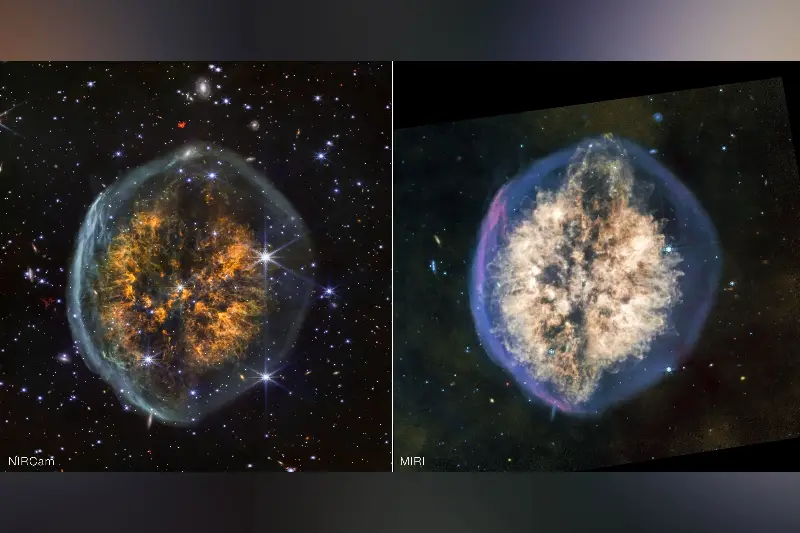
NASA released new images from the James Webb Space Telescopeof a little-studied nebula, PMR 1, whose split hemispheres and dark central lane resemble a transparent skull encasing a brain.
Why It Matters
The Webb images capture a relatively short-lived stage in a dying star’s evolution, offering clues to how stars shed their outer layers.
What To Know
NASA said Webb observed PMR 1, nicknamed the “Exposed Cranium” nebula, in both near-infrared with NIRCam and mid-infrared with MIRI, revealing a brain-like interior divided by a dark vertical lane. The nebula shows an outer, skull-like shell composed largely of hydrogen ejected first, and a more structured inner cloud made of mixed gases.
Webb’s resolution indicates the central dark lane could be linked to an outburst or twin jets from the central star, with MIRI highlighting apparent ejections at the nebula’s top, NASA said.
A side-by-side comparison shows NIRCam piercing through to reveal more stars and background galaxies, while MIRI emphasizes the glow of cosmic dust.
PMR 1 lies in the constellation Vela about 5,000 light-years away, with Webb’s composite image spanning roughly 3.2 light-years, according to NASA.
NASA said the star’s mass remains undetermined, leaving open whether it will end as a dense white dwarf like the sun or explode as a supernova if it is sufficiently massive.
Spitzer, NASA’s retired telescope, first revealed the planetary nebula in infrared light more than a decade ago.
What People Are Saying
NASA Webb Telescope posted on X: “A brain-new image from Webb!
“What looks like a brain is actually a dying star blowing off a shell of gas, and within that shell, a cloud of various gases. The dark lane that divides its “hemispheres” may be related to an outflow from the central star.”
What Happens Next
NASA recently outlined a total lunar eclipse on March 3 that will be visible across the Pacific, in the evening for eastern Asia and Australia, overnight across the ocean, and before dawn for North and Central America and far western South America.
The agency also issued a timeline for what to expect during the event:
- Penumbral eclipse begins at 12:44 a.m. PST / 3:44 a.m. EST / 08:44 UTC, when subtle dimming starts as the moon enters Earth’s penumbra.
- Partial eclipse begins at 1:50 a.m. PST / 4:50 a.m. EST / 09:50 UTC, as the moon enters the umbra and a dark “bite” appears on the lunar disk.
- Totality begins at 3:04 a.m. PST / 6:04 a.m. EST / 11:04 UTC, when the entire moon is within the umbra and turns coppery red.
- Totality ends at 4:03 a.m. PST / 7:03 a.m. EST / 12:03 UTC, as the red hue fades and the shadowed “bite” appears on the opposite side.
- Partial eclipse ends at 5:17 a.m. PST / 8:17 a.m. EST / 13:17 UTC, with only subtle dimming remaining in the penumbra.
- Penumbral eclipse ends at 6:23 a.m. PST / 9:23 a.m. EST / 14:23 UTC, marking the conclusion of the event.