



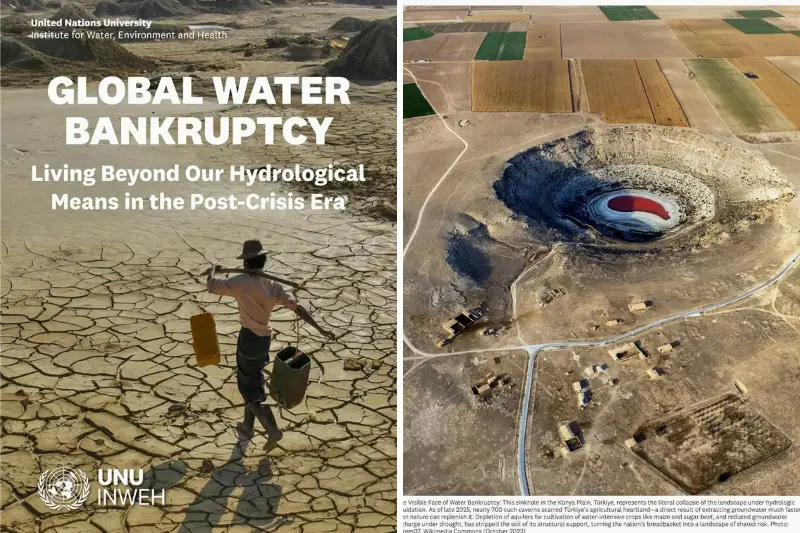
The United Nations has said that terms like “water crisis” no longer reflect the state of the world’s water capitol, and that things are now far worse, leaving us in a “post-crisis era” of “global water bankruptcy.”
The UN is calling on world leaders to acknowledge the situation, which they attribute to factors including irreversible losses of natural water, deforestation, pollution and global warming.
World leaders are now encouraged to create science-backed solutions to tackle this new reality, instead of responding to the status of the crisis several years ago.
Standing out in the report are several statistics that underline the UN’s push for a new approach towards the Earth‘s dissipating supply of quality water.
These include the fact that 50 percent of world’s largest lakes have lost water since the early 1990s; how 50 percent of global domestic water is now derived from groundwater; that 410 million hectares of natural wetlands were erased in the past five decades; and how 75 percent of the world’s people live in countries classified as water-insecure or critically water-insecure.
An alarming 2 billion people are also living on sinking ground, while 3.5 billion lack safely managed clean water.
AccuWeather, the weather forecasting firm, recently conducted a climate study that found that annual rainfall in the contiguous U.S. has been declining. However, the analysis showed that extreme rainfall events have been increasing, contributing to the growing body of evidence for a post-crisis era highlighted in the U.N. report.
“If these trends continue, the well-known climate models may not be capturing all of the important changes our studies have revealed,” Dr. Joel Myers, founder and executive chair of AccuWeather, told Newsweek, in line with the tone of the U.N. report.
Reflecting on AccuWeather’s study, he added: “If these trends continue, we expect to see accelerating harmful impacts on crop production, more frequent wildfires, and less available water due to greater drought. Furthermore, the crop-growing areas in the U.S. may shrink as soil becomes more arid…These effects could become more obvious over the next decade or two.”
The study also addressed the ground becoming drier, a result of global warming, and how the warming of the air and ground could, echoing the U.N.’s warning, accelerate beyond what climate models are currently predicting.
AccuWeather’s researchers said one way this could show up is in expanded desert areas and flash flooding, because more intense rainfall cannot be absorbed into the soil like slower, more spread out rain.
Actions the UN Wants
The UN’s new report intends to get world leaders to drop their current focus on drinking water and accept the new post-crisis state, making actions accordingly like elevating water issues in climate negotiations and embedding water-bankruptcy monitoring in global frameworks.
“The report clearly highlights the severe state of water insecurity in many parts of the world,” Wouter Buytaert, professor of hydrology and water resources at Imperial College London in England, said in a statement.
“The report is right in pointing out that many water systems are irreversibly degraded.
“In this, the water cycle is no different from other natural resources such as soils and ecosystems, all of which experience widespread transgression of their planetary boundaries. I agree with the report that we need a long-term view on sustainable and equitable progress towards water security, instead of short-term crisis management.”
He went on to suggest that a global water bankruptcy narrative could jolt policy makers into action but warned that it could also risk triggering global inaction and resignation by paralyzing them with fear. He advises highlighting successful, contemporary efforts to address water concerns and global warming as a whole.
“It does not do justice to [the] magnitude and significance of ongoing efforts,” he said. “Documenting, championing, and replicating success stories like these can create a more engaging and solution-oriented narrative.”
Do you have a tip on a science story that Newsweek should be covering? Do you have a question about global warming? Let us know via [email protected].
Reference
Madani, K. (2026). Global water bankruptcy: Living beyond our hydrological means in the post-crisis era. United Nations University Institute for Water, Environment and Health. https://doi.org/10.53328/INR26KAM001