



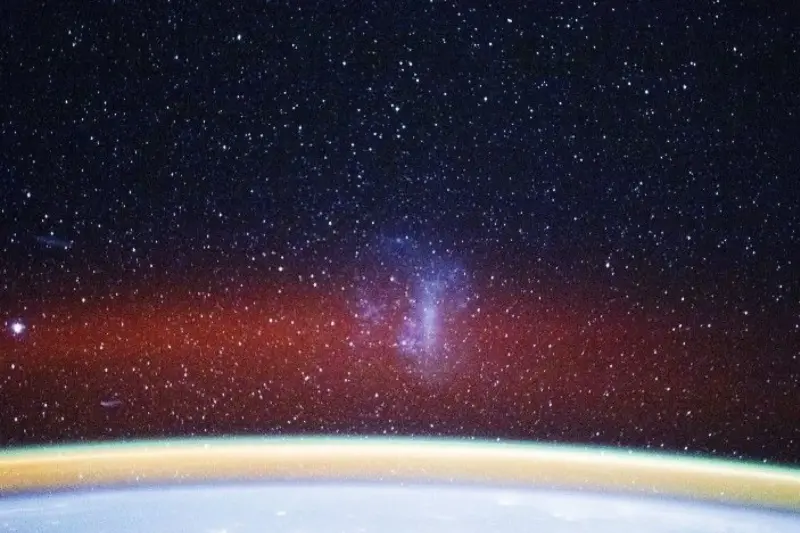
Astronauts aboard the International Space Station (ISS) have captured a dazzling new image of the Large Magellanic Cloud (LMC)—offering a rare, direct view of one of the Milky Way’s closest galactic neighbors.
The photograph, taken on November 28, 2025 from the orbiting laboratory, shows the dwarf galaxy as a glistening purple smudge in the star-filled sky, hovering above the Earth’s limb.
The LMC lies roughly 160,000 light-years away. Despite this vast distance, the galaxy is neverthelesss visible to skywatchers in the Southern Hemisphere and the lower latitudes of the Northern Hemisphere without special equipment.
While the galaxy is a familiar sight to astronomers, images taken from orbit allow for a crisper and broader view.
The station’s unique vantage point—free from atmospheric distortion—provides a striking look at the cosmic structure some have dubbed the “galaxy next door.”
In the ISS photo, a broad band of the Earth’s upper atmosphere is seen at the bottom of the photograph, glowing with yellow, green and diffuse red layers of airglow.
Hovering above it, the dwarf galaxy appears as a luminous patch, highlighting its prominent position in the Local Group—a cluster of more than 50 galaxies, including the Milky Way, Andromeda and Triangulum galaxies, spread across a region around 10 million light-years wide.
Astronauts have photographed the Large Magellanic Cloud before, but this latest capture from a member of the Expedition 73 crew adds to the catalog of Earth and sky images compiled by the ISS Crew Earth Observations Facility.
The dwarf galaxy is more than just a visual feature in the night sky. Astronomers consider it a rich site of stellar activity. The galaxy hosts regions dense with star formation and stellar remnants, offering researchers an exciting mechanism to study the life cycle of stars.
One of the most studied events in the Large Magellanic Cloud occurred in 1987, when astronomers observed Supernova 1987A—the closest supernova seen in modern times. The explosion released energy equivalent to 100 million suns and left behind a glowing ring of gas that scientists continued to monitor.
The aftermath of SN 1987A gave astronomers valuable insights into the processes of stellar death and rebirth. In later studies, researchers observed that the remnants of the supernova began forming substantial amounts of cosmic dust.
Do you have a tip on a science story that Newsweek should be covering? Do you have a question about astronomy? Let us know via [email protected].