



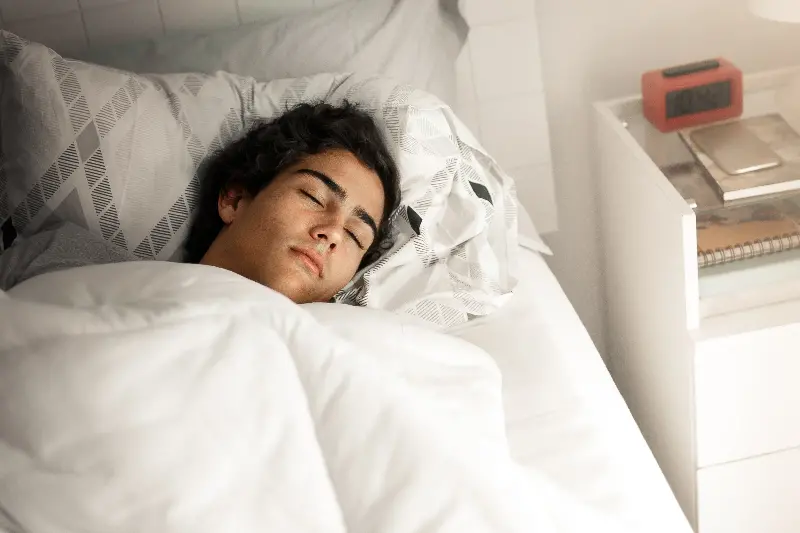
It might be tempting to wake up your teenager for fear of them wasting their day, but allowing them to sleep longer on weekends may actually be of benefit to their mental health.
This the conclusion of a study by researchers at the University of Oregon and the State University of New York Upstate Medical University, which found that young people aged 16–24 who caught up on lost sleep during the weekend had a significantly lower risk of depressive symptoms.
In fact, those who slept more on weekends were found to be 41 percent less likely to report symptoms of depression than peers who did not make up for weekday sleep loss.
“It’s normal for teens to be night owls, so let them catch up on sleep on weekends if they can’t get enough sleep during the week because that’s likely to be somewhat protective,” paper author and University of Oregon psychologist Melynda Casement said in a statement.
In the study, participants reported their usual bedtimes and wake-up times on both weekdays and weekends, allowing researchers to calculate their “weekend catch-up sleep”—the difference between average weekend sleep and weekday sleep.
Each subject was also asked about their emotional wellbeing. Those who reported feeling sad or depressed daily were categorized as having symptoms of depression.
Researchers found adolescents and young adults who made up for lost sleep on weekends showed a substantially lower risk of depressive symptoms.
This age group has rarely been included in studies of weekend catch-up sleep, but is a population marked by significant sleep challenges and heightened vulnerability to depression, the researchers noted.
The scientists recommend that adolescents get between eight and 10 hours of sleep every night, but agreed that ideal sleep schedules are often unrealistic for teens juggling school, homework, extracurricular activities, social lives and—for many—part-time jobs.
While consistent nightly sleep remains the gold standard, the study suggests that weekend sleep-ins may offer a meaningful mental health benefit when weekday schedules fall short.
Biology plays a major role in adolescent sleep deprivation. During puberty, circadian rhythms—the body’s internal clock—shift later, making it harder for teens to fall asleep early.
“Instead of being a morning lark you’re going to become more of a night owl,” Casement explained. “And sleep onset keeps progressively delaying in adolescence until age 18 to 20. After that, you start becoming more morning larkish again.”
Depression is one of the leading causes of disability among people aged 16 to 24, Casement noted. In this context, disability refers broadly to impaired daily functioning, including difficulty attending school or work, frequent absences or chronic lateness.
“It makes that age range of particular interest in trying to understand risk factors for depression and how those might relate to delivery of interventions,” Casement added.
Do you have a tip on a science story that Newsweek should be covering? Do you have a question about sleep? Let us know via [email protected].
Reference
Carbone, J. T., & Casement, M. D. (2026). Weekend catch-up sleep and depressive symptoms in late adolescence and young adulthood: Results from the National Health and Nutrition Examination Survey. Journal of Affective Disorders, 394. https://doi.org/10.1016/j.jad.2025.120613