



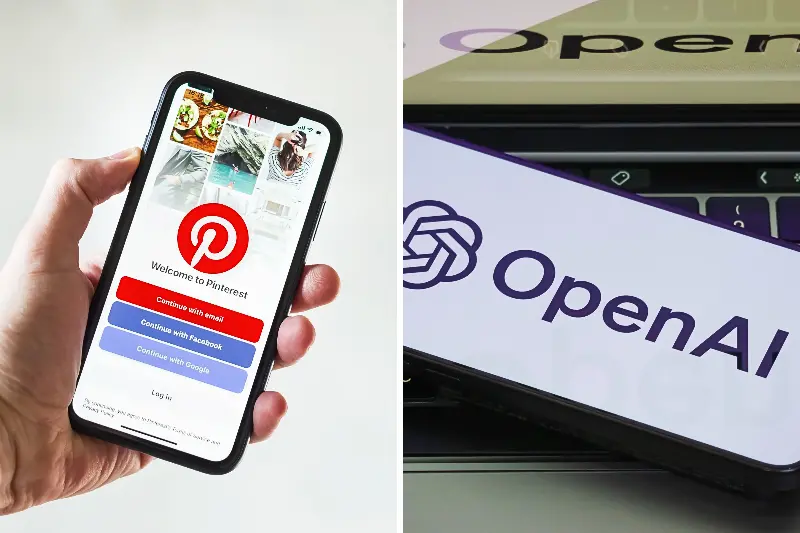
Could OpenAI be planning an $18 billion-plus purchase of Pinterest? Fans of the popular “inspo” platform believe that such an acquisition could be on the cards, after it was highlighted in a “predictions” report by The Information, which was published at the beginning of this year.
The report hinted at the potential move’s purpose being to expose OpenAI to more human-generated data, train AI on how we browse online, and better compete with Google and Meta who already have a firm hand in popular social-media sites.
Newsweek reached out to Pinterest and OpenAI for comment via email on Wednesday. Neither company has released an official response to the viral rumor.
Though it has not been spurred on by OpenAI or Pinterest executives, the rumor has caught fire on social-media platforms such as TikTok and Instagram where loyal users of the latter have voiced hopes that their digital sanctuary stays a limited AI zone.
These users, around 42 percent of which are in Generation Z, have been glamorizing analogue lifestyles, offline hobbies, physical media and craftsmanship for some time. For them, Pinterest is one of the last remaining refuges from the AI-saturated web—a space unbothered by the churn of algorithms or synthetic media.
One creator, who goes by @irelyn.may on TikTok, told her followers on January 4: “If AI buys Pinterest, I will have nothing left.”
Her post has been liked almost 1 million times, leading to an outpouring of similar sentiments in the comments. Although her post has been viewed more than 3.5 million times, she is just one of the many young internet users voicing their dislike of a potential future acquisition.
“Gen Z‘s concern about AI on Pinterest isn’t about technology; it’s about trust,” Yehuda Neuman, senior vice president of influencer marketing for PartnerCentric and former ByteDance staff member, told Newsweek.
“Pinterest built its value on human curation and authentic inspiration [and] when AI starts generating that content at scale, the platform risks becoming just another feed of beautiful, but hollow recommendations.
“The irony of an OpenAI-Pinterest merger is that it could solve discovery while destroying what makes discovery meaningful. Gen Z doesn’t hate AI,” Neuman said. “They hate when AI replaces the human context that makes creative platforms worth visiting in the first place.”
Launched in 2010 and propelled by its sleek iPhone app in 2011, Pinterest quickly cemented itself as the internet’s visual inspiration board—a haven for creatives, dreamers, and anyone longing for aesthetic content, quotes that could be saved, and a quieter corner of the internet.
Over the years, Pinterest became more than somewhere to store moodboards; for many, it turned into a source of income, a tool for planning, and a deeply personal space to collect and curate ideas.
“The reason Gen Z worries about AI entering Pinterest is less about AI and more about the potential loss of online spaces that feel personal to them,” Baruch Labunski, a CEO at Rank Secure, a web design and marketing company, told Newsweek. “Pinterest is a space where people collect ideas and like to keep things for themselves and not to perform for others just like other social-media platforms.
“An AI-flooded Pinterest would lose that sense of intimacy and personal touch, which is what Gen Z worries about as they are burnt out from hyper-algorithmic feeds. It’s meant to help people express ideas and not to copy what is already there.”
OpenAI, ChatGPT’s parent firm, which was launched in 2015, could benefit from the billions of images and media files that Pinterest hosts and take advantage of its ad features, which have been optimized to drive user purchases.
OpenAI could leverage that and make the curated pins, saves and searches of users even more shoppable. But Neuman and Labunski feel skeptical about whether Gen Z will get on board.
“They can spot fake content instantly, and they resent being treated like they can’t tell the difference,” Neuman said. “If this merger happens, success won’t come from automating inspiration. It’ll come from using AI to surface more authentic human creativity, faster.
“The moment Pinterest becomes a rendering engine instead of a reflection of real people’s taste and effort, Gen Z will do what they’re already doing on other platforms: log off and find community elsewhere.”
Labunski added: “They simply want to organize inspiration and not for AI to be creative for them. Younger users simply want to control how creativity is used. Pinterest will lose its special trust if it uses AI to create content.”
Newsweek reached out to @irelyn.may for more information via TikTok.