



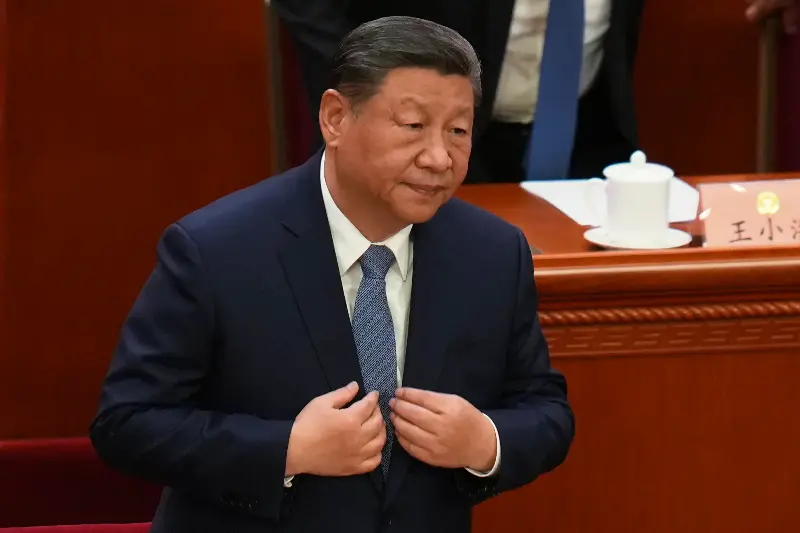
Nine senior officers of the People’s Liberation Army were stripped of membership in China’s top legislature, as President Xi Jinping continues his purge of the military establishment.
Why It Matters
The move comes less than a week before the “Two Sessions,” the Chinese Communist Party’s most important annual political gathering, begin in Beijing. The timing may signal an effort by Xi to consolidate control ahead of a year expected to focus heavily on economic management and internal stability.
Since taking office in 2013, Xi has overseen a sweeping anti-corruption campaign targeting thousands of senior and junior officials, whom he has described as “tigers and flies.” Since 2022, 101 generals and lieutenant generals have either been formally removed or disappeared from public view, per a study by the Center for Strategic and International Studies’ China Power Project.
Newsweek reached out to the Chinese Embassy in the United States by email with a request for comment.
What To Know
China’s top legislature, the National People’s Congress (NPC), is now down by 19 officials after their removal by the body’s Standing Committee, state media announced Thursday.
The list included nine PLA officers—two admirals, four major generals, two generals and one lieutenant general—leaving 2,878 deputies in the NPC.
Notably absent from the list was Zhang Youxia, previously the PLA’s de facto No. 2 figure until he was placed under investigation last month for “suspected serious discipline and law violations”—a Party euphemism for corruption. His omission has fueled speculation that any move against him may require more careful political handling.
Zhang, along with General Liu Zhenli, was removed from the Central Military Commission (CMC)—China’s top military decision-making body—last month, leaving just two members: Xi himself and the commission’s discipline secretary, Zhang Shengmin.
“[Zhang Youxia] retaining his membership in the Politburo] may reflect a preference to manage the process as formally and procedurally as possible, given the magnitude of the political implications,” Jaehwan Lim, professor in the Department of International Politics at Tokyo’s Aoyama Gakuin University, told Newsweek. “Zhang is a sufficiently senior figure that even Xi would likely approach his exit with considerable caution.”
What People Are Saying
Bill Bishop, a leading China analyst and publisher of the Sinocism newsletter, quipped: “The purges will continue until morale improves.”
Lyle Morris, senior fellow for Foreign Policy and National Security at the Asia Policy think tank’s Center for China Analysis, wrote on X: “Most of these officers had been missing for a year or longer, and long suspected of having been purged. This is the first formal indication that their fate has been sealed.”
The Center for Strategic and International Studies’s China Power Project wrote in a recent report: “Some have speculated that this indicates Xi felt Zhang in particular had amassed too much influence within the [People’s Liberation Army] or that factionalism threatened CCP rule over the military. Whatever way Xi seeks to refill or restructure the CMC, he will likely seek candidates that are not only loyal to him but have demonstrated little evidence of amassing their own followers within the military.”
What Happens Next
It remains’s unclear how soon Xi will fill the vacancies left by officials swept up in the purge. The leadership gaps would erode the effectiveness of the People’s Liberation Army in the event of a major military campaign, such as an invasion of Beijing-claimed Taiwan.
The “Two Sessions,” referring to the annual meetings of China’s top political advisory body the Chinese People’s Political Consultative Conference (CPPCC), and of the NPC, will begin on March 4 and March 5 respectively and are expected to last about a week.