



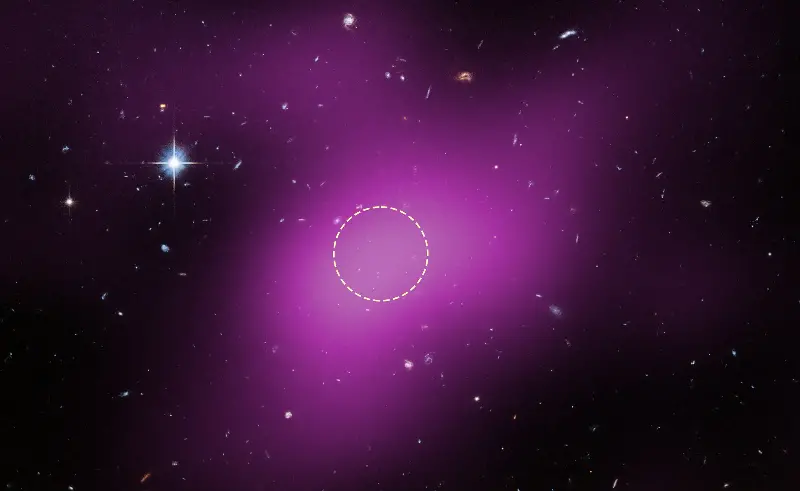
Scientists have uncovered a unique space object located 14 million light-years from Earth that is believed to be a “relic” of early galaxy formation—and, moreover, “the first confirmed detection of such an object in the universe,” NASA says.
Known as “Cloud-9,” this “starless, gas-rich, dark-matter cloud” was discovered using the Hubble Space Telescope and is “a finding that furthers the understanding of galaxy formation, the early universe and the nature of dark matter itself,” the space agency said in a statement.
The results of the latest discovery, published in The Astrophysical Journal Letters, were presented at a press conference Monday at the 247th meeting of the American Astronomical Society in Phoenix, Arizona.
“This cloud is a window into the dark universe,” paper author and astronomer Andrew Fox of the European Space Agency said in a statement.
“We know from theory that most of the mass in the universe is expected to be dark matter, but it’s difficult to detect this dark material because it doesn’t emit light. Cloud-9 gives us a rare look at a dark-matter-dominated cloud.”
“This is a tale of a failed galaxy,” said paper author and astrophysicist professor Alejandro Benitez-Llambay of the Milano-Bicocca University in Italy.
“In science, we usually learn more from the failures than from the successes. In this case, seeing no stars is what proves the theory right. It tells us that we have found in the local universe a primordial building block of a galaxy that hasn’t formed.”
The discovery of Cloud-9 suggests the potential existence of other “failed galaxies” in the universe. It provides insight into the dark components in the universe that are difficult to examine with conventional observations of bright objects like stars and galaxies.
“Cloud-9 is an example of structures and mysteries that don’t involve stars. Just looking at stars doesn’t give the full picture,” NASA said, noting that “studying the gas and dark matter helps provide a more complete understanding of what’s going on in these systems that would otherwise be unknown.”
The core of Cloud-9 is made of neutral hydrogen and is about 4,900 light-years in diameter, with researchers estimating that mass of the hydrogen gas in the object is approximately one million times the mass of the sun.
As the ninth gas cloud identified on the outskirts of a nearby spiral galaxy, Messier 94 (M94), Cloud-9 appears to have a physical association with M94.
“The cloud may eventually form a galaxy in the future, provided it grows more massive—although how that would occur is under speculation,” NASA concluded.
Do you have a tip on a science story that Newsweek should be covering? Do you have a question about dark matter? Let us know via [email protected].
Reference
Anand, G. S., Benítez-Llambay, A., Beaton, R., Fox, A. J., Navarro, J. F., & D’Onghia, E. (2025). The First RELHIC? Cloud-9 is a Starless Gas Cloud. The Astrophysical Journal Letters, 993(2). https://doi.org/10.3847/2041-8213/ae1584