



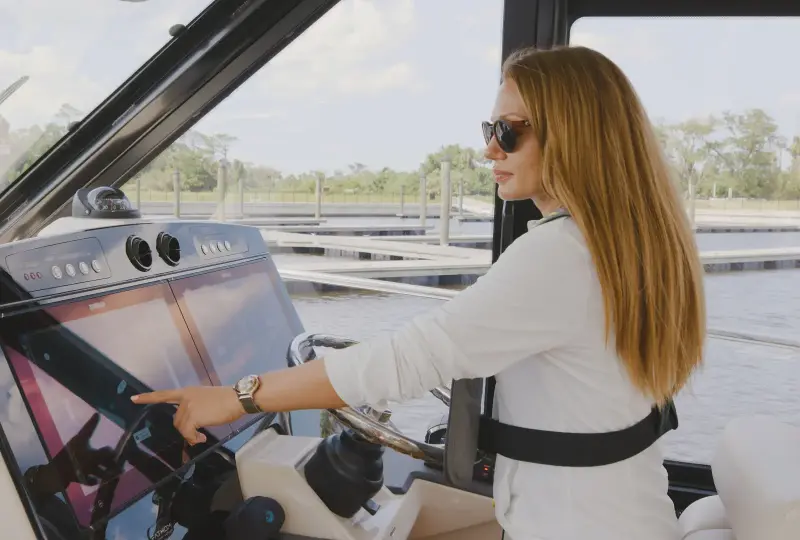
Brunswick Corporation, the world’s largest marine technology company and parent company of over 60 marine brands, debuted its AutoCaptain autonomous boating technology at CES, a technology trade show, today.
“We are always focused on providing boaters with fun, convenient, intuitive, and stress-free experiences on the water, whether through thoughtful boat and propulsion design and features or through smart application of technology,” David Foulkes, CEO of Brunswick Corporation, told Newsweek.
The artificial intelligence-enhanced AutoCaptain has been more than a decade in the making. It’s a feat more difficult than creating piloting technology for land-bound vehicles. “We have been developing autonomous boat technology for at least 10 years, refining and evolving the tech-stack that works best in the unique marine environment with wind, waves, current, pitch, heave, roll, and overall a much less structured situation than the on-road environment with its signs and lane markings etc.,” Foulkes said.
The technology was developed in-house by Brunswick’s Simrad team, which is part of Navico Group, the company’s marine electronics and technology division. It can be integrated into other original equipment manufacturer’s products.
AutoCaptain is made possible at this juncture because of the maturation of a host of technologies that are used to support its operations in real-world conditions and because of changes in consumer comfortability with it.
“Advances in sensors, AI processing, and onboard computing mean we can deliver systems that are predictable, transparent, and intuitive; not experimental. At the same time, consumer expectations have shifted. People are already comfortable with assisted technologies in cars, aviation, and everyday devices. Boating is ready for the same thoughtful evolution, one that respects the captain while making the experience more accessible and less intimidating,” the CEO said.
For many, boating is a leisure activity and being at the helm is relaxation more than transport. Some worry that technologies like AutoCaptain would lessen the joy of boating.
Foulkes explained that Brunswick’s technology was created with enjoyment in mind, saying, “When it came to how to first apply AutoCaptain, we listened to boaters and non-boaters about where stress actually exists on the water. For most people, it’s not cruising in open water, it’s docking, maneuvering in tight spaces, dealing with wind and current, or operating in crowded marinas. We call this situational autonomy; we don’t want to remove the fun of operating the boat, we want to assist in situation where the boater values it most.”
It is those tricky situations that AutoCaptain is primarily designed for. “The system operates within clearly defined speed, environmental, and situational boundaries. If conditions fall outside those parameters, control seamlessly returns to the captain. Safety, clarity, and predictability are fundamental to how we designed this technology,” Foulkes said.
In the fast-paced modern world, technology evolves quickly. Boaters who purchase an AutoCaptain-equipped vessel today won’t be saddled with dated technology in the years ahead. “The AutoCaptain hardware is actually capable of supporting more functionality than we are initially delivering,” Foulkes said. Additional features will be available later via upgrades.
AutoCaptain technology is currently available on the Boston Whaler 405 Conquest. The technology will expand to other boat builder partners in 2026, including Sea Ray, which is part of the Brunswick portfolio of brands.