



A senior astronomer has warned that NASA’s Artemis program must not become a vehicle for unregulated commercial activity in space, arguing that the return of humans to the moon should be governed by clear international rules — rather than a “frontier mentality.”
Responding to this week’s launch of the Artemis II mission to circle the moon, Mike Lockwood — president of the U.K.’s Royal Astronomical Society (RAS) and professor of space environment physics at the University of Reading — said that the growing commercial interest surrounding the program risked undermining existing space law if such is not properly controlled.
“The commercialization of Artemis II is mainly in the form of the services supplied to support the mission, but there is talk about the Artemis program paving the way for mining of the moon,” Lockwood said in a statement.
“This would be contrary to international law. The 1967 Outer Space Treaty says that nobody can own a part of a planet or moon and that nobody should contaminate it. These restrictions apply to companies as well as nation states. We do not want a frontier mentality and a lack of sustainable thinking to produce an interplanetary Wild West.”
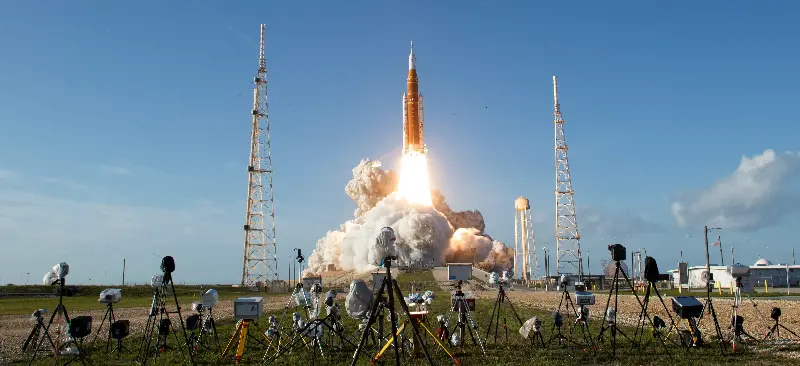
His comments come as NASA forges ahead with its plans to return humans to the moon, with the first crewed mission under the Artemis program, which launched successfully and to international attention on April 1.
What Is the Artemis Program?
Artemis is a series of increasingly complex missions designed to expand human exploration beyond low-Earth orbit.
Under the program, NASA aims to carry out scientific discovery on the moon, create economic opportunities and build the technical and operational experience needed for future crewed missions to Mars. The program has been widely welcomed by the global space community as a decisive step back to deep-space exploration after decades focused largely on near-Earth orbit.
Artemis II builds on the success of Artemis I, an uncrewed test mission that flew back in 2022. It is NASA’s first mission where astronauts will travel via the Space Launch System (SLS) rocket and the Orion spacecraft. The Artemis II flight is a lunar flyby, carrying just four experienced astronauts on a 10-day mission to test life-support systems, navigation, and other capabilities required for long-duration deep-space travel.
NASA has described the mission as a critical step toward a sustained human presence on and around the moon. The first crewed Artemis flight is intended to lay the groundwork for future landings and, ultimately, for human missions to Mars.
Looking further ahead, Artemis III is slated for some time in 2027. That mission is planned as a demonstration in low-Earth orbit to test one or both commercial lunar landers being developed by SpaceX and Blue Origin. The growing role of private companies in these missions has intensified debate about how space activities should be regulated.
Despite its ambitions, Lockwood said that the Artemis program carries significant geopolitical consequences.
“Artemis has considerable geopolitical implications,” he said. “It is an international collaboration, but it’s not global. Importantly, it doesn’t include China or Russia.”
However, he also argues that the mission offers a timely opportunity to update global space governance, particularly as Earth’s orbital environment becomes increasingly crowded.
“The mission presents an opportunity to forge a new international space treaty that is urgently needed because of the escalating problem of junk in near-Earth space,” he said.
Lockwood drew parallels with the Antarctic Treaty, signed in 1961, which banned territorial claims and military activity on the southernmost continent.
“There are clear parallels to the Antarctica Treaty,” he said, noting that it was agreed decades after initial exploration. “It is now 50 years since the first exploration of the moon, but the world today is not in such a cooperative mood, so a similar treaty may be more difficult to agree.”
Do you have a tip on a science story that Newsweek should be covering? Do you have a question about Artemis II? Let us know via [email protected].