



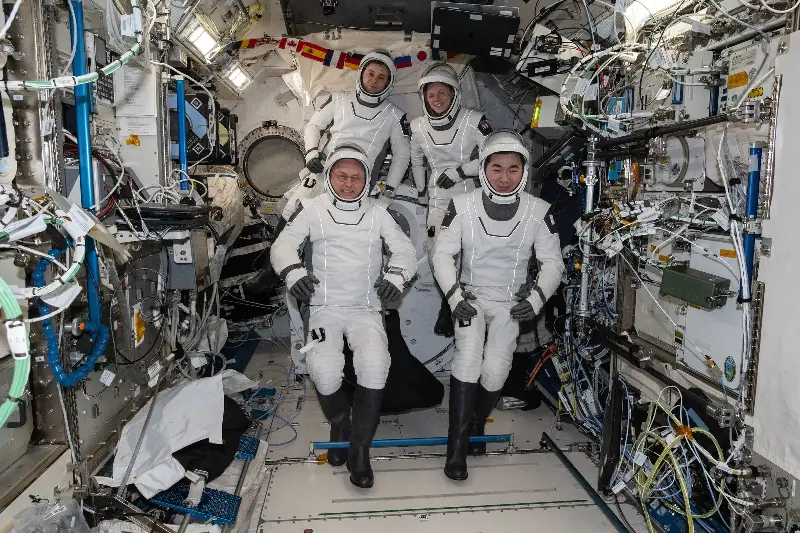
The astronauts evacuated last week from the International Space Station (ISS) said a portable ultrasound machine proved invaluable during a medical emergency that prompted NASA’s first crew evacuation in 65 years of human spaceflight.
In their first public appearance since returning to Earth, the four astronauts declined Wednesday to identify which crew member required medical attention or describe the nature of the problem. NASA has also withheld those details, citing medical privacy.
ISS Medical Issue: What to Know
The medical issue emerged January 7, one day before a planned spacewalk that was abruptly canceled. NASA astronaut Mike Fincke said the crew quickly turned to the station’s onboard ultrasound device once the problem became apparent.
“The ultrasound machine came in super handy,” Fincke said at a press conference at Cape Canaveral, Florida, noting the crew had already been using it regularly to monitor routine physical changes associated with long-term exposure to weightlessness. “So when we had this emergency, we were already very familiar with it.”
Fincke said the experience underscored the importance of equipping spacecraft with versatile diagnostic tools and argued that portable ultrasound units should be standard on future missions.
“It really helped,” he said. “We don’t have the big machines that we have here on Earth. We do everything we can before flight to reduce the chances of medical surprises, but sometimes things happen. What mattered was that the team was ready.”
NASA astronaut Zena Cardman, who commanded the crew’s early return aboard a SpaceX capsule, said the space station is designed to handle medical contingencies as effectively as possible given its constraints. She said NASA made the correct call in canceling the spacewalk — which would have been her first — and prioritizing the crew’s health.
Japanese astronaut Kimiya Yui said he was struck by how well years of preflight medical and emergency training translated to real-world conditions.
“We can handle any kind of difficult situation,” Yui said. “This is actually very good experience for the future of human spaceflight.”
The mission included Russia’s Oleg Platonov and was originally scheduled to last about six and a half months. Instead, the crew spent roughly 5 and a half months aboard the orbiting laboratory. They launched from Florida in August and splashed down in the Pacific Ocean off the coast of San Diego last week.
What Happens Next
Their replacements greeted them in Houston after landing, though the incoming crew is not scheduled to launch until mid-February. NASA and SpaceX are working to move that flight earlier.
“We were hoping to give them hugs in space,” Fincke said, “but we gave them hugs on Earth.”
Updates: 1/21/26, 7:28 p.m. ET: This article was updated with new information.
This article includes reporting by the Associated Press.
In a polarized era, the center is dismissed as bland. At Newsweek, ours is different: The Courageous Center—it’s not “both sides,” it’s sharp, challenging and alive with ideas. We follow facts, not factions. If that sounds like the kind of journalism you want to see thrive, we need you.
When you become a Newsweek Member, you support a mission to keep the center strong and vibrant. Members enjoy: Ad-free browsing, exclusive content and editor conversations. Help keep the center courageous. Join today.