



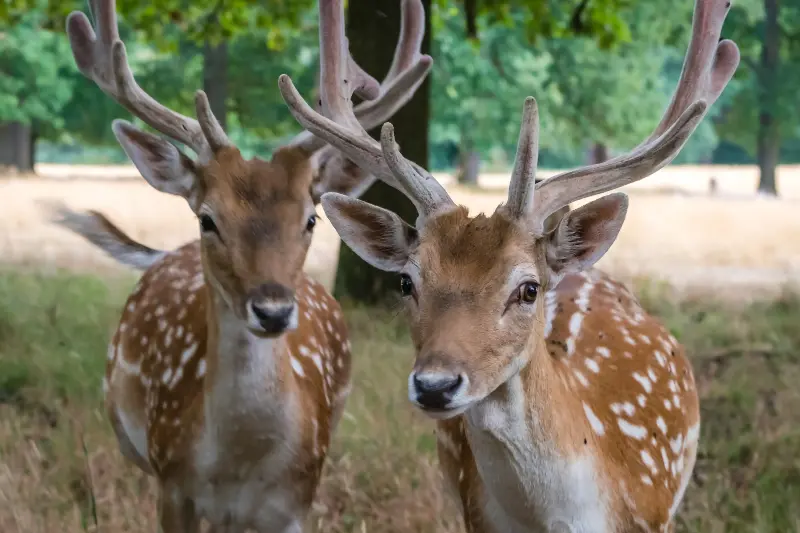
In a viral video, a woman from Alberta, Canada, revealed that some very unusual guests keep making an appearance in her backyard—internet users can’t cope with who they are.
The heartwarming Instagram video, shared in January under the username @2tailsontrails, shows a family of deer hanging out in the poster’s snowy backyard, comfortably lying down as if feeling right at home. “When your yard has been nap-approved by the locals,” the caption says. “They let you know when they feel safe.”
Experts at Wildlife Population Review say that there are about 36 million deer living across the country, with some states having a bigger population than others.
Texas leads by a large margin with over 5 million deer, followed by Michigan with around 2 million, and several other states with more than 1 million, including Alabama, Mississippi, Wisconsin, Pennsylvania, Missouri, Georgia, and New York.
States with smaller populations include many in the West, with figures often below 500,000. Rhode Island and Delaware have the fewest deer, partly due to their small area.
Deer populations nearly disappeared in the U.S. in the past but have rebounded thanks to conservation and management efforts. Hunting remains popular and is sometimes needed to keep numbers balanced with local ecosystems.
Several species—whitetail, blacktail, and mule deer—are present in different regions, with white-tailed deer being the most widespread.
Deer attacks on people are very rare, but when they do occur, there are usually three main triggers. First, deer sometimes act defensively when they feel threatened, especially if a person gets too close suddenly or blocks their escape. In such situations, a deer’s natural flight response can shift to aggression if it perceives no way out.
Second, deer can become aggressive during mating season (the rut). Bucks experience high testosterone and heightened territorial behavior, which can lead them to chase or strike at humans they mistake for rivals.
Third, female deer, or does, will attack to protect their young. When fawns are nearby and a person approaches, the doe may interpret this as a threat and respond forcefully to defend them.
Even when no contact happens between deer and humans, they can sometimes damage yards and crops—but there are things you can do to keep them away from your home.
Chemical repellents either create a barrier around an area or make plants taste unpleasant, but not all are approved for use, and results vary. Some widely mentioned folk remedies—such as human hair, lion dung, scented soap, mothballs or human urine—are generally unreliable.
Visual and sonic devices often fail over time because deer become accustomed to them, though motion-triggered water sprayers or alarms can sometimes help.
The most-dependable protection is a well-built physical fence of the correct height and specification for the deer species involved. Individual plants can also be protected with tubes or surrounded by cut branches to keep deer away while they establish.
Instagram embed will be rendered here
The video quickly went viral on social media and has so far received over 203,000 views and more than 23,000 likes on the platform.
One user, Teresereppond, commented: “WOW! Beautiful sight to see. That’s special. They feel safe there.”
Pollothebunny said: “I would be so proud if that was my yard.”
Suus.dej wrote: “They feel save with you! Quite the privilege…”
Newsweek reached out to @2tailsontrails for comment via email. We could not verify the details of the case.
Do you have funny and adorable videos or pictures of your pet you want to share? Send them to [email protected] with some details about your best friend, and they could appear in our Pet of the Week lineup.