



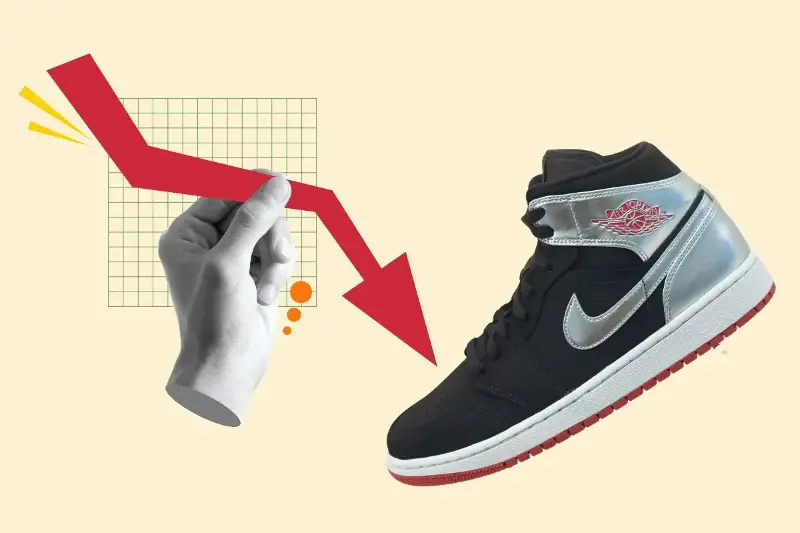
A video proclaiming the death of sneakers has been viewed over 8 million times on TikTok, shared by Hidden Realm, the owner of a sneaker store in California.
The sneaker game has undoubtedly changed in comparison to recent years. According to the outlet Resell Calendar, in 2020, 58 percent of sneakers were trading above retail on secondary platforms. As of 2024, that number was down to 47 percent.
But is the sneaker market really crashing? Newsweek spoke to the experts to find out more.
Why It Matters
Over the past 10 years, sneakers have evolved from a niche collectors’ hobby to a mainstream asset class, as streetwear took the fashion world by storm. Limited-edition drops, celebrity collaborations, and the rise of platforms like StockX, GOAT, and Flight Club made reselling more accessible than ever.
The U.S. sneaker resale market is projected to hit $6 billion by the end of 2025, according to Resell Calendar, while a report from Future Market Insights values the global sneaker at some $87 billion as of 2025.
Resale prices surged at the height of the pandemic, and the collection of sneakers developed a similar prestige to the collection of other luxury items like handbags. Brands helped develop the fanfare, capitalizing on the frenzy by changing the number and frequency of releases and introducing limited-edition drops.
Today, though, the sneaker industry appears to be facing a slowdown, as the hype around sneakers has declined.
What To Know
Newsweek spoke to John Kim, the editor in chief of the outlet, Sneaker News. “Sneaker demand is still very high for the core sneaker community, and there are plenty of sneakers that are selling for 2x, 3x, even 10x the MSRP,” he told Newsweek over email. “Reselling aside, there are plenty of shoes that don’t have a problem moving off retail shelves at the MSRP. Consumers have also gotten smarter and have waited for markdowns. All in all, sneaker demand is still there.”
Newsweek also spoke with Frédéric Godart, a full professor of organizational behaviour at INSEAD in France. “First of all, it is not clear that the sneakers market is really slowing down, and it is certainly not ‘dying,’ since most sources forecast a healthy growth rate in the next few years,” he said.
Alan Vinogradov, the CEO of Sneaker Con, the global sneaker-culture convention, also spoke to Newsweek and said, “Sneaker demand is still very healthy.”
So, sneakers are undoubtedly still popular. The Lyst index for Q3 of 2025 featured two sneakers in its top 20 hottest products – the Nike x Jacquemus Moon Shoe and the Nike Shox TL Sneakers. In fact, sneakers were the only repeat product category on the list. Meanwhile, Lyst reported in its index that the platform had seen a 7 percent rise in Nike products, with sneakers among the brand’s key exports.
So, what’s actually happening? According to Vinogradov, “Hype sneaker demand has slowed dramatically because many brands have expanded their target audience and are no longer consistently creating ‘energy’ product that speaks directly to the collectible sneaker community. That collectible community has historically been a major engine for generating hype and excitement across the entire industry.”
“The bubble has burst,” Godart told Newsweek.
“For a couple of years, the sneakers market behaved like a speculative asset (not dissimilar to NFTs); but sneakers are made to be worn, they’re not speculative assets, and this tension was not sustainable,” Godart said.
Economic pressures are also, unsurprisingly, a driving force. “Economic pressures are definitely affecting some participants, especially casual buyers and newer resellers. That said, the core collector community tends to stay active and is always looking for more, though they are becoming more selective and value-conscious about what they’re willing to pay a premium for,” Vinogradov told Newsweek.
And beyond this, times and tastes change, and this affects the desirability of certain styles. “There is too much new product out there that speaks to mainstream trends for new and older stock to gain demand. Older releases that resellers are holding onto won’t appreciate in value because sneaker collectors are getting smarter with purchasing,” Kim told Newsweek.
“Will there be one-off exceptions? Always, but that’s not a scalable business model,” he added.
As is the nature of the fashion industry, demands for styles change. What was the It shoe one moment can quickly become the style that has oversaturated the market, be oh, so last season. Godart highlighted this, telling Newsweek, “Changes in customers’ tastes (i.e., the emergence of new fads) and a general backlash against overpriced items in luxury have led to oversupply and a sharp drop in prices.”
The sneaker industry isn’t dead, but the styles that were once all the rage may be falling victim to what can be a vicious trend cycle.
What People Are Saying
John Kim, the Editor in Chief of the outlet, Sneaker News, told Newsweek over email: “Sneakers have cooled off in terms of social media clout. At one point, simply posting a pair of sneakers on an Instagram feed would generate likes and comments and follows. Today, that return is not there, which decreases the value of the shoe in both a monetary and social standpoint. It’s sad to say but there are a lot of people who buy super-expensive shoes, post them on social media, never wear them, and sell them to the next guy. That community has moved on to chasing different avenues of attention on social media such as watches or other ‘exclusive’ or ‘hard to get’ items (ahem labubu).”
What’s Next
So, what can we expect from the sneaker market moving forward? Godart told Newsweek, “The hype bubble is certainly gone, and will not come back, at least for a while (other bubbles and hypes have already replaced sneakers).”
“The sneakers market in general will keep growing: it is a long-term trend, although more traditional shoes may come back into fashion and erode sneakers’ newfound dominance.